
Pulp Fiction, 1901 · page 373 of 400
The Argosy — page 373: what you’re looking at
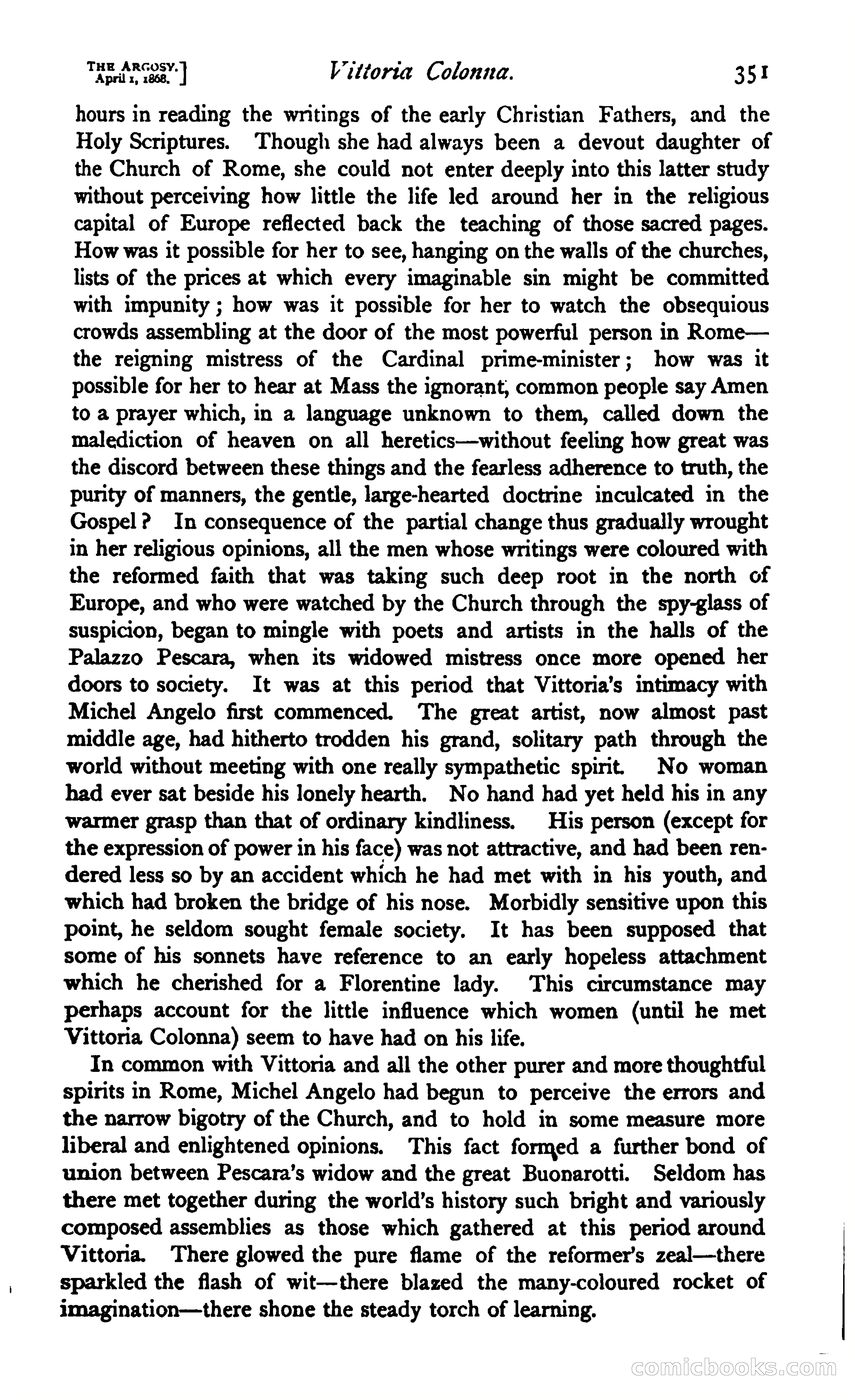
A restored page from Pulp Fiction, 1901. Page through the whole issue in the reader above.
📄 Transcribed text from this page (OCR, searchable)
Machine-transcribed from the original scan — historical spelling and the odd misread are preserved.
THE ARGosY.} Vittorta Colonna. 351 hours in reading the wnitings of the early Christian Fathers, and the Holy Scriptures. Though she had always been a devout daughter of the Church of Rome, she could not enter deeply into this latter study without perceiving how little the life led around her in the religious capital of Europe reflected back the teaching of those sacred pages. How was it possible for her to see, hanging on the walls of the churches, lists of the prices at which every imaginable sin might be committed with impunity ; how was it possible for her to watch the obsequious crowds assembling at the door of the most powerful person in Rome— the reigning mistress of the Cardinal prime-minister; how was it possible for her to hear at Mass the ignorant, common people say Amen to a prayer which, in a language unknown to them, called down the malediction of heaven on all heretics—without feeling how great was the discord between these things and the fearless adherence to truth, the purity of manners, the gentle, large-hearted doctrine inculcated in the Gospel? In consequence of the partial change thus gradually wrought in her religious opinions, all the men whose writings were coloured with the reformed faith that was taking such deep root in the north of Europe, and who were watched by the Church through the spy-glass of suspicion, began to mingle with poets and artists in the halls of the Palazzo Pescara, when its widowed mistress once more opened her doors to society. It was at this period that Vittoria’s intimacy with Michel Angelo first commenced. The great artist, now almost past middle age, had hitherto trodden his grand, solitary path through the world without meeting with one really sympathetic spint. No woman had ever sat beside his lonely hearth. No hand had yet held his in any warmer grasp than that of ordinary kindliness. His person (except for the expression of power in his face) was not attractive, and had been ren- dered less so by an accident which he had met with in his youth, and which had broken the bridge of his nose. Morbidly sensitive upon this point, he seldom sought female society. It has been supposed that some of his sonnets have reference to an early hopeless attachment which he cherished for a Florentine lady. This circumstance may perhaps account for the little influence which women (until he met Vittoria Colonna) seem to have had on his life. In common with Vittoria and all the other purer and more thoughtful spirits in Rome, Michel Angelo had begun to perceive the errors and the narrow bigotry of the Church, and to hold in some measure more liberal and enlightened opinions. This fact formed a further bond of union between Pescara’s widow and the great Buonarotti. Seldom has there met together during the world’s history such bright and variously composed assemblies as those which gathered at this period around Vittoria. There glowed the pure flame of the reformer’s zeal—there sparkled the flash of wit—there blazed the many-coloured rocket of imagination—there shone the steady torch of learning. comicloooks (CO)