
Pulp Fiction, 1901 · page 371 of 400
The Argosy — page 371: what you’re looking at
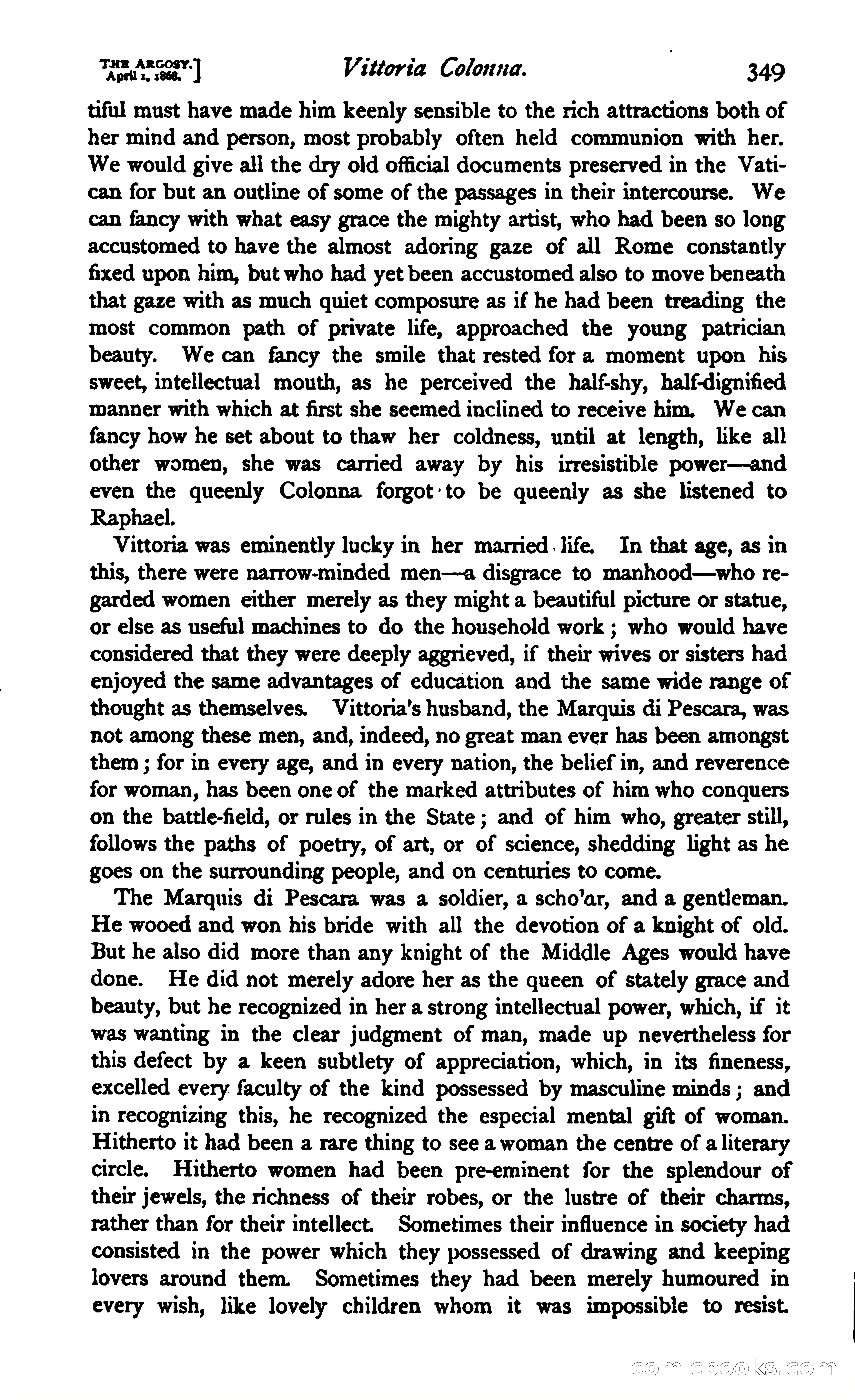
A restored page from Pulp Fiction, 1901. Page through the whole issue in the reader above.
📄 Transcribed text from this page (OCR, searchable)
Machine-transcribed from the original scan — historical spelling and the odd misread are preserved.
Tue ARCOSY. Vittorta Colonna. | 349 tiful must have made him keenly sensible to the rich attractions both of her mind and person, most probably often held communion with her. We would give all the dry old official documents preserved in the Vati- can for but an outline of some of the passages in their intercourse. We can fancy with what easy grace the mighty artist, who had been so long accustomed to have the almost adoring gaze of all Rome constantly fixed upon him, but who had yet been accustomed also to move beneath that gaze with as much quiet composure as if he had been treading the most common path of private life, approached the young patrician beauty. Wecan fancy the smile that rested fora moment upon his sweet, intellectual mouth, as he perceived the half-shy, half-dignified manner with which at first she seemed inclined to receive him. We can fancy how he set about to thaw her coldness, until at length, like all other women, she was carried away by his irresistible power—and even the queenly Colonna forgot:to be queenly as she listened to Raphael. Vittoria was eminently lucky in her married. life. In that age, as in this, there were narrow-minded men—a disgrace to manhood—who re- garded women either merely as they might a beautiful picture or statue, or else as useful machines to do the household work ; who would have considered that they were deeply aggrieved, if their wives or sisters had enjoyed the same advantages of education and the same wide range of thought as themselves. Vittona’s husband, the Marquis di Pescara, was not among these men, and, indeed, no great man ever has been amongst them ; for in every age, and in every nation, the belief in, and reverence for woman, has been one of the marked attributes of him who conquers on the battle-field, or rules in the State; and of him who, greater still, follows the paths of poetry, of art, or of science, shedding light as he goes on the surrounding people, and on centuries to come. The Marquis di Pescara was a soldier, a scho'ar, and a gentleman. He wooed and won his bnde with all the devotion of a knight of old. But he also did more than any knight of the Middle Ages would have done. He did not merely adore her as the queen of stately grace and beauty, but he recognized in her a strong intellectual power, which, if it was wanting in the clear judgment of man, made up nevertheless for this defect by a keen subtlety of appreciation, which, in its fineness, excelled every. faculty of the kind possessed by masculine minds; and in recognizing this, he recognized the especial mental gift of woman. Hitherto it had been a rare thing to see a woman the centre of a literary circle. Hitherto women had been pre-eminent for the splendour of their jewels, the richness of their robes, or the lustre of their charms, rather than for their intellect. Sometimes their influence in society had consisted in the power which they possessed of drawing and keeping lovers around them. Sometimes they had been merely humoured in every wish, like lovely children whom it was impossible to resist. COMIC OOOKS. EO mn _