
Pulp Fiction, 1901 · page 370 of 400
The Argosy — page 370: what you’re looking at
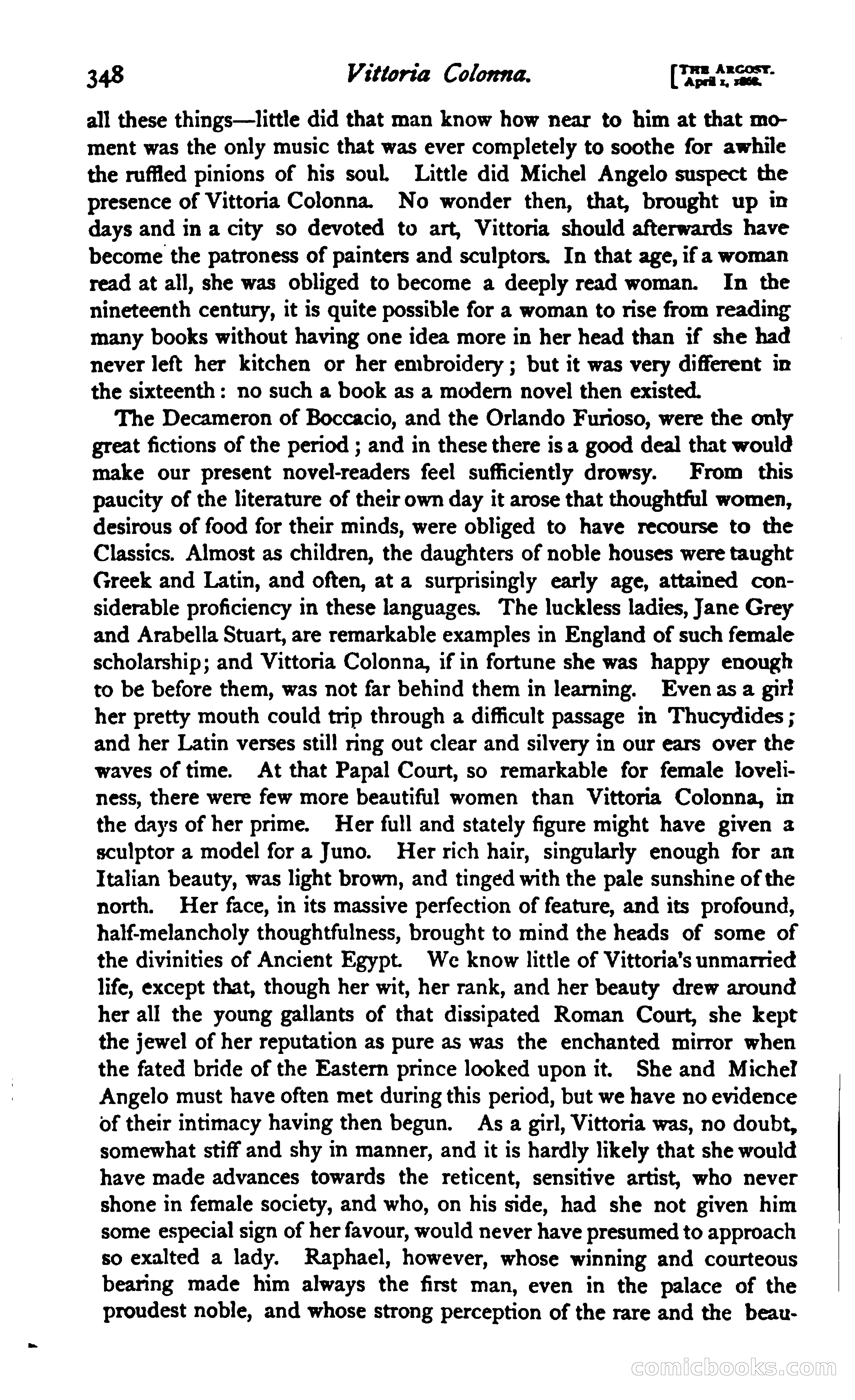
A restored page from Pulp Fiction, 1901. Page through the whole issue in the reader above.
📄 Transcribed text from this page (OCR, searchable)
Machine-transcribed from the original scan — historical spelling and the odd misread are preserved.
348 Vittoria Colonna. THE_ARCOST. Aped x, 7868. all these things—little did that man know how near to him at that mo- ment was the only music that was ever completely to soothe for awhile the ruffled pinions of his soul. Little did Michel Angelo suspect the presence of Vittoria Colonna. No wonder then, that, brought up in days and ina city so devoted to art, Vittoria should afterwards have become the patroness of painters and sculptors. In that age, if a woman read at all, she was obliged to become a deeply read woman. In the nineteenth century, it is quite possible for a woman to nse from reading many books without having one idea more in her head than if she had never left her kitchen or her embroidery ; but it was very different in the sixteenth: no such a book as a modern novel then existed. The Decameron of Boccacio, and the Orlando Furioso, were the only great fictions of the period ; and in these there is a good deal that would make our present novel-readers feel sufficiently drowsy. From this paucity of the literature of their own day it arose that thoughtful women, desirous of food for their minds, were obliged to have recourse to the Classics. Almost as children, the daughters of noble houses were taught Greek and Latin, and often, at a surprisingly early age, attained con- siderable proficiency in these languages. The luckless ladies, Jane Grey and Arabella Stuart, are remarkable examples in England of such female scholarship; and Vittoria Colonna, if in fortune she was happy enough to be before them, was not far behind them in learning. Even as a girt her pretty mouth could trip through a difficult passage in Thucydides ; and her Latin verses still rng out clear and silvery in our ears over the waves of time. At that Papal Court, so remarkable for female lovel:- ness, there were few more beautiful women than Vittoria Colonna, in the days of her prime. Her full and stately figure might have given 2 sculptor a model for a Juno. Her rich hair, singularly enough for an Italian beauty, was light brown, and tinged with the pale sunshine of the north. Her face, in its massive perfection of feature, and its profound, half-melancholy thoughtfulness, brought to mind the heads of some of the divinities of Ancient Egypt. We know little of Vittoria’s unmarried life, except that, though her wit, her rank, and her beauty drew around her all the young gallants of that dissipated Roman Court, she kept the jewel of her reputation as pure as was the enchanted mirror when the fated bride of the Eastern prince looked upon it. She and Miche? Angelo must have often met during this period, but we have no evidence of their intimacy having then begun. As a girl, Vittoria was, no doubt, somewhat stiff and shy in manner, and it Is hardly likely that she would have made advances towards the reticent, sensitive artist, who never shone in female society, and who, on his side, had she not given him some especial sign of her favour, would never have presumed to approach so exalted a lady. Raphael, however, whose winning and courteous bearing made him always the first man, even in the palace of the proudest noble, and whose strong perception of the rare and the beau- COMIC OOOKS. EO mn _