
Pulp Fiction, 1901 · page 173 of 400
The Argosy — page 173: what you’re looking at
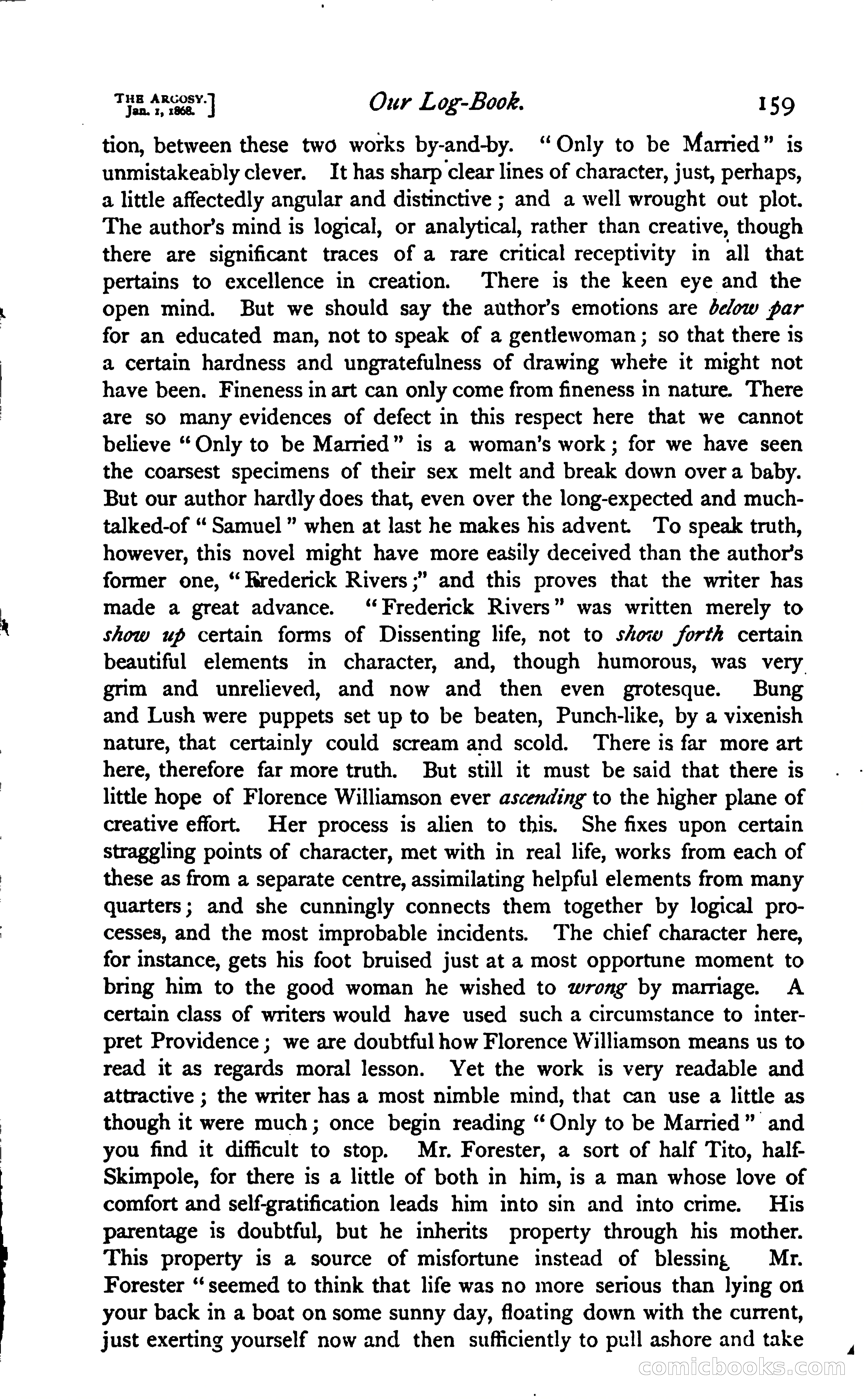
A restored page from Pulp Fiction, 1901. Page through the whole issue in the reader above.
📄 Transcribed text from this page (OCR, searchable)
Machine-transcribed from the original scan — historical spelling and the odd misread are preserved.
Fae Aneaey, Our Log-Book. 159 an. 1,1 tion, between these two works by-and-by. “Only to be Married” is unmistakeably clever. It has sharp clear lines of character, just, perhaps, a little affectedly angular and distinctive ; and a well wrought out plot. The author’s mind is logical, or analytical, rather than creative, though there are significant traces of a rare critical receptivity in all that pertains to excellence in creation. There is the keen eye and the open mind. But we should say the author’s emotions are delow par for an educated man, not to speak of a gentlewoman; so that there 1s a certain hardness and ungratefulness of drawing whete it might not have been. Fineness in art can only come from fineness in nature. There are sO many evidences of defect in this respect here that we cannot believe “Only to be Marmed” is a woman’s work; for we have seen the coarsest specimens of their sex melt and break down over a baby. But our author hardly does that, even over the long-expected and much- talked-of “ Samuel” when at last he makes his advent. To speak truth, however, this novel might have more easily deceived than the author's former one, “ lerederick Rivers ;” and this proves that the writer has made a great advance. ‘Frederick Rivers” was written merely to show up certain forms of Dissenting hfe, not to show forth certain beautiful elements in character, and, though humorous, was very grim and unrelieved, and now and then even grotesque. Bung and Lush were puppets set up to be beaten, Punch-like, by a vixenish nature, that certainly could scream and scold. There is far more art here, therefore far more truth. But still it must be said that there is little hope of Florence Williamson ever ascending to the higher plane of creative effort. Her process is alien to this. She fixes upon certain straggling points of character, met with in real life, works from each of these as from a separate centre, assimilating helpful elements from many quarters; and she cunningly connects them together by logical pro- cesses, and the most improbable incidents. The chief character here, for instance, gets his foot bruised just at a most opportune moment to bring him to the good woman he wished to wrong by marnage. <A certain class of writers would have used such a circumstance to inter- pret Providence ; we are doubtful how Florence Williamson means us to read it as regards moral lesson. Yet the work is very readable and attractive ; the writer has a most nimble mind, that can use a little as though it were much; once begin reading “Only to be Married” and you find it difficult to stop. Mr. Forester, a sort of half Tito, half- Skimpole, for there 1s a little of both in him, is a man whose love of comfort and self-gratification leads him into sin and into crime. His parentage is doubtful, but he inherits property through his mother. This property is a source of misfortune instead of blessing Mr. Forester ‘‘seemed to think that life was no more serious than lying on your back in a boat on some sunny day, floating down with the current, just exerting yourself now and then sufficiently to pull ashore and take ECOMicoOolkxs.cO©