
Pulp Fiction, 1901 · page 174 of 400
The Argosy — page 174: what you’re looking at
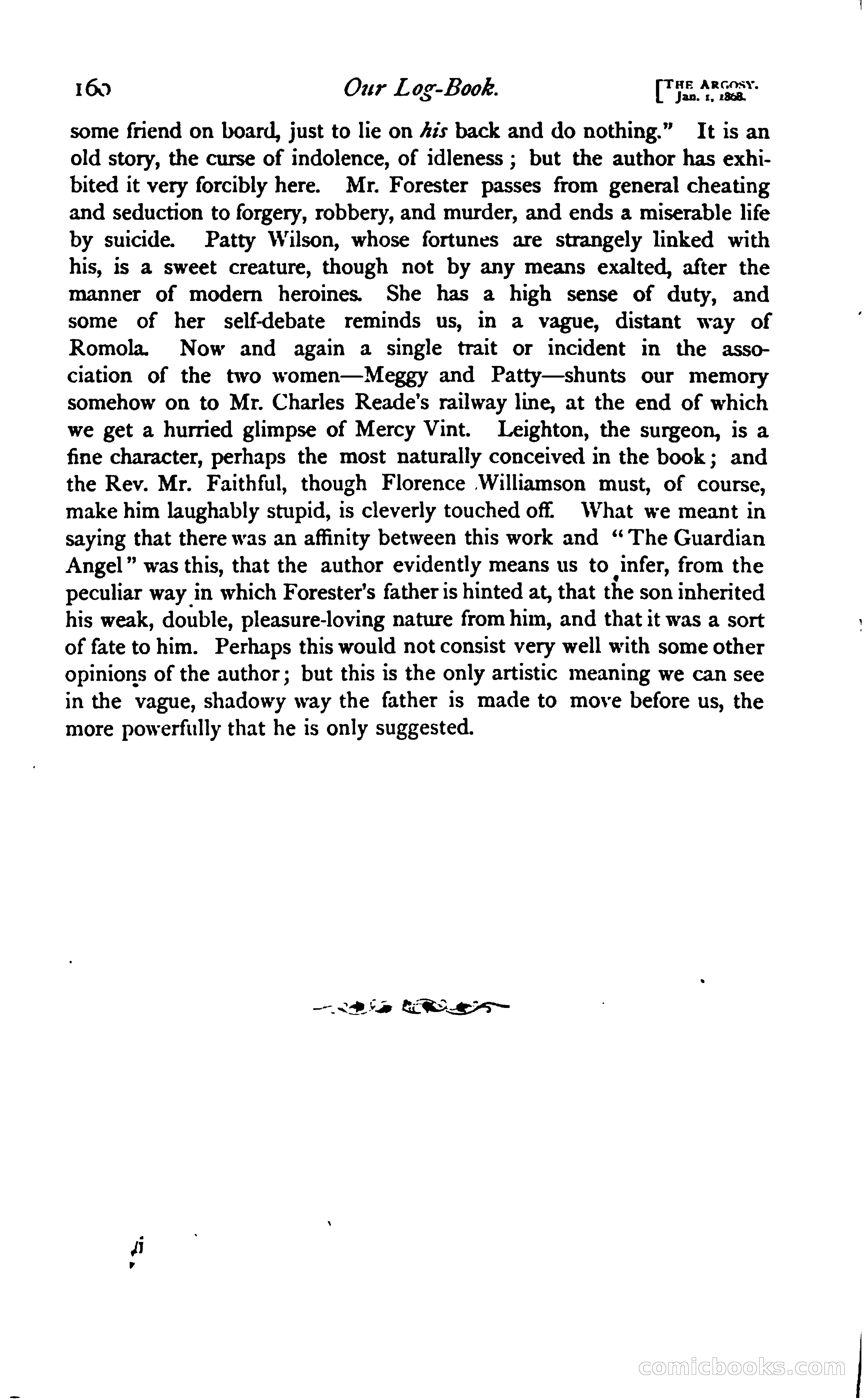
A restored page from Pulp Fiction, 1901. Page through the whole issue in the reader above.
📄 Transcribed text from this page (OCR, searchable)
Machine-transcribed from the original scan — historical spelling and the odd misread are preserved.
THE ARGOSY. 160 Our Log-Book. oe some friend on board, just to lie on 42s back and do nothing.” It is an old story, the curse of indolence, of idleness ; but the author has exhi- bited it very forcibly here. Mr. Forester passes from general cheating and seduction to forgery, robbery, and murder, and ends a miserable life by suicide. Patty Wilson, whose fortunes are strangely linked with his, is a sweet creature, though not by any means exalted, after the manner of modern heroines. She has a high sense of duty, and some of her self-debate reminds us, in a vague, distant way of Romola. Now and again a single trait or incident in the asso- clation of the two women—Meggy and Patty—shunts our memory somehow on to Mr. Charles Reade’s railway line, at the end of which we get a hurried glimpse of Mercy Vint. Leighton, the surgeon, is a fine character, perhaps the most naturally conceived in the book; and the Rev. Mr. Faithful, though Florence Williamson must, of course, make him laughably stupid, 1s cleverly touched off What we meant in saying that there was an affinity between this work and “The Guardian Angel” was this, that the author evidently means us to infer, from the peculiar way in which Forester’s father is hinted at, that the son inherited his weak, double, pleasure-loving nature from him, and that it was a sort of fate to him. Perhaps this would not consist very well with some other opinions of the author; but this is the only artistic meaning we can see in the vague, shadowy way the father 1s made to move before us, the more powerfully that he 1s only suggested. GOHRMGIOO <S GO)