
Pulp Fiction, 1901 · page 172 of 400
The Argosy — page 172: what you’re looking at
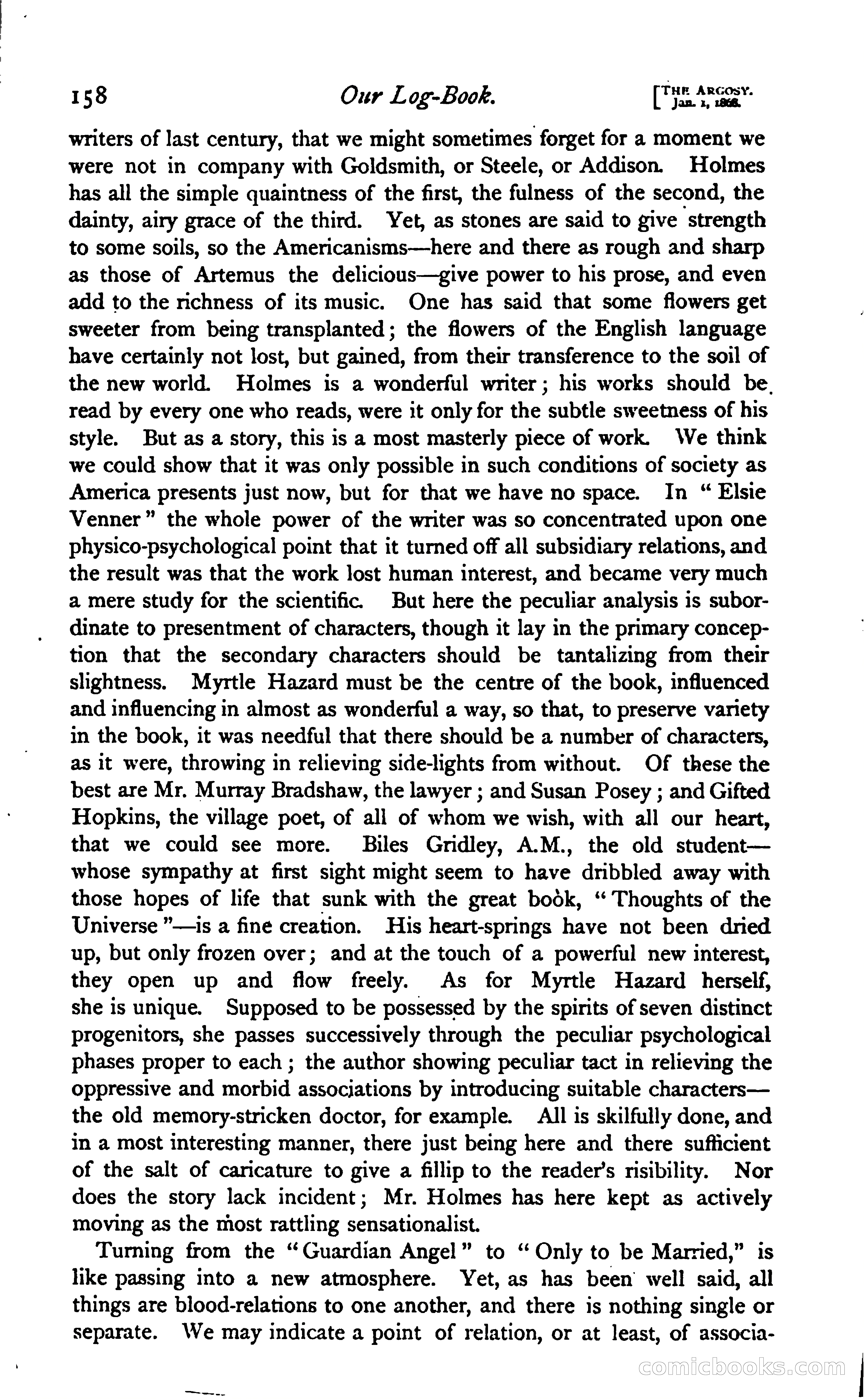
A restored page from Pulp Fiction, 1901. Page through the whole issue in the reader above.
📄 Transcribed text from this page (OCR, searchable)
Machine-transcribed from the original scan — historical spelling and the odd misread are preserved.
158 Our Log-Book. THE ARGOSY. Jan. 3, writers of last century, that we might sometimes forget for a moment we were not in company with Goldsmith, or Steele, or Addison. Holmes has all the simple quaintness of the first, the fulness of the second, the dainty, airy grace of the third. Yet, as stones are said to give strength to some soils, so the Americanisms—here and there as rough and sharp as those of Artemus the delicious—give power to his prose, and even add to the nchness of its music. One has said that some flowers get sweeter from being transplanted; the flowers of the English language have certainly not lost, but gained, from their transference to the soil of the new world. Holmes is a wonderful writer; his works should be. read by every one who reads, were it only for the subtle sweetness of his style. But as a story, this is a most masterly piece of work. We think we could show that it was only possible in such conditions of society as America presents just now, but for that we have no space. In “ Elsie Venner” the whole power of the writer was so concentrated upon one physico-psychological point that it turned off all subsidiary relations, and the result was that the work lost human interest, and became very much a mere study for the scientific. But here the peculiar analysis is subor- dinate to presentment of characters, though it lay in the primary concep- tion that the secondary characters should be tantalizing from their slightness. Myrtle Hazard must be the centre of the book, influenced and influencing in almost as wonderful a way, so that, to preserve vanety in the book, it was needful that there should be a number of characters, as it were, throwing in relieving side-lights from without. Of these the best are Mr. Murray Bradshaw, the lawyer ; and Susan Posey ; and Gifted Hopkins, the village poet, of all of whom we wish, with all our heart, that we could see more. Biles Gmndley, A.M., the old student-— whose sympathy at first sight might seem to have dnbbled away with those hopes of life that sunk with the great book, ‘“ Thoughts of the Universe ”—is a fine creation. His heart-springs have not been dned up, but only frozen over; and at the touch of a powerful new interest, they open up and flow freely. As for Myrtle Hazard herself, she is unique. Supposed to be possessed by the spirits of seven distinct progenitors, she passes successively through the peculiar psychological phases proper to each ; the author showing peculiar tact in relieving the oppressive and morbid associations by introducing suitable characters— the old memory-stricken doctor, for example. All is skilfully done, and in a most interesting manner, there just being here and there sufficient of the salt of caricature to give a fillip to the reader’s nisibility. Nor does the story lack incident; Mr. Holmes has here kept as actively moving as the most rattling sensationalist. Turning from the “Guardian Angel” to “ Only to be Married,” is like passing into a new atmosphere. Yet, as has been’ well said, all things are blood-relations to one another, and there is nothing single or separate. We may indicate a point of relation, or at least, of associa- comicaooks GO)