
Pulp Fiction, 1901 · page 171 of 400
The Argosy — page 171: what you’re looking at
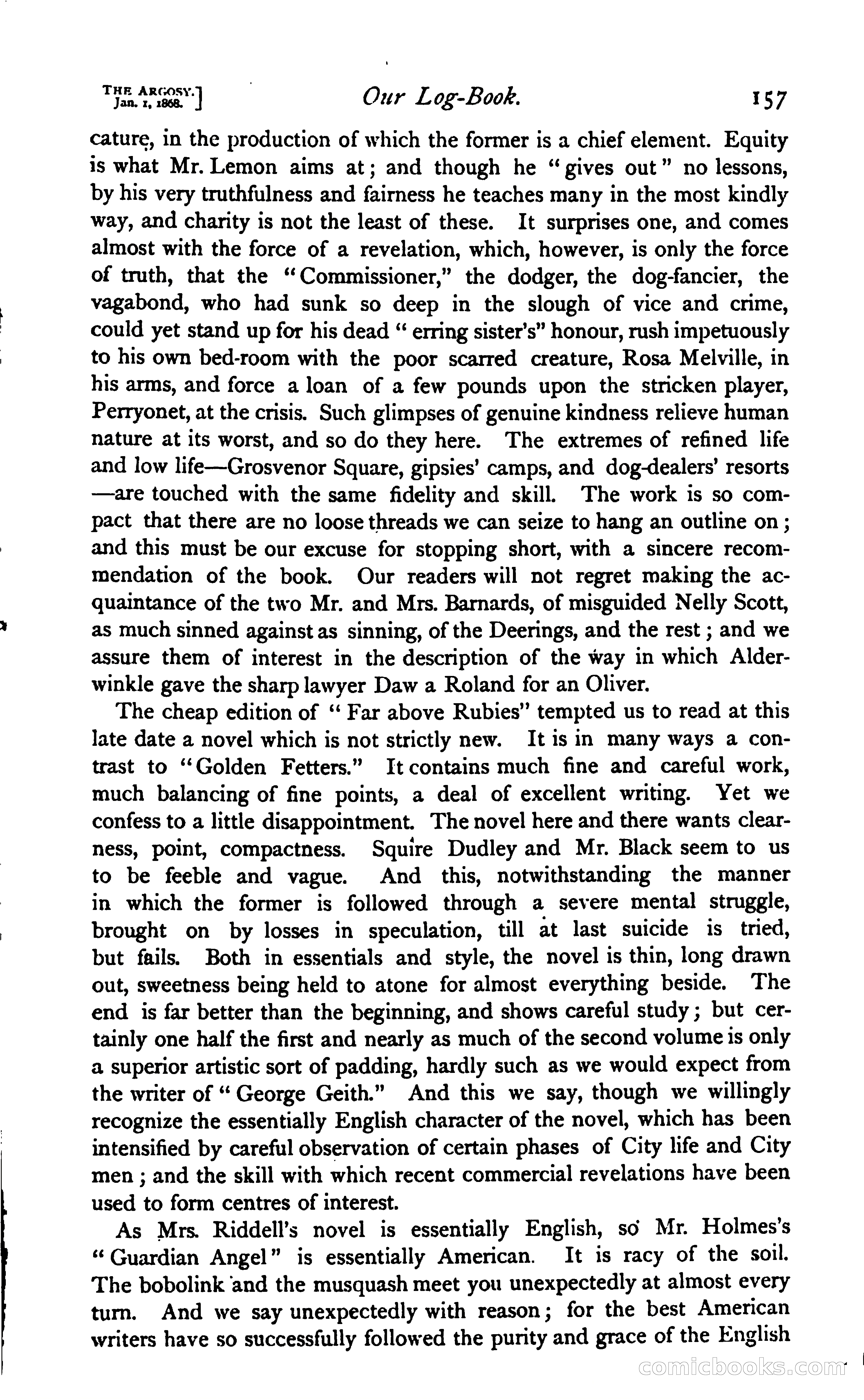
A restored page from Pulp Fiction, 1901. Page through the whole issue in the reader above.
📄 Transcribed text from this page (OCR, searchable)
Machine-transcribed from the original scan — historical spelling and the odd misread are preserved.
aa eee | Our Log-Book. 157 cature, in the production of which the former is a chief element. Equity is what Mr. Lemon aims at; and though he “gives out” no lessons, by his very truthfulness and fairness he teaches many in the most kindly way, and charity is not the least of these. It surprises one, and comes almost with the force of a revelation, which, however, is only the force of truth, that the ‘ Commissioner,” the dodger, the dog-fancier, the vagabond, who had sunk so deep in the slough of vice and cnme, could yet stand up for his dead “ erring sister’s” honour, rush impetuously to his own bed-room with the poor scarred creature, Rosa Melville, in his arms, and force a loan of a few pounds upon the stricken player, Perryonet, at the crisis. Such glimpses of genuine kindness relieve human nature at its worst, and so do they here. The extremes of refined life and low life—Grosvenor Square, gipsies’ camps, and dog-dealers’ resorts —are touched with the same fidelity and skill. The work is so com- pact that there are no loose threads we can seize to hang an outline on ; and this must be our excuse for stopping short, with a sincere recom- mendation of the book. Our readers will not regret making the ac- quaintance of the two Mr. and Mrs. Barnards, of misguided Nelly Scott, as much sinned against as sinning, of the Deerings, and the rest ; and we assure them of interest in the description of the way in which Alder- winkle gave the sharp lawyer Daw a Roland for an Oliver. The cheap edition of ‘‘ Far above Rubies” tempted us to read at this late date a novel which is not strictly new. It 1s im many ways a con- trast to “‘Golden Fetters.” It contains much fine and careful work, much balancing of fine points, a deal of excellent writing. Yet we confess to a little disappointment. The novel here and there wants clear- ness, point, compactness. Squire Dudley and Mr. Black seem to us to be feeble and vague. And this, notwithstanding the manner in which the former is followed through a severe mental struggle, brought on by losses in speculation, till at last suicide is tried, but fails. Both in essentials and style, the novel is thin, long drawn out, sweetness being held to atone for almost everything beside. The end is far better than the beginning, and shows careful study; but cer- tainly one half the first and nearly as much of the second volume is only a superior artistic sort of padding, hardly such as we would expect from the writer of “ George Geith.” And this we say, though we willingly recognize the essentially English character of the novel, which has been intensified by careful observation of certain phases of City hfe and City men ; and the skill with which recent commercial revelations have been used to form centres of interest. As Mrs. Riddell’s novel is essentially English, so Mr. Holmes’s ‘“ Guardian Angel” is essentially American. It is racy of the soil. The bobolink ‘and the musquash meet you unexpectedly at almost every turn. And we say unexpectedly with reason; for the best American writers have so successfully followed the purity and grace of the English comicaooks GO)