
Pulp Fiction, 1924 · page 47 of 172
Argosy All-Story Weekly, October 25, 1924 — page 47: what you’re looking at
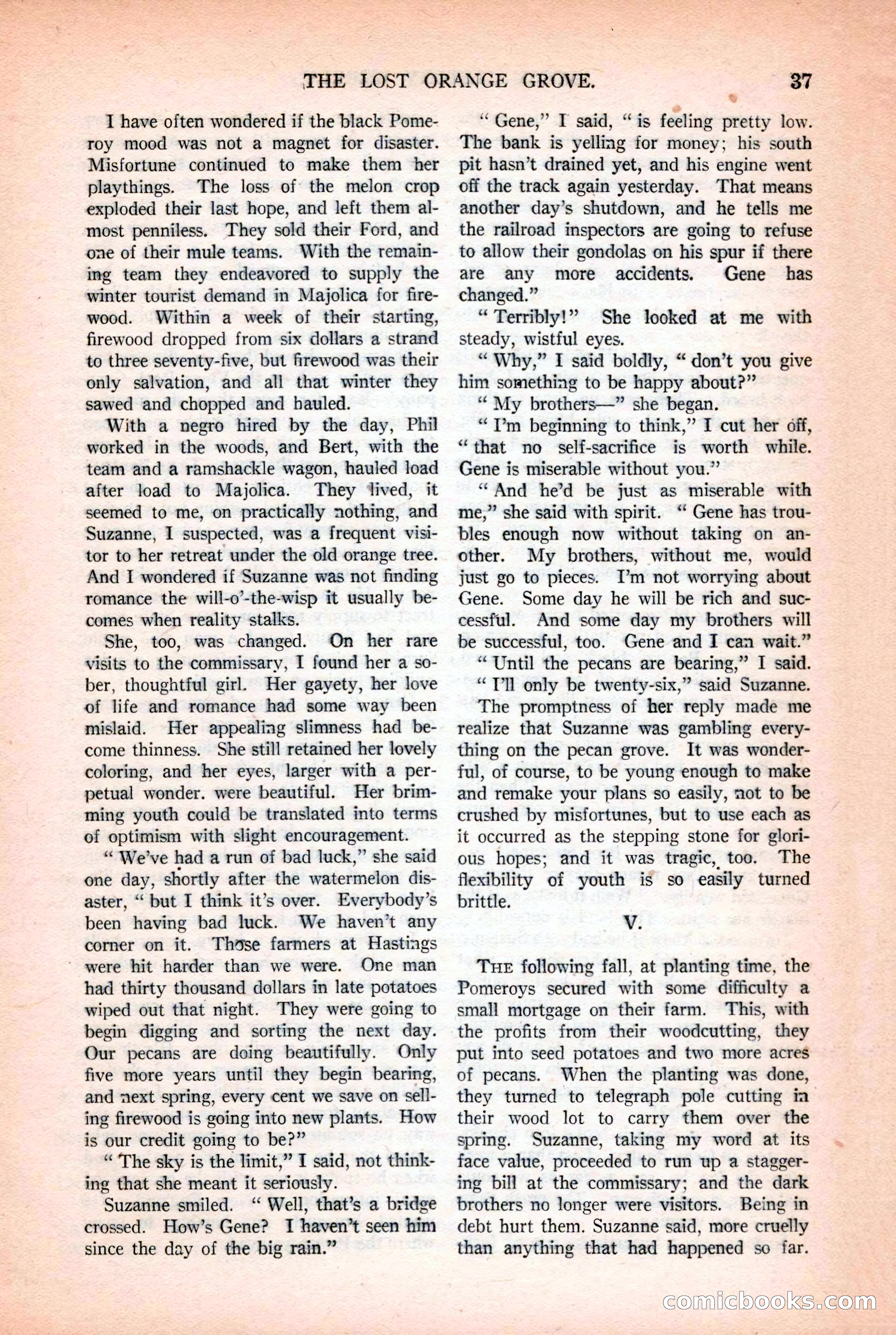
A restored page from Pulp Fiction, 1924. Page through the whole issue in the reader above.
📄 Transcribed text from this page (OCR, searchable)
Machine-transcribed from the original scan — historical spelling and the odd misread are preserved.
THE LOST ORANGE GROVE. I have often wondered if the black Pome- roy mood was not a magnet for disaster. Misfortune continued to make them her playthings. The loss of the melon crop exploded their last hope, and left them al- most penniless. They sold their Ford, and one of their mule teams. With the remain- ing team they endeavored to supply the winter tourist demand in Majolica for fire- wood. Within a week of their starting, firewood dropped from six dollars a strand to three seventy-five, but firewood was their only salvation, and all that winter they sawed and chopped and hauled. With a negro hired by the day, Phil worked in the woods, and Bert, with the team and a ramshackle wagon, hauled load after load to Majolica. They ‘lived, it seemed to me, on practically nothing, and Suzanne, I suspected, was a frequent visi- tor to her retreat under the old orange tree. And I wondered if Suzanne was not finding romance the will-o’-the-wisp it usually be- comes when reality stalks. She, too, was changed. On her rare visits to the commissary, I found her a so- ber, thoughtful girl. Her gayety, her love of life and romance had some way been mislaid. Her appealing slimness had be- come thinness. She still retained her lovely coloring, and her eyes, larger with a per- petual wonder. were beautiful. Her brim- ming youth could be translated into terms of optimism with slight encouragement. “We've had a run of bad luck,” she said one day, shortly after the watermelon dis- aster, “ but I think it’s over. Everybody’s been having bad luck. We haven’t any corner on it. Those farmers at Hastings ' were hit harder than we were. One man had thirty thousand dollars in late potatoes wiped out that night. They were going to begin digging and sorting the next day. Our pecans are doing beautifully. Only five more years until they begin bearing, and next spring, every cent we save on sell- ing firewood is going into new plants. How is our credit going to be?” “The sky is the limit,” I said, not think- ing that she meant it seriously. Suzanne smiled. ‘“ Well, that’s a bridge crossed. How’s Gene? I haven’t seen him since the day of the big rain.” 37 S “Gene,” IT said, “is feeling pretty low. The bank is yelling for money; his south pit hasn’t drained yet, and his engine went off the track again yesterday. That means another day’s shutdown, and he tells me the railroad inspectors are going to refuse to allow their gondolas on his spur if there are any more accidents. Gene has changed.” “ Terribly!” She looked at me with steady, wistful eyes. “Why,” I said boldly, “ don’t you give him something to be happy about?” “ My brothers—” she began. “T’m beginning to think,” I cut her off, “that no self-sacrifice is worth while. Gene is miserable without you.” “And he’d be just as miserable with me,” she said with spirit. “ Gene has trou- bles enough now without taking on an- other. My brothers, without me, would just go to pieces. I’m not worrying about Gene. Some day he will be rich and suc- cessful. And some day my brothers will be successful, too. Gene and I can wait.” “Until the pecans are bearing,” I said. “Tl only be twenty-six,” said Suzanne. The promptness of her reply made me realize that Suzanne was gambling every- thing on the pecan grove. It was wonder- ful, of course, to be young enough to make and remake your plans so easily, not to be crushed by misfortunes, but to use each as it occurred as the stepping stone for glori- ous hopes; and it was tragic, too. The flexibility of youth is so easily turned brittle. V. TueE following fall, at planting time, the Pomeroys secured with some difficulty a small mortgage on their farm. This, with the profits from their woodcutting, they put into seed potatoes and two more acres of pecans. When the planting was done, they turned to telegraph pole cutting ia their wood lot to carry them over the spring. Suzanne, taking my word at its face value, proceeded to run up a stagger- ing bill at the commissary; and the dark brothers no longer were visitors. Being in debt hurt them. Suzanne said, more cruelly than anything that had happened so far. COmiclboookKks (E@