
Pulp Fiction, 1924 · page 48 of 172
Argosy All-Story Weekly, October 25, 1924 — page 48: what you’re looking at
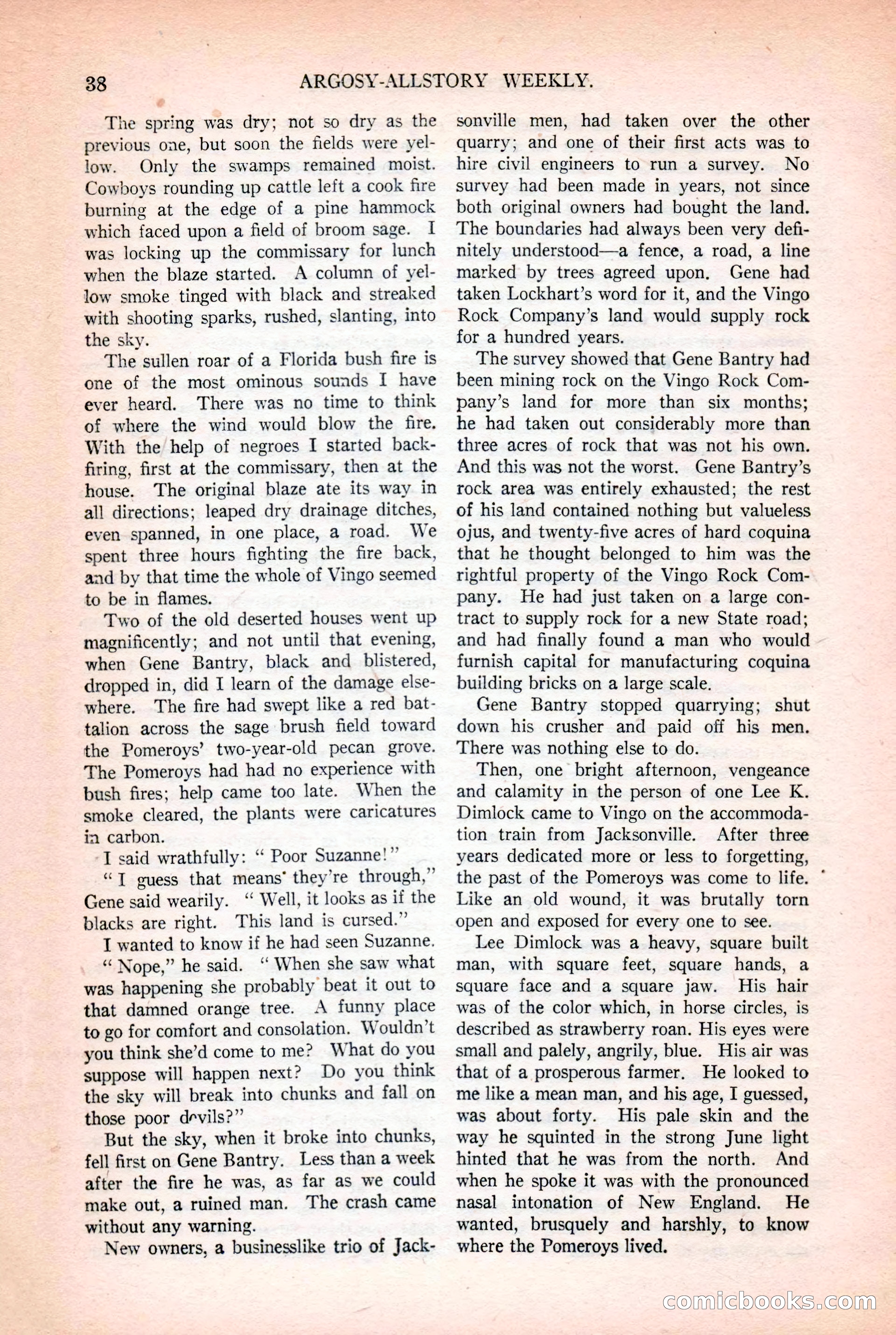
A restored page from Pulp Fiction, 1924. Page through the whole issue in the reader above.
📄 Transcribed text from this page (OCR, searchable)
Machine-transcribed from the original scan — historical spelling and the odd misread are preserved.
38 The spring was dry; not so dry as the previous one, but soon the fields were yel- low. Only the swamps remained moist. Cowboys rounding up cattle left a cook fire burning at the edge of a pine hammock which faced upon a field of broom sage. I was locking up the commissary for lunch when the blaze started. A column of yel- low smoke tinged with black and streaked with shooting sparks, rushed, slanting, into the sky. The sullen roar of a Florida bush fire is one of the most ominous sounds I have ever heard. There was no time to think of where the wind would blow the fire. With the help of negroes I started back- firing, first at the commissary, then at the house. The original blaze ate its way in all directions; leaped dry drainage ditches, even spanned, in one place, a road. We spent three hours fighting the fire back, and by that time the whole of Vingo seemed to be in flames. Two of the old deserted houses went up magnificently; and not until that evening, when Gene Bantry, black and blistered, dropped in, did I learn of the damage else- where. The fire had swept like a red bat- talion across the sage brush field toward the Pomeroys’ two-year-old pecan grove. The Pomeroys had had no experience with bush fires; help came too late. When the smoke cleared, the plants were caricatures in carbon. I said wrathfully: “‘ Poor Suzanne!”’ “T guess that means’ they’re through,” Gene said wearily. ‘‘ Well, it looks as if the blacks are right. This land is cursed.” I wanted to know if he had seen Suzanne. “ Nope,” he said. ‘“ When she saw what was happening she probably beat it out to that damned orange tree. A funny place to go for comfort and consolation. Wouldn’t you think she’d come to me? What do you suppose will happen next? Do you think the sky will break into chunks and fall on those poor devils?” But the sky, when it broke into chunks, fell first on Gene Bantry. Less than a week after the fire he was, as far as we could make out, a ruined man. The crash came without any warning. New owners, a businesslike trio of Jack- ARGOSY-ALLSTORY WEEKLY. sonville men, had taken over the other quarry; and one of their first acts was to hire civil engineers to run a survey. No survey had been made in years, not since both original owners had bought the land. The boundaries had always been very defi- nitely understood—a fence, a road, a line marked by trees agreed upon. Gene had taken Lockhart’s word for it, and the Vingo Rock Company’s land would supply rock for a hundred years. The survey showed that Gene Bantry had been mining rock on the Vingo Rock Com- pany’s land for more than six months; he had taken out considerably more than three acres of rock that was not his own. And this was not the worst. Gene Bantry’s rock area was entirely exhausted; the rest of his land contained nothing but valueless ojus, and twenty-five acres of hard coquina that he thought belonged to him was the rightful property of the Vingo Rock Com- pany. He had just taken on a large con- tract to supply rock for a new State road; and had finally found a man who would furnish capital for manufacturing coquina building bricks on a large scale. Gene Bantry stopped quarrying; shut down his crusher and paid off his men. There was nothing else to do. Then, one bright afternoon, vengeance and calamity in the person of one Lee K. Dimlock came to Vingo on the accommoda- tion train from Jacksonville. After three years dedicated more or less to forgetting, the past of the Pomeroys was come to life. * Like an old wound, it was brutally torn open and exposed for every one to see. Lee Dimlock was a heavy, square built man, with square feet, square hands, a square face and a square jaw. His hair was of the color which, in horse circles, is described as strawberry roan. His eyes were small and palely, angrily, blue. His air was that of a prosperous farmer. He looked to me like a mean man, and his age, I guessed, was about forty. His pale skin and the way he squinted in the strong June light hinted that he was from the north. And when he spoke it was with the pronounced nasal intonation of New England. He wanted, brusquely and harshly, to know where the Pomeroys lived. COnmmicloool< (C@