
Pulp Fiction, 1924 · page 164 of 172
Argosy All-Story Weekly, May 17, 1924 — page 164: what you’re looking at
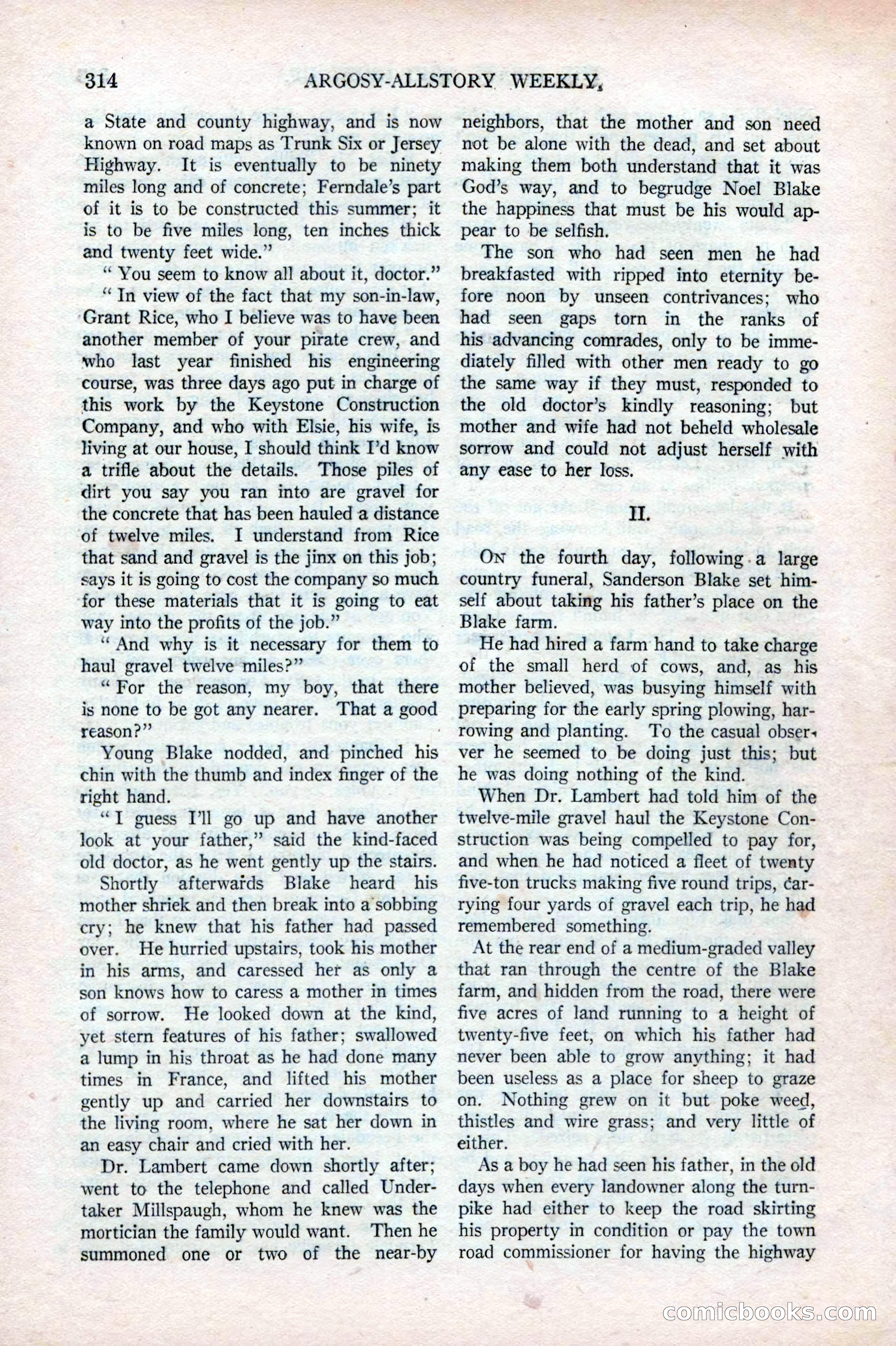
A restored page from Pulp Fiction, 1924. Page through the whole issue in the reader above.
📄 Transcribed text from this page (OCR, searchable)
Machine-transcribed from the original scan — historical spelling and the odd misread are preserved.
ol4 a State and county highway, and is now known on road maps as Trunk Six or Jersey Highway. It is eventually to be ninety miles long and of concrete; Ferndale’s part of it is to be constructed this summer; it is to be five miles long, ten inches thick and twenty feet wide.” “You seem to know all about it, doctor.” “In view of the fact that my son-in-law, ‘Grant Rice, who I believe was to have been another member of your pirate crew, and who last year finished his engineering course, was three days ago put in charge of this work by the Keystone Construction Company, and who with Elsie, his wife, is living at our house, I should think I’d know a trifle about the details. Those piles of dirt you say you ran into are gravel for the concrete that has been hauled a distance of twelve miles. I understand from Rice that sand and gravel is the jinx on this job; says it is going to cost the company so much for these materials that it is going to eat way into the profits of the job.” ‘And why is it necessary for them to haul gravel twelve miles?” “For the reason, my boy, that there is none to be got any nearer. That a good reason?” , Young Blake nodded, and pinched his chin with the thumb and index finger of the right hand. “T guess I'll go up and have another look at your father,” said the kind-faced old doctor, as he went gently up the stairs. Shortly afterwards Blake heard his mother shriek and then break into a sobbing cry; he knew that his father had passed over. He hurried upstairs, took his mother in his arms, and caressed her as only a son knows how to caress a mother in times of sorrow. He looked down at the kind, yet stern features of his father; swallowed a lump in his throat as he had done many times in France, and lifted his mother gently up and carried her downstairs to the living room, where he sat her down in an easy chair and cried with her. Dr. Lambert came down shortly after; went to the telephone and called Under- taker Millspaugh, whom he knew was the mortician the family would want. Then he summoned one or two of the near-by ARGOSY-ALLSTORY WEEKLY, neighbors, that the mother and son need not be alone with the dead, and set about making them both understand that it was God’s way, and to begrudge Noel Blake the happiness that must be his would ap- pear to be selfish. The son who had seen men he had breakfasted with ripped into eternity be- fore noon by unseen contrivances; who had seen gaps torn in the ranks of his advancing comrades, only to be imme- diately filled with other men ready to go the same way if they must, responded to the old doctor’s kindly reasoning; but mother and wife had not beheld wholesale sorrow and could not adjust herself with any ease to her loss. YI. On the fourth day, following.a large country funeral, Sanderson Blake set him- self about taking his father’s place on the Blake farm. He had hired a farm hand to take charge of the small herd of cows, and, as his mother believed, was busying himself with preparing for the early spring plowing, har- rowing and planting. To the casual obser: ver he seemed to be doing just this; but he was doing nothing of the kind. When Dr. Lambert had told him of the twelve-mile gravel haul the Keystone Con- struction was being compelled to pay for, and when he had noticed a fleet of twenty five-ton trucks making five round trips, ¢ar- rying four yards of gravel each trip, he had remembered something. At the rear end of a medium-graded valley that ran through the centre of the Blake farm, and hidden from the road, there were five acres of land running to a height of twenty-five feet, on which his father had never been able to grow anything; it had been useless as a place for sheep to graze on. Nothing grew on it but poke weed, thistles and wire grass; and very little of either. As a boy he had seen his father, in the old days when every landowner along the turn- pike had either to keep the road skirting his property in condition or pay the town road commissioner for having the highway COmmicloooks (C@