
Pulp Fiction, 1924 · page 163 of 172
Argosy All-Story Weekly, May 17, 1924 — page 163: what you’re looking at
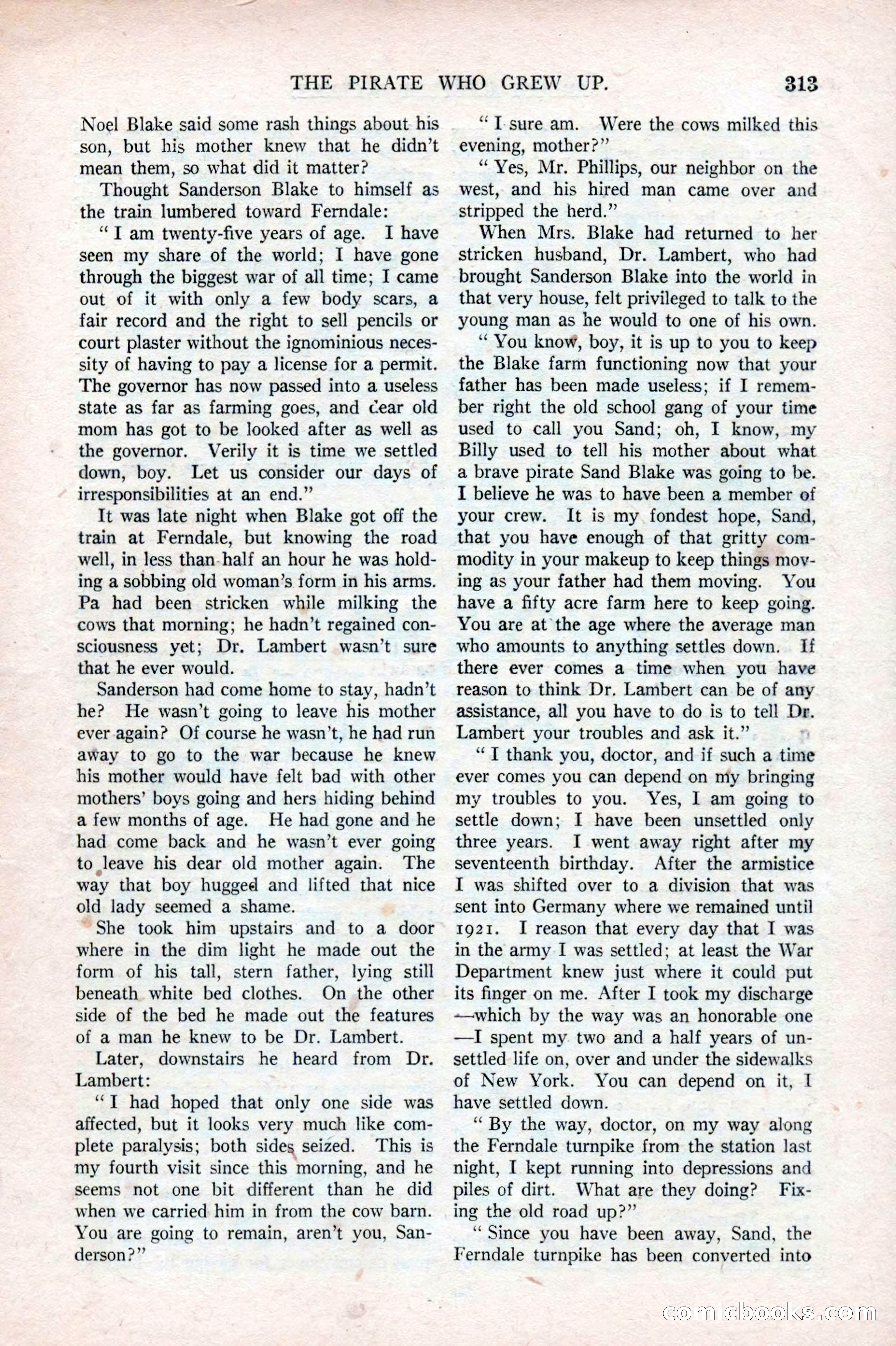
A restored page from Pulp Fiction, 1924. Page through the whole issue in the reader above.
📄 Transcribed text from this page (OCR, searchable)
Machine-transcribed from the original scan — historical spelling and the odd misread are preserved.
THE PIRATE WHO GREW Noel Blake said some rash things about his son, but his mother knew that he didn’t mean them, so what did it matter? Thought Sanderson Blake to himself as the train lumbered toward Ferndale: ““T am twenty-five years of age. I have seen my share of the world; I have gone through the biggest war of all time; I came out of it with only a few body scars, a fair record and the right to sell pencils or court plaster without the ignominious neces- sity of having to pay a license for a permit. The governor has now passed into a useless state as far as farming goes, and cear old mom has got to be looked after as well as the governor. Verily it is time we settled down, boy. Let us consider our days of irresponsibilities at an end.” It was late night when Blake got off the train at Ferndale, but knowing the road well, in less than-half an hour he was hold- ing a sobbing old woman’s form in his arms. Pa had been stricken while milking the cows that morning; he hadn’t regained con- sciousness yet; Dr. Lambert wasn’t sure that he ever would. Sanderson had come home to stay, hadn’t he? He wasn’t going to leave his mother ever again? Of course he wasn’t, he had run away to go to the war because he knew his mother would have felt bad with other mothers’ boys going and hers hiding behind a few months of age. He had gone and he had come back and he wasn’t ever going to leave his dear old mother again. The way that boy hugged and lifted that nice old lady seemed a shame. ~ She took him upstairs and to a door where in the dim light he made out the form of his tall, stern father, lying still beneath white bed clothes. On the other side of the bed he made out the features of a man he knew to be Dr. Lambert. Later, downstairs he heard from Dr. Lambert: “T had hoped that only one side was affected, but it looks very much like com- plete paralysis; both sides seized. This is my fourth visit since this morning, and he seems not one bit different than he did when we carried him in from the cow barn. You are going to remain, aren’t you, San- derson?” UP. 213 “T-sure am. Were the cows milked this evening, mother?” “Yes, Mr. Phillips, our neighbor on the west, and his hired man came over and stripped the herd.” When Mrs. Blake had returned to her stricken husband, Dr. Lambert, who had brought Sanderson Blake into the world in that very house, felt privileged to talk to the young man as he would to one of his own. ‘You know, boy, it is up to you to keep the Blake farm functioning now that your father has been made useless; if I remem- ber right the old school gang of your time used to call you Sand; oh, I know, my Billy used to tell his mother about what a brave pirate Sand Blake was going to be. I believe he was to have been a member of your crew. It is my fondest hope, Sand, that you have enough of that gritty com- modity in your makeup to keep things mov- ing as your father had them moving. You have a fifty acre farm here to keep going. You are at the age where the average man who amounts to anything settles down. If there ever comes a time when you have reason to think Dr. Lambert can be of any assistance, all you have to do is to tell Dr. Lambert your troubles and ask it.” ‘“‘T thank you, doctor, and if such a time ever comes you can depend on my bringing my troubles to you. Yes, I am going to settle down; I have been unsettled only three years. I went away right after my seventeenth birthday. After the armistice I was shifted over to a division that was sent into Germany where we remained until 1921. I reason that every day that I was in the army I was settled; at least the War Department knew just where it could put its finger on me. After I took my discharge —which by the way was an honorable one —I spent my two and a half years of un- settled life on, over and under the sidewalks of New York. You can depend on it, I have settled down. ‘““ By the way, doctor, on my way along the Ferndale turnpike from the station last night, I kept running into depressions and piles of dirt. What are they doing? Fix- ing the old road up?” ‘“ Since you have been away, Sand, the Ferndale turnpike has been converted into COmicloooks (C@