
Pulp Fiction, 1924 · page 165 of 172
Argosy All-Story Weekly, May 17, 1924 — page 165: what you’re looking at
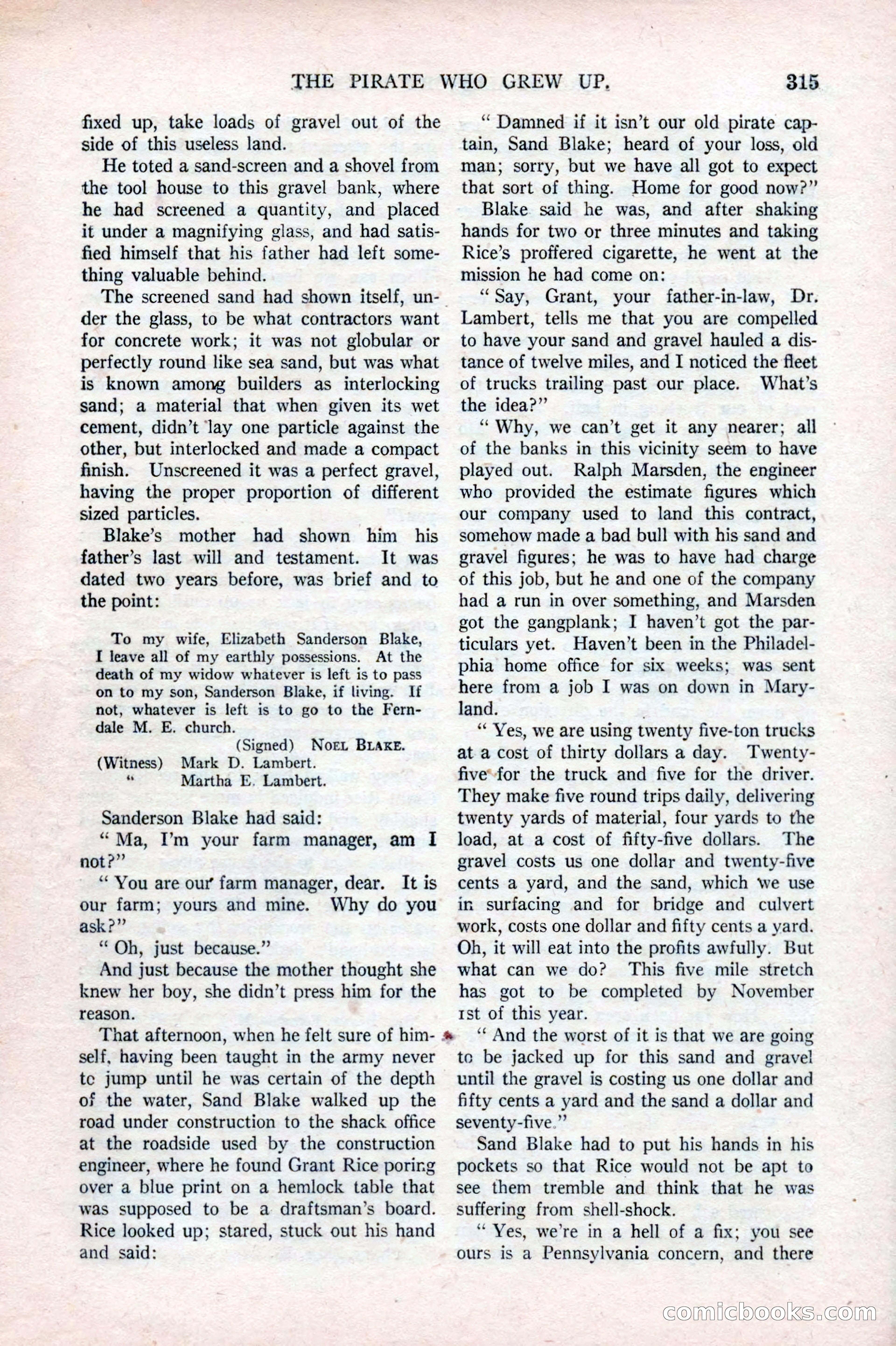
A restored page from Pulp Fiction, 1924. Page through the whole issue in the reader above.
📄 Transcribed text from this page (OCR, searchable)
Machine-transcribed from the original scan — historical spelling and the odd misread are preserved.
THE PIRATE WHO GREW UP, fixed up, take loads of gravel out of the side of this useless land. He toted a sand-screen and a shovel from the tool house to this gravel bank, where he had screened a quantity, and placed it under a magnifying glass, and had satis- fied himself that his father had left some- thing valuable behind. The screened sand had shown itself, un-— der the glass, to be what contractors want for concrete work; it was not globular or perfectly round like sea sand, but was what is known among builders as interlocking sand; a material that when given its wet cement, didn’t lay one particle against the other, but interlocked and made a compact finish. Unscreened it was a perfect gravel, having the proper proportion of different sized particles. Blake’s mother had shown him his father’s last will and testament. It was dated two years before, was brief and to the point: To my wife, Elizabeth Sanderson Blake, I leave all of my earthly possessions. At the death of my widow whatever is left is to pass on to my son, Sanderson Blake, if living. If not, whatever is left is to go to the Fern- dale M. E. church. (Signed) Nort BLAKE. (Witness) Mark D. Lambert. * Martha E. Lambert. Sanderson Blake had said: “Ma, I’m your farm manager, am I not?” “You are our’ farm manager, dear. It is our farm; yours and mine. Why do you ask?” “Oh, just because.” And just because the mother thought she knew her boy, she didn’t press him for the reason. That afternoon, when he felt sure of him- : self, having been taught in the army never tc jump until he was certain of the depth of the water, Sand Blake walked up the road under construction to the shack office at the roadside used by the construction engineer, where he found Grant Rice poring over a blue print on a hemlock table that was supposed to be a draftsman’s board. Rice looked up; stared, stuck out his hand and said: 315 “ Damned if it isn’t our old pirate cap- tain, Sand Blake; heard of your loss, old man; sorry, but we have all got to expect that sort of thing. Home for good now?” Blake said he was, and after shaking hands for two or three minutes and taking Rice’s proffered cigarette, he went at the mission he had come on: “Say, Grant, your father-in-law, Dr. Lambert, tells me that you are compelled to have your sand and gravel hauled a dis- tance of twelve miles, and I noticed the fleet of trucks trailing past our place. What’s the idea?” ‘““ Why, we can’t get it any nearer; all of the banks in this vicinity seem to have played out. Ralph Marsden, the engineer who provided the estimate figures which our company used to land this contract, somehow made a bad bull with his sand and gravel figures; he was to have had charge of this job, but he and one of the company had a run in over something, and Marsden got the gangplank; I haven’t got the par- ticulars yet. Haven’t been in the Philadel- phia home office for six weeks; was sent here from a job I was on down in Mary- land. :; “ Ves, we are using twenty five-ton trucks at a cost of thirty dollars a day. Twenty- five’ for the truck and five for the driver. They make five round trips daily, delivering twenty yards of material, four yards to the load, at a cost of fifty-five dollars. The gravel costs us one dollar and twenty-five cents a yard, and the sand, which we use in surfacing and for bridge and culvert work, costs one dollar and fifty cents a yard. Oh, it will eat into the profits awfully. But what can we do? This five mile stretch has got to be completed by November rst of this year. ‘* And the worst of it is that we are going tc be jacked up for this sand and gravel until the gravel is costing us one dollar and fifty cents a yard and the sand a dollar and seventy-five.” Sand Blake had to put his hands in his pockets so that Rice would not be apt to see them tremble and think that he was suffering from shell-shock. ‘Yes, we're in a hell of a fix; you see ours is a Pennsylvania concern, and there COmiclboooks (C@