
Pulp Fiction, 1922 · page 137 of 176
Argosy All-Story Weekly, Vol. 146 No. 4 — page 137: what you’re looking at
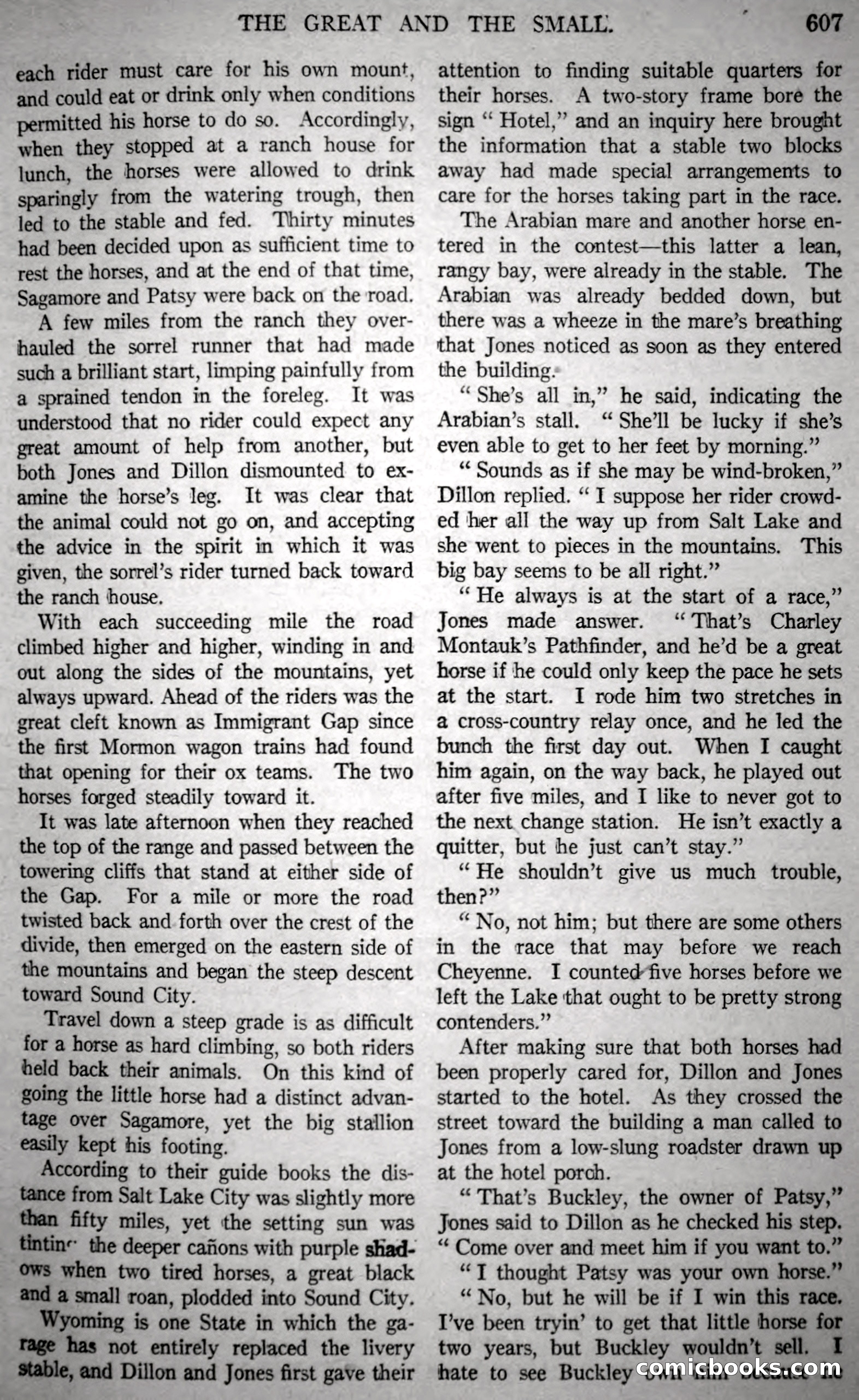
A restored page from Pulp Fiction, 1922. Page through the whole issue in the reader above.
📄 Transcribed text from this page (OCR, searchable)
Machine-transcribed from the original scan — historical spelling and the odd misread are preserved.
THE GREAT AND THE SMALL. each rider must care for his own mount, and could eat or drink only when conditions permitted his horse to do so. Accordingly, when they stopped at a ranch house for lunch, the horses were allowed to drink sparingly from the watering trough, then led to the stable and fed. Thirty minutes had been decided upon as sufficient time to rest the horses, and at the end of that time, Sagamore and Patsy were back on the road. A few miles from the ranch they over- hauled the sorrel runner that had made such a brilliant start, limping painfully from a sprained tendon in the foreleg. It was understood that no rider could expect any great amount of help from another, but both Jones and Dillon dismounted to ex- amine the horse’s leg. It was clear that the animal could not go on, and accepting the advice in the spirit in which it was given, the sorrel’s rider turned back toward the ranch house. With each succeeding mile the road climbed higher and higher, winding in and out along the sides of the mountains, yet always upward. Ahead of the riders was the great cleft known as Immigrant Gap since the first Mormon wagon trains had found that opening for their ox teams. The two horses forged steadily toward it. It was late afternoon when they reached the top of the range and passed between the towering cliffs that stand at either side of the Gap. For a mile or more the road twisted back and forth over the crest of the divide, then emerged on the eastern side of the mountains and began the steep descent toward Sound City. Travel down a steep grade is as difficult for a horse as hard climbing, so both riders held back their animals. On this kind of going the little horse had a distinct advan- tage over Sagamore, yet the big stallion easily kept his footing. According to their guide books the dis- tance from Salt Lake City was slightly more than fifty miles, yet the setting sun was _ tintin~ the deeper cafions with purple shad- _ ows when two tired horses, a great black and a small roan, plodded into Sound City. __ Wyoming is one State in which the ga- Tage has not entirely replaced the livery , and Dillon and Jones first gave their eo attention to finding suitable quarters for their horses. A two-story frame bore the sign “ Hotel,” and an inquiry here brought the information that a stable two blocks away had made special arrangements to care for the horses taking part in the race. The Arabian mare and another horse en- tered in the contest—this latter a lean, rangy bay, were already in the stable. The Arabian was already bedded down, but there was a wheeze in the mare’s breathing that Jones noticed as soon as they entered the building: ““She’s all in,” he said, indicating the Arabian’s stall. “She'll be lucky if she’s even able to get to her feet by morning.” ** Sounds as if she may be wind-broken,” Dillon replied. “ I suppose her rider crowd- ed ‘her all the way up from Salt Lake and she went to pieces in the mountains. This big bay seems to be all right.” ‘He always is at the start of a race,” Jones made answer. “ That’s Charley Montauk’s Pathfinder, and he’d be a great horse if he could only keep the pace he sets at the start. I rode him two stretches in @ cross-country relay once, and he led the bunch the first day out. When I caught him again, on the way back, he played out after five miles, and I like to never got to the next change station. He isn’t exactly a quitter, but he just can’t stay.” “He shouldn’t give us much trouble, then?” “No, not him; but there are some others in the race that may before we reach Cheyenne. I counted-five horses before we left the Lake that ought to be pretty strong contenders.” After making sure that both horses had been properly cared for, Dillon and Jones started to the hotel. As they crossed the street toward the building a man called to Jones from a low-slung roadster drawn up at the hotel porch. “ That’s Buckley, the owner of Patsy,” Jones said to Dillon as he checked his step. “ Come over and meet him if you want to.” “T thought Patsy was your own horse.” “No, but he will be if I win this race. in, I’ve been tryin’ to get that little horse for