
Pulp Fiction, 1922 · page 138 of 176
Argosy All-Story Weekly, Vol. 146 No. 4 — page 138: what you’re looking at
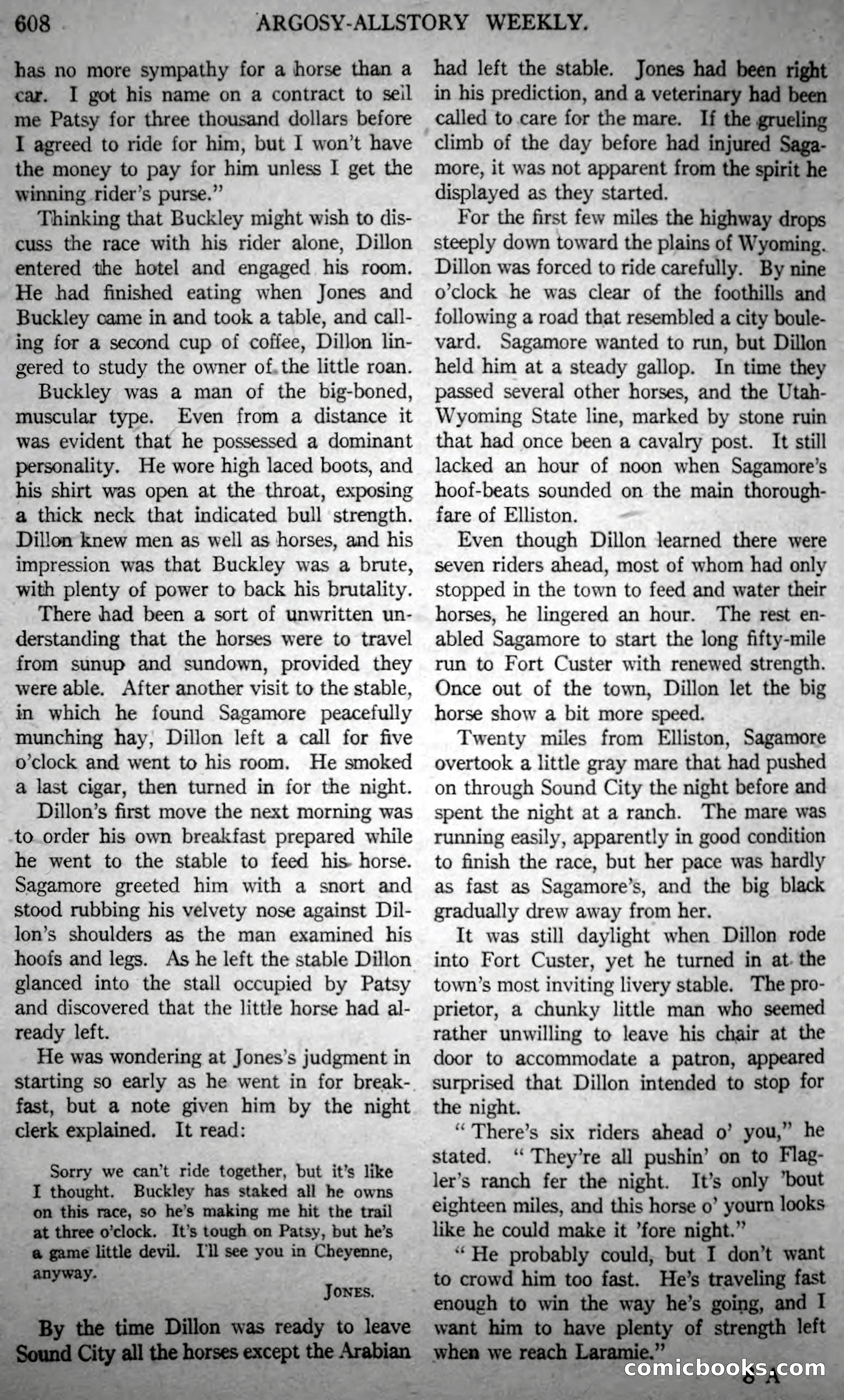
A restored page from Pulp Fiction, 1922. Page through the whole issue in the reader above.
📄 Transcribed text from this page (OCR, searchable)
Machine-transcribed from the original scan — historical spelling and the odd misread are preserved.
— . has no more sympathy for a horse than a car. I got his name on a contract to seil me Patsy for three thousand dollars before I agreed to ride for him, but I won’t have the money to pay for him unless I get the winning rider’s purse.” Thinking that Buckley might wish to dis- cuss the race with his rider alone, Dillon entered the hotel and engaged his room. He had finished eating when Jones and Buckley came in and took a table, and call- ing for a second cup of coffee, Dillon lin- gered to study the owner of, the little roan. Buckley was a man of the big-boned, muscular type. Even from a distance it was evident that he possessed a dominant personality. He wore high laced boots, and his shirt was open at the throat, exposing a thick neck that indicated bull strength. Dillon knew men as well as horses, and his impression was that Buckley was a brute, with plenty of power to back his brutality. There had been a sort of unwritten un- derstanding that the horses were to travel from sunup and sundown, provided they were able. After another visit to the stable, in which he found Sagamore peacefully munching hay, Dillon left a call for five o'clock and went to his room. He smoked a last cigar, then turned in for the night. Dillon’s first move the next morning was -to.order his own breakfast prepared while he went to the stable to feed his horse. Sagamore greeted him with a snort and stood rubbing his velvety nose against Dil- lon’s shoulders as the man examined his hoofs and legs. As he left the stable Dillon glanced into the stall occupied by Patsy and discovered that the little horse had al- ready left. He was wondering at Jones’s judgment in starting so early as he went in for break- fast, but a note given him by the night clerk explained. It read: Sorry we can’t ride together, but it’s like I thought. Buckley has staked all he owns on this race, so he’s making me hit the trail at three o’clock. It’s tough on Patsy, but he’s @ game little devil. Ill see you in Cheyenne, xia REE ibe reach ARGOSY-ALLSTORY WEEKLY. climb of the day before had injured S: Saga-_ fo. ccond int ton: Se He's. Na Bite had left the stable. Jones had F een tig ef in his prediction, and a veterinary had Deen called to care for the mare. If the grueling — more, it was not apparent from the spirit he displayed as they started. For the first few miles the highway drops steeply down toward the plains of Wyoming. Dillon was forced to ride carefully. By nine o’clock he was clear of the foothills and following a road that resembled a city boule- vard. Sagamore wanted to run, but Dillon held him at a steady gallop. In time they passed several other horses, and the Utah- Wyoming State line, marked by stone ruin that had once been a cavalry post. It still lacked an hour of noon when Sagamore’s hoof-beats sounded on the main thorough- fare of Elliston. Even though Dillon learned there were seven riders ahead, most of whom had only stopped in the town to feed and water their horses, he lingered an hour. The rest en- abled Sagamore to start the long fifty-mile run to Fort Custer with renewed strength. Once out of the town, Dillon let the big horse show a bit more speed. Twenty miles from Elliston, Sagamore overtook a little gray mare that had pushed on through Sound City the night before and spent the night at a ranch. The mare was running easily, apparently in good condition to finish the race, but her pace was hardly as fast as Sagamore’s, and the big black gradually drew away from her. It was still daylight when Dillon rode into Fort Custer, yet he turned in at. the town’s most inviting livery stable. The pro- prietor, a chunky little man who seemed rather unwilling to leave his chair at the door to accommodate a patron, appeared surprised that Dillon intended to stop for the night. “There’s six riders ahead 0’ you,” he stated. ‘“ They’re all pushin’ on to Flag- ler’s ranch fer the night. It’s only "bout eighteen miles, and this horse o * yourn. looks like he could make it ’fore night.” “He probably could, but I don’t sie enough to vie ee ws Dg, 3 a ed Lar ceotmiebooke. com