
Pulp Fiction, 1922 · page 136 of 176
Argosy All-Story Weekly, Vol. 146 No. 4 — page 136: what you’re looking at
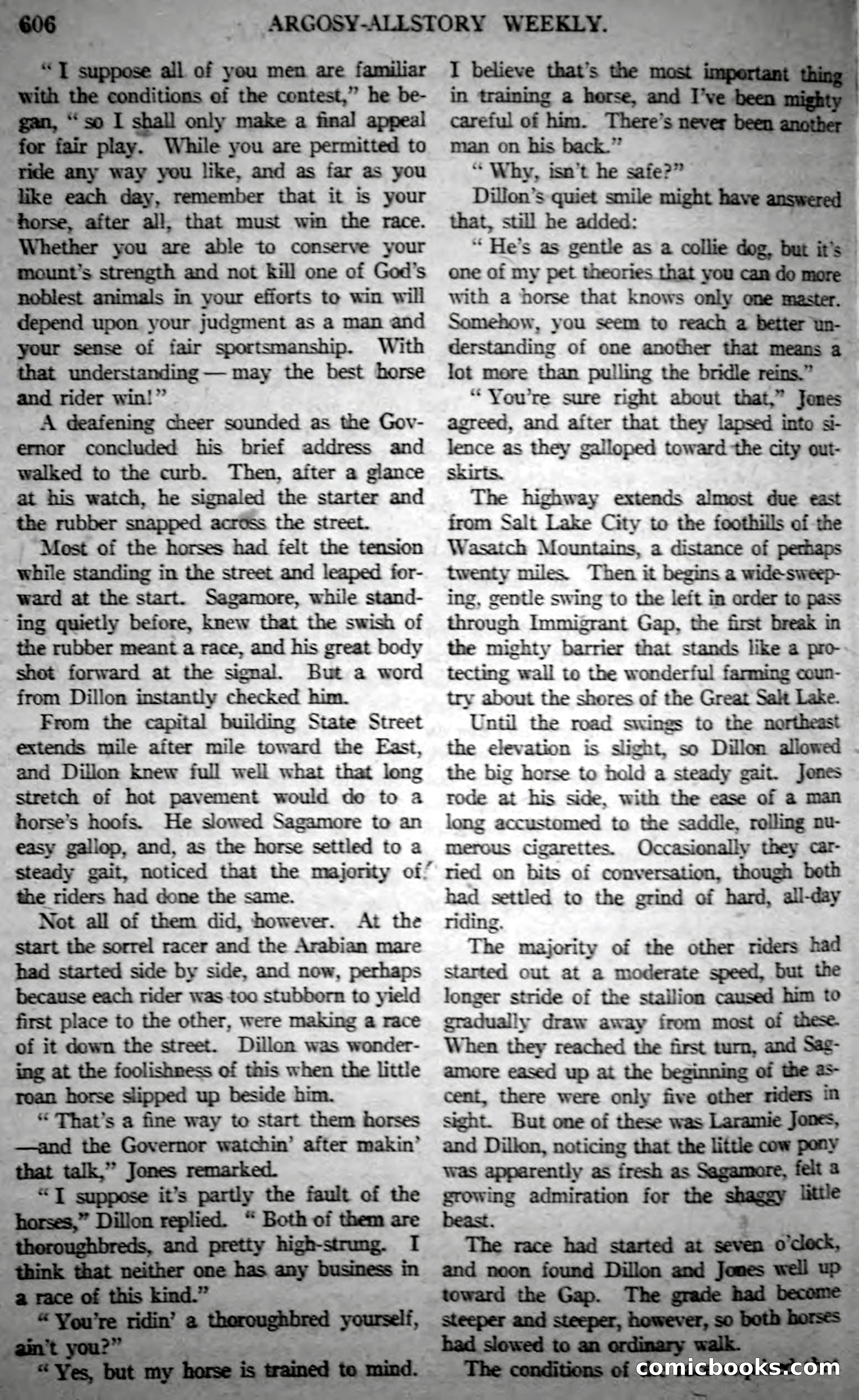
A restored page from Pulp Fiction, 1922. Page through the whole issue in the reader above.
📄 Transcribed text from this page (OCR, searchable)
Machine-transcribed from the original scan — historical spelling and the odd misread are preserved.
“horse, after all, that must win the race. Whether you are able to conserve your mount’s strength and not kill one of God’s noblest animals in your efforts to win will and rider win!” A deafening cheer sounded as the Gov- ernor concluded his brief address and walked to the curb. Then, after a glance ‘Mest of the horses had felt the tension while standing in the street and leaped for- ward at the start. Sagamore, while stand- ing quietly before, knew that the swish of the rubber meant a race, and his great body shot forward at the signal. But a word from Dillon instantly checked him. From the capital building State Street extends mile after mile toward the East, and Dillon knew full well what that long stretch of hot pavement would de to a horse’s hoofs. He slowed Sagamore to an easy gallop, and, as the horse settled to a steady gait, noticed that the majority oi’ the riders had done the same. Not all of them did, however. At the start the sorrel racer and the Arabian mare had started side by side, and now, perhaps because each rider was too stubborn to yield first place to the other, were making a race of it down the street. Dillon was wonder- ing at the foolishness of this when the little “ That’s a fine way to start them horses —and the Governor watchin’ after makin’ “ He’s as gentle as a collie dog, but it’s one of my pet theories that you cam do more with a horse that knows only one master. Somehow, you seem to reach a better un- derstanding of one another that means a lot more than pulling the bridle reins.” “You’re sure right about that,” Jones agreed, and after that they lapsed into s- lence as they galloped toward the city out- skirts. The highway extends almost due east from Salt Lake City to the foothills of the Wasatch Mountains, a distance of peshaps twenty miles. Then it begins a wide-sweep- ing, gentle swing to the left in order to pass through Immigrant Gap, the first break in the mighty barrier that stands like a pro tecting wall to the wonderful fanming coun- try about the shores of the Great Salt Lake. Until the road swings to the northeast the elevation is slight, so Dillon allowed . the big horse to hald a steady gait. Jones rode at his side, with the ease of a man long accustomed to the saddle, rolling nu- merous cigarettes. Occasionally they car- ried on bits of conversation, though both had settled to the grind of hard, all-day riding. The majority of the other riders had started out at a moderate but the longer stride of the stallion caused him to gradually draw away from most of these. When they reached the first turn, and Sag- amore eased up at the beginning of the as- cent, there were only five other riders in sight. But one of these was Laramie Jones,