
Pulp Fiction, 1920 · page 79 of 180
Argosy, Vol. 118, No. 2 — page 79: what you’re looking at
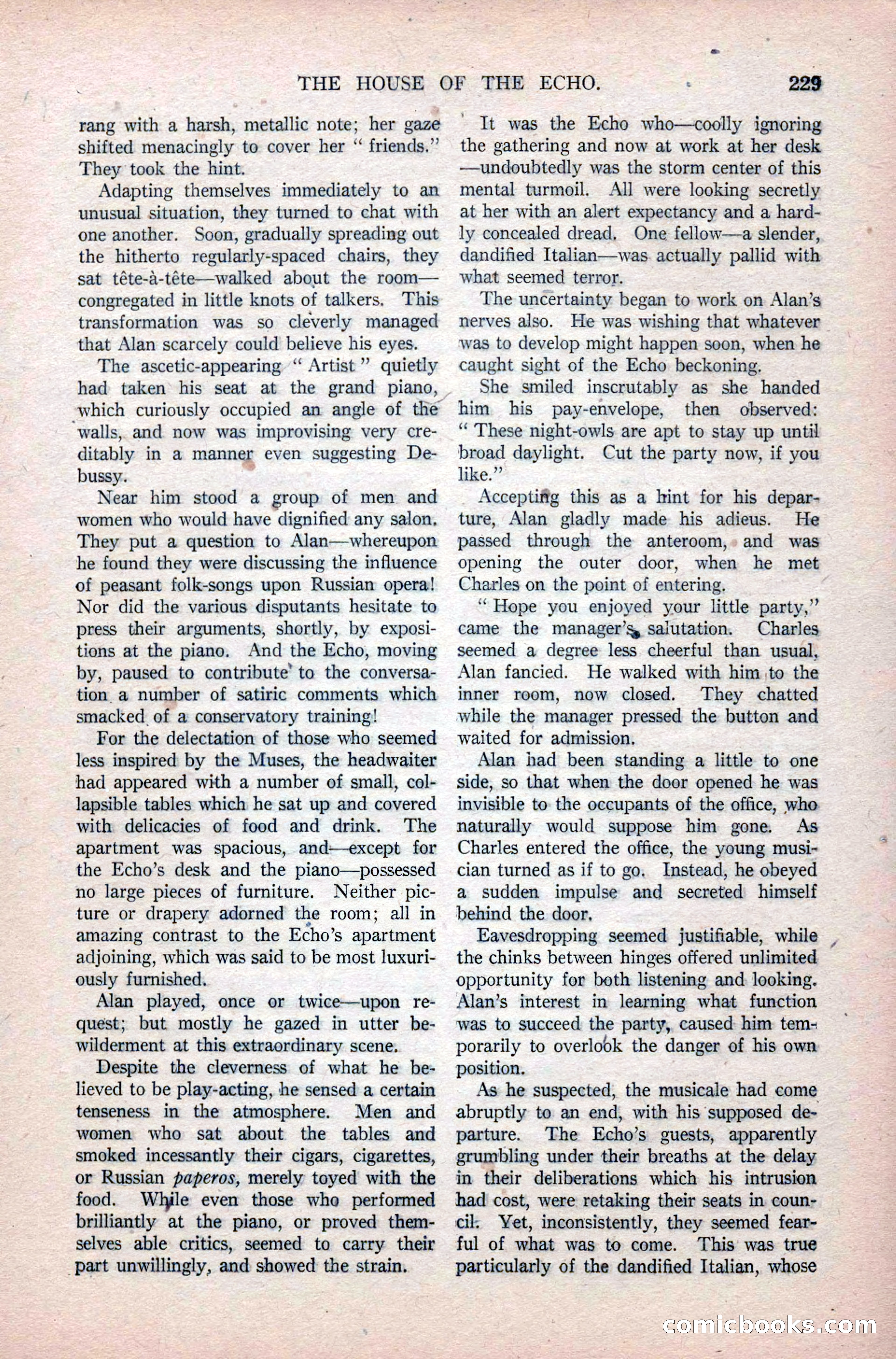
A restored page from Pulp Fiction, 1920. Page through the whole issue in the reader above.
📄 Transcribed text from this page (OCR, searchable)
Machine-transcribed from the original scan — historical spelling and the odd misread are preserved.
THE HOUSE OF THE ECHO. rang with a harsh, metallic note; her gaze shifted menacingly to cover her “ friends.” They took the hint. Adapting themselves immediately to an unusual situation, they turned to chat with one another. Soon, gradually spreading out the hitherto regularly-spaced chairs, they sat téte-a-téte—walked about the room— congregated in little knots of talkers. This transformation was so cleverly managed that Alan scarcely could believe his eyes. The ascetic-appearing ‘‘ Artist” quietly had taken his seat at the grand piano, which curiously occupied an angle of the ‘walls, and now was improvising very cre- ditably in a manner even suggesting De- bussy. Near him stood a group of men and women who would have dignified any salon, They put a question to Alan—whereupon he found they were discussing the influence of peasant folk-songs upon Russian opera! Nor did the various disputants hesitate to press their arguments, shortly, by exposi- tions at the piano. And the Echo, moving by, paused to contribute’ to the conversa- tion a number of satiric comments which smacked of a conservatory training! For the delectation of those who seemed less inspired by the Muses, the headwaiter had appeared with a number of small, col- lapsible tables which he sat up and covered with delicacies of food and drink. The apartment was spacious, and—except for the Echo’s desk and the piano—possessed no large pieces of furniture. Neither pic- ture or drapery adorned the room; all in amazing contrast to the Echo’s apartment adjoining, which was said to be most luxuri- ously furnished. Alan played, once or twice—upon re- quest; but mostly he gazed in utter be- wilderment at this extraordinary scene. Despite the cleverness of what he be- lieved to be play-acting, he sensed a certain tenseness in the atmosphere. Men and women who sat about the tables and smoked incessantly their cigars, cigarettes, or Russian paperos, merely toyed with the food. Whjile even those who performed brilliantly at the piano, or proved them- selves able critics, seemed to carry their part unwillingly, and showed the strain. 229 - It was the Echo who—coolly ignoring the gathering and now at work at her desk —undoubtedly was the storm center of this mental turmoil. All were looking secretly at her with an alert expectancy and a hard- ly concealed dread, One fellow—a slender, dandified Italian—was. actually pallid with what seemed terror. The uncertainty began to work on Alan’s nerves also. He was wishing that whatever - was to develop might happen soon, when he caught sight of the Echo beckoning. She smiled inscrutably as she handed him his pay-envelope, then observed: ‘“ These night-owls are apt to stay up until broad daylight. Cut the party now, if you like.” Acceptifig this as a lint for his depar- ture, Alan gladly made his adieus. He passed through the anteroom,» and was opening the outer door, when he met Charles on the point of entering. ‘Hope you enjoyed your little party,” came the manager’s salutation. Charles seemed a degree less cheerful than usual, Alan fancied. He walked with him to the inner room, now closed. They chatted while the manager pressed the button and waited for admission, Alan had been standing a little to one side, so that when the door opened he was invisible to the occupants of the office, who naturally would suppose him gone. As Charles entered the office, the young musi- cian turned as if to go. Instead, he obeyed a sudden impulse and secreted himself behind the door, Eavesdropping seemed justifiable, while the chinks between hinges offered unlimited opportunity for both listening and looking. Alan’s interest in learning what function was to succeed the party, caused him tem- porarily to overlook the danger of his own position. As he suspected, the musicale had come abruptly to an end, with his supposed de- parture. The Echo’s guests, apparently grumbling under their breaths at the delay in their deliberations which his intrusion had cost, were retaking their seats in coun- cil. Yet, inconsistently, they seemed fear- ful of what was to come. This was true particularly of the dandified Italian, whose CEOPMIC LOOKS (Ge)