
Pulp Fiction, 1920 · page 80 of 180
Argosy, Vol. 118, No. 2 — page 80: what you’re looking at
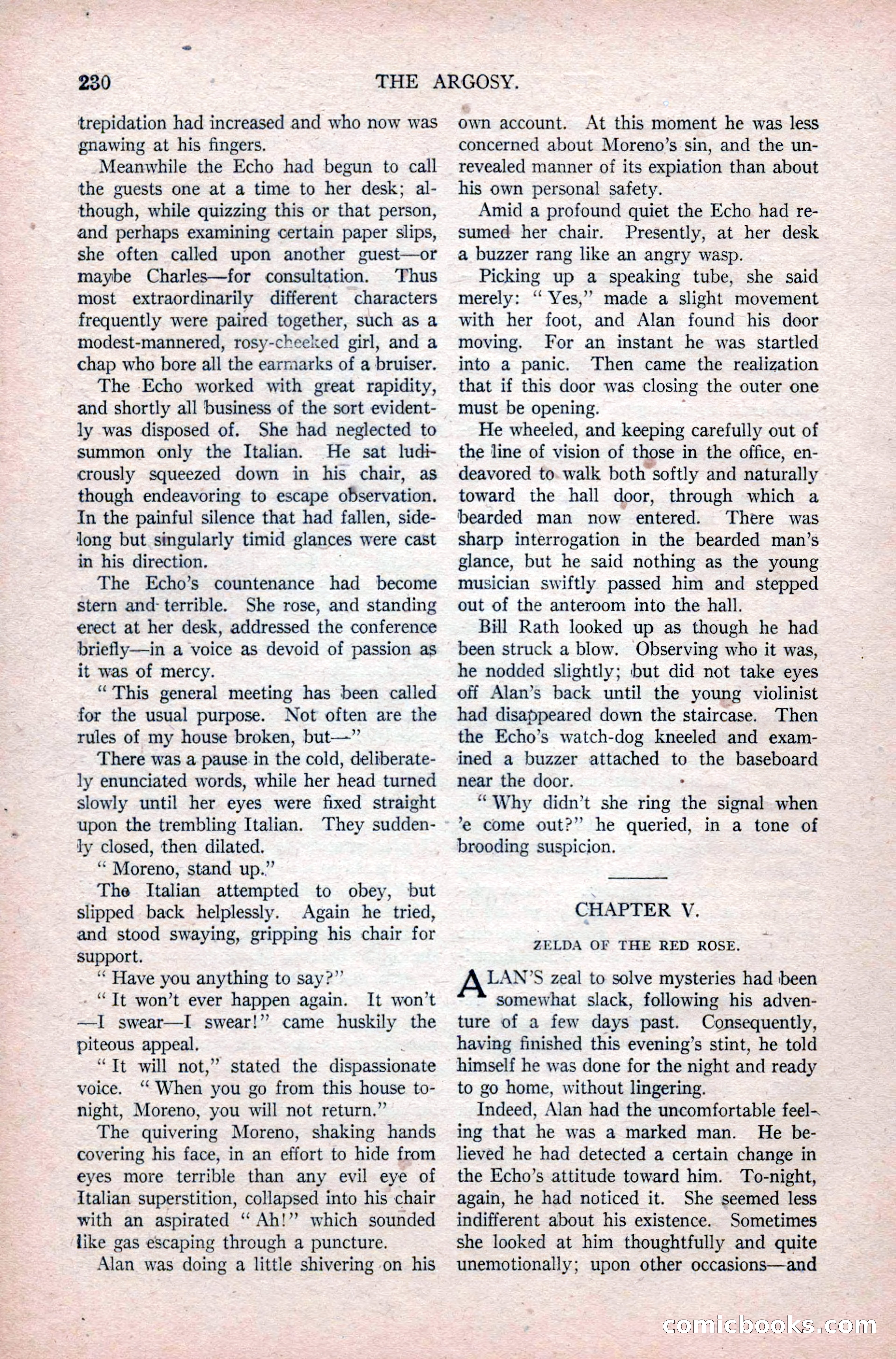
A restored page from Pulp Fiction, 1920. Page through the whole issue in the reader above.
📄 Transcribed text from this page (OCR, searchable)
Machine-transcribed from the original scan — historical spelling and the odd misread are preserved.
230 trepidation had increased and who now was gnawing at his fingers. Meanwhile the Echo had begun to call the guests one at a time to her desk; al- though, while quizzing this or that person, and perhaps examining certain paper slips, She often called upon another guest—or maybe Charles—for consultation. Thus most extraordinarily different characters frequently were paired together, such as a modest-mannered, rosy-cheeked girl, and a chap who bore all the earmarks of a bruiser. The Echo worked with great rapidity, and shortly all business of the sort evident- ly was disposed of. She had neglected to summon only the Italian. He sat ludi- crously squeezed down in his chair, as though endeavoring to escape observation. In the painful silence that had fallen, side- long but singularly timid glances were cast in his direction. The Echo’s countenance had become stern and- terrible. She rose, and standing erect at her desk, addressed the conference briefly—in a voice as devoid of passion as it was of mercy. “This general meeting has been called for the usual purpose. Not often are the rules of my house broken, but—”’ There was a pause in the cold, deliberate- ly enunciated words, while her head turned slowly until her eyes were fixed straight upon the trembling Italian. They sudden- ly closed, then dilated. “Moreno, stand up.’ The Italian attempted to obey, but slipped back helplessly. Again he tried, and stood swaying, gripping his chair for support. ‘ Have you anything to say?” - “Tt won’t ever happen again. It won’t —I swear—I swear!’ came huskily the piteous appeal. “Tt will not,” stated the dispassionate voice. ‘‘ When you go from this house to- night, Moreno, you will not return.” The quivering Moreno, shaking hands covering his face, in an effort to hide from eyes more terrible than any evil eye of italian superstition, collapsed into his chair with an aspirated ‘“ Ah!” which sounded like gas escaping through a puncture. Alan was doing a little shivering on his THE ARGOSY. own account. At this moment he was less concerned about Moreno’s sin, and the un- revealed manner of its expiation than about his own personal safety. Amid a profound quiet the Echo had re- sumed her chair. Presently, at her desk a buzzer rang like an angry wasp. Picking up a speaking tube, she said merely: ‘‘ Yes,’ made a slight movement with her foot, and Alan found his door moving. For an instant he was startled into a panic. Then came the realization that if this door was closing the outer one must be opening. He wheeled, and keeping carefully out of the line of vision of those in the office, en- deavored to. walk both softly and naturally toward the hall door, through which a bearded man now entered. There was sharp interrogation in the bearded man’s glance, but he said nothing as the young musician swiftly passed him and stepped out of the anteroom into the hall. Bill Rath looked up as though he had been struck a blow. Observing who it was, he nodded slightly; but did not take eyes off Alan’s back until the young violinist had disappeared down the staircase. Then the Echo’s watch-dog kneeled and exam- ined a buzzer attached to the baseboard near the door. “Why didn’t she ring ‘ie signal when e come out?’ he queried, in a tone of brooding suspicion. ] CHAPTER V. ZELDA OF THE RED ROSE. LAN’S zeal to solve mysteries had been somewhat slack, following his adven- ture of a few days past. Consequently, having finished this evening’s stint, he told himself he was done for the night and ready to go home, without lingering. Indeed, Alan had the uncomfortable feel- ing that he was a marked man. He be- lieved he had detected a certain change in the Echo’s attitude toward him. To-night, again, he had noticed it. She seemed less indifferent about his existence. Sometimes she looked at him thoughtfully and quite unemotionally; upon other occasions—and (E@) SS DOV) AMIE (C@)