
Pulp Fiction, 1920 · page 78 of 180
Argosy, Vol. 118, No. 2 — page 78: what you’re looking at
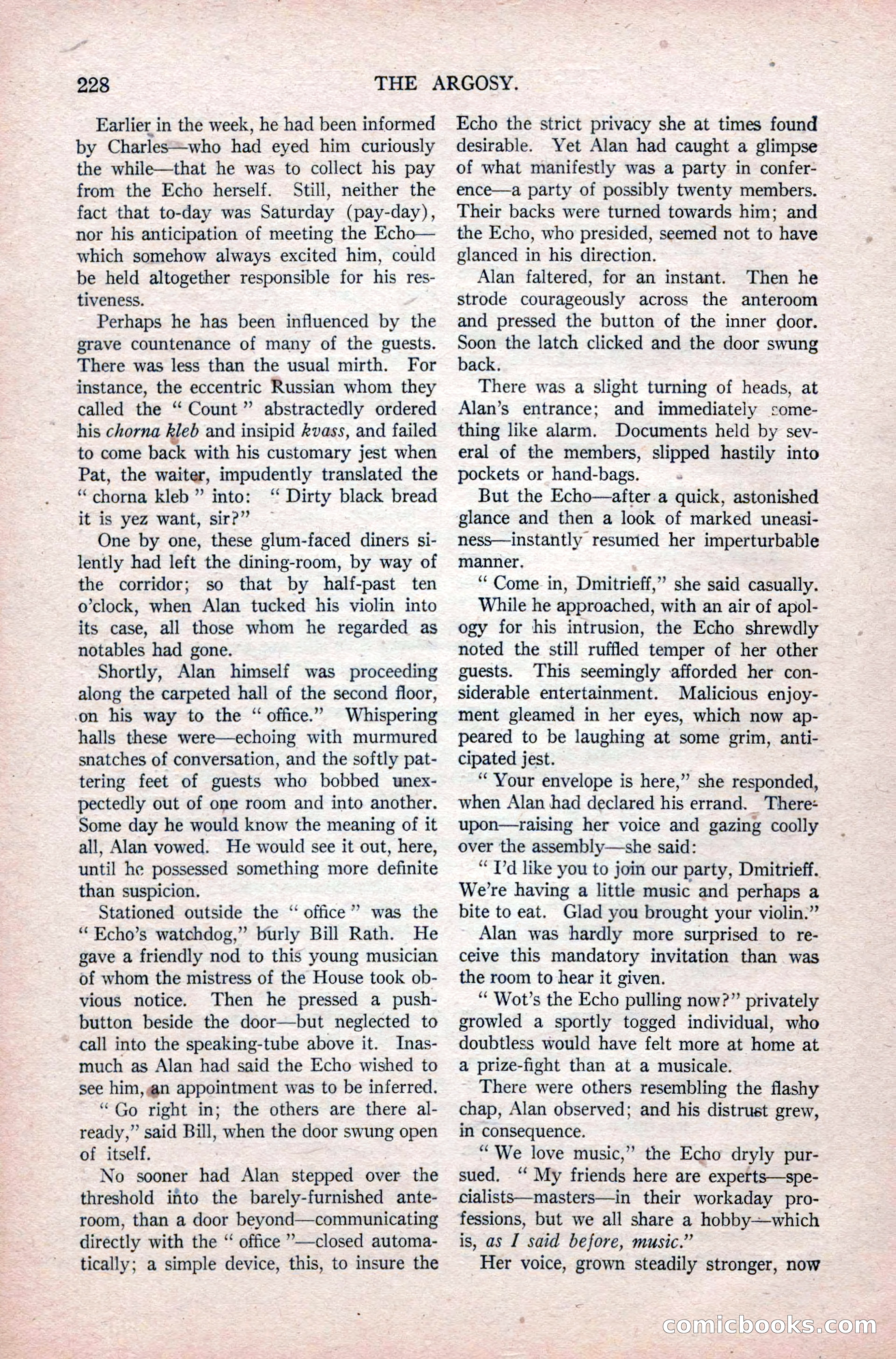
A restored page from Pulp Fiction, 1920. Page through the whole issue in the reader above.
📄 Transcribed text from this page (OCR, searchable)
Machine-transcribed from the original scan — historical spelling and the odd misread are preserved.
228 Earlier in the week, he had been informed by Charles~who had eyed him curiously the while—that he was to collect his pay from the Echo herself. Still, neither the fact that to-day was Saturday (pay-day), nor his anticipation of meeting the Echo— which somehow always excited him, could be held altogether responsible for his res- tiveness. Perhaps he has been influenced by the grave countenance of many of the guests. There was less than the usual mirth. For instance, the eccentric Russian whom they called the ‘“‘ Count ” abstractedly ordered his chorna kleb and insipid kvass, and failed to come back with his customary jest when Pat, the waiter, impudently translated the 4 chorna kleb ” into: “ Dirty black bread it is yez want, sir?” One by one, these glum-faced diners si- lently had left the dining-room, by way of the corridor; so that by half-past ten o’clock, when Alan tucked his violin into its case, all those whom he regarded as notables had gone. Shortly, Alan himself was proceeding along the carpeted hall of the second floor, on his way to the “ office.” Whispering halls these were—echoing with murmured snatches of conversation, and the softly pat- tering feet of guests who bobbed wnex- pectedly out of one room and into another. Some day he would know the meaning of it all, Alan vowed. He would see it out, here, until he possessed something more definite than suspicion. Stationed outside the “ office” was the ‘Echo’s watchdog,” burly Bill Rath. He gave a friendly nod to this young musician of whom the mistress of the House took ob- vious notice. Then he pressed a push- button beside the door—but neglected to call into the speaking-tube above it. Inas- much as Alan had said the Echo wished to see him,an appointment was to be inferred. “Go right in; the others are there al- ready,” said Bill, when the door swung open of itself. No sooner had Alan stepped over the threshold into the barely-furnished ante- room, than a door beyond—communicating directly with the “ office ”—-closed automa- tically; a simple device, this, to insure the THE ARGOSY. Echo the strict privacy she at times found desirable. Yet Alan had caught a glimpse of what manifestly was a party in confer- ence—a party of possibly twenty members. Their backs were turned towards him; and the Echo, who presided, seemed not to have glanced in his direction. Alan faltered, for an instant. Then he strode courageously across the anteroom and pressed the button of the inner door. Soon the latch clicked and the door swung back, There was a slight turning of heads, at Alan’s entrance; and immediately some- thing like alarm. Documents held by sev- eral of the members, slipped hastily into pockets or hand-bags. . But the Echo—after a quick, astonished glance and then a look of marked uneasi- ness—instantly resumed her imperturbable manner. ‘Come in, Dmitrieff,”’ she said casually. While he approached, with an air of apol- ogy for his intrusion, the Echo shrewdly noted the still ruffled temper of her other guests. This seemingly afforded her con- siderable entertainment. Malicious enjoy- ment gleamed in her eyes, which now ap- peared to be laughing at some grim, anti- cipated jest. “Your envelope is here,” she responded, when Alan had declared his errand. There: upon—raising her voice and gazing coolly over the assembly—she said: “ Pd like you to join our party, Dmitrieff. We’re having a little music and perhaps a bite to eat. Glad you brought your violin.” Alan was hardly more surprised to re- ceive this mandatory invitation than was the room to hear it given. ‘Wot’s the Echo pulling now?” privately growled a sportly togged individual, who doubtless would have felt more at home at a prize-fight than at a musicale. There were others resembling the flashy chap, Alan observed; and his distrust grew, in consequence. “We love music,” the Echo dryly pur- sued, “ My friends here are experts—spe- cialists—masters—in their workaday pro- fessions, but we all share a hobby—which is, as I said before, music.” Her voice, grown steadily stronger, now EORMIGLOO (Cc CS (E@)