
Pulp Fiction, 1920 · page 54 of 188
Argosy, Vol. 117, No. 3 — page 54: what you’re looking at
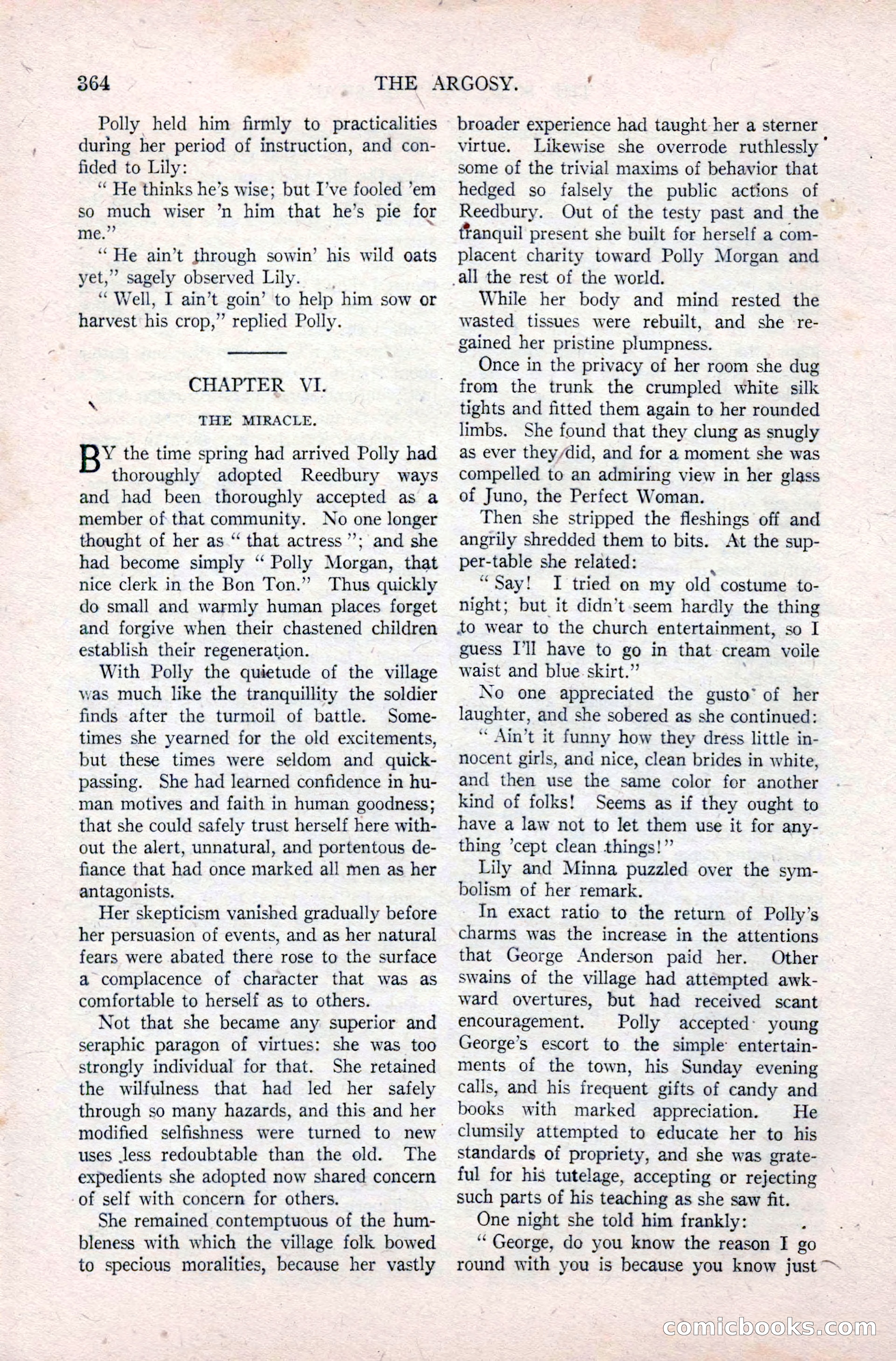
A restored page from Pulp Fiction, 1920. Page through the whole issue in the reader above.
📄 Transcribed text from this page (OCR, searchable)
Machine-transcribed from the original scan — historical spelling and the odd misread are preserved.
364 Polly held him firmly to practicalities during her period of instruction, and con- fided to Lily: ‘“ He thinks he’s wise; but I’ve fooled ’em so much wiser ’n him that he’s pie for me.” “He ain’t through sowin’ his wild oats yet,’ sagely observed Lily. __ “Well, I ain’t goin’ to help him sow or harvest his crop,” replied Polly. CHAPTER VI. THE MIRACLE. Y the time spring had arrived Polly had thoroughly adopted Reedbury ways and had been thoroughly accepted as a member of that community. No one longer thought of her as “‘ that actress’; and she had become simply ‘ Polly Morgan, that nice clerk in the Bon Ton.” Thus quickly do small and warmly human places forget and forgive when their chastened children establish their regeneration. With Polly the quietude of the village was much like the tranquillity the soldier finds after the turmoil of battle. Some- times she yearned for the old excitements, but these times were seldom and quick- passing. She had learned confidence in hu- man motives and faith in human goodness; that she could safely trust herself here with- out the alert, unnatural, and portentous de- fiance that had once marked all men as her antagonists. Her skepticism vanished gradually before her persuasion of events, and as her natural fears were abated there rose to the surface a complacence of character that was as comfortable to herself as to others. Not that she became any superior and seraphic paragon of virtues: she was too strongly individual for that. She retained the wilfulness that had led her safely through so many hazards, and this and her modified selfishness were turned to new. uses Jess redoubtable than the old. The expedients she adopted now shared concern of self with concern for others. She remained contemptuous of the hum- bleness with which the village folk bowed to specious moralities, because her vastly THE ARGOSY. ; broader experience had taught her a sterner virtue. some of the trivial maxims of behavior that Likewise she overrode ruthlessly ° hedged so falsely the public actions of | Reedbury. Out of the testy past and the ttanquil present she built for herself a com- placent charity toward Polly Morgan and _all the rest of the world. While her body and mind rested the wasted tissues were rebuilt, and she re- gained her pristine plumpness. Once in the privacy of her room she dug from the trunk the crumpled white silk tights and fitted them again to her rounded limbs. She found that they clung as snugly as ever they/did, and for a moment she was compelled to an admiring view in her glass of Juno, the Perfect Woman. Then she stripped the fleshings off and angrily shredded them to bits. At the sup- per-table she related: s “Say! I tried on my old costume to- night; but it didn’t seem hardly the thing to wear to the church entertainment, so I guess I'll have to go in that cream voile waist and blue skirt.” No one appreciated the gusto’ of her laughter, and she sobered as she continued: ‘ Ain’t it funny how they dress little in- nocent girls, and nice, clean brides in white, and then use the same color fer another kind of folks! Seems as if they ought to have a law not to let them use it for any- thing ’cept clean things!” Lily and Minna puzzled over the sym- bolism of her remark. In exact ratio to the return of Polly’s charms was the increase in the attentions that George Anderson paid her. Other swains of the village had attempted awk- ward overtures, but had received scant encouragement. Polly accepted: young George’s escort to the simple’ entertain- ments of the town, his Sunday evening calls, and his frequent gifts of candy and books with marked appreciation. He clumsily attempted to educate her to his standards of propriety, and she was grate- ful for his tutelage, accepting or rejecting — such parts of his teaching as she saw fit. One night she told him frankly: : ‘“ George, do you know the reason I go round with you is because you know just ™ EOMICLOO© (C <S (C@