
Pulp Fiction, 1920 · page 53 of 188
Argosy, Vol. 117, No. 3 — page 53: what you’re looking at
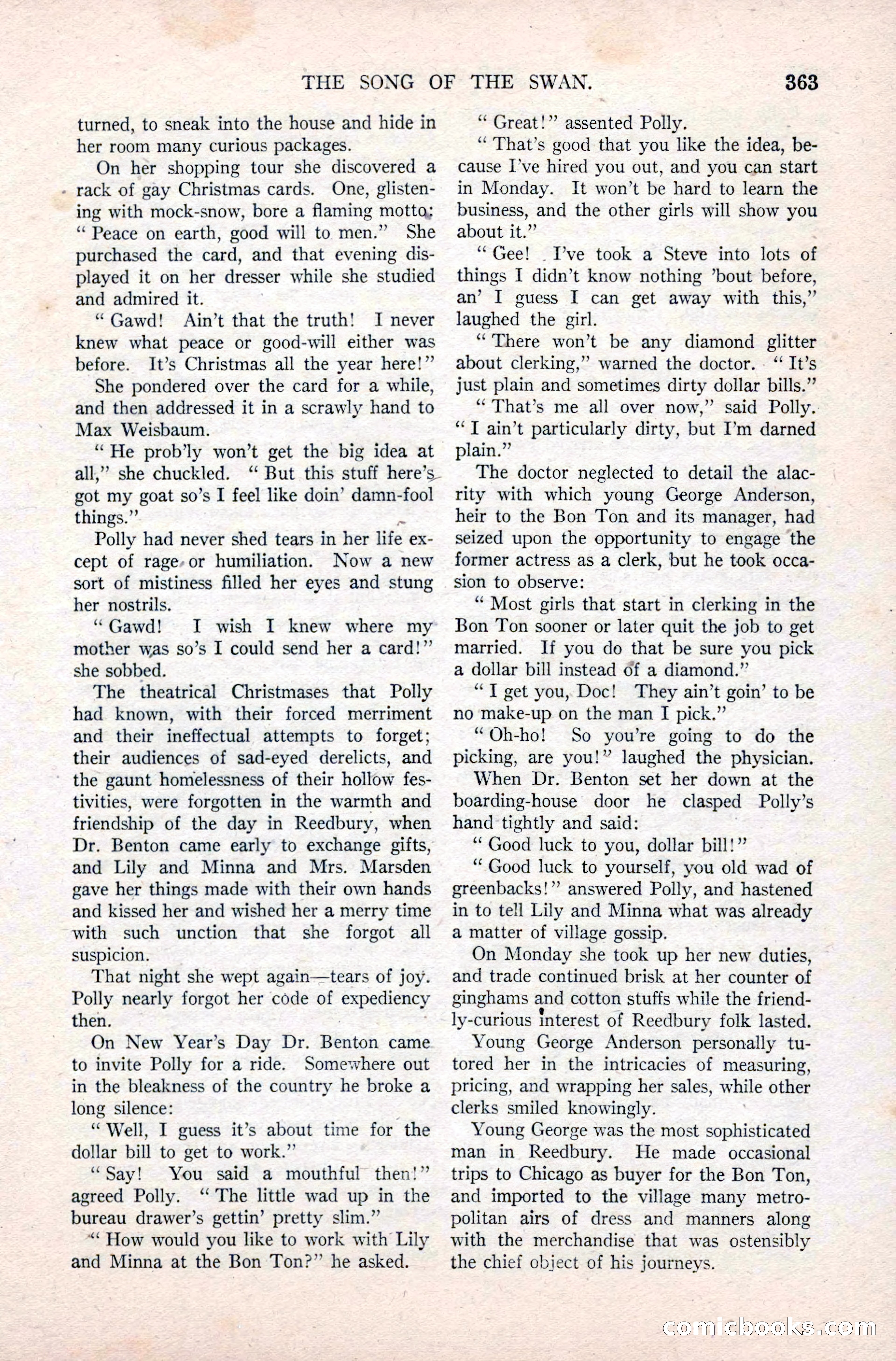
A restored page from Pulp Fiction, 1920. Page through the whole issue in the reader above.
📄 Transcribed text from this page (OCR, searchable)
Machine-transcribed from the original scan — historical spelling and the odd misread are preserved.
THE SONG OF THE SWAN. turned, to sneak into the house and hide in her room many curious packages. On her shopping tour she discovered a - rack of gay Christmas cards. One, glisten- ing with mock-snow, bore a flaming motto; “Peace on earth, good will to men.” She purchased the card, and that evening dis- played it on her dresser while she studied and admired it. “Gawd! Ain’t that the truth! I never knew what peace or good-will either was before. It’s Christmas all the year here!” She pondered over the card for a while, and then addressed it in a scrawly hand to Max Weisbaum. ‘““He prob’ly won’t get the big idea at all,”” she chuckled. got my goat so’s I feel like doin’ damn-fool things.”’ = Polly had never shed tears in her life ex- cept of rage-or humiliation. Now a new sort of mistiness filled her eyes and stung her nostrils. ‘“ Gawd! mother was so’s I could send her a card she sobbed. The theatrical Christmases that Polly had known, with their forced merriment and their ineffectual attempts to forget; their audiences of sad-eyed derelicts, and the gaunt homelessness of their hollow fes- tivities, were forgotten in the warmth and friendship of the day in Reedbury, when Dr. Benton came early to exchange gifts, and Lily and Minna and Mrs. Marsden gave her things made with their own hands and kissed her and wished her a merry time with such unction that she forgot all suspicion. That night she wept again—tears of joy. Polly nearly forgot her code of expediency then. . On New Year’s Day Dr. Benton came to invite Polly for a ride. Somewhere out in the bleakness of the country he broke a long silence: | “Well, I guess it’s about time for the dollar bill to get to work.” “Say! You said a mouthful then!” agreed Polly. ‘‘ The little wad up in the bureau drawer’s gettin’ pretty slim.” ““ How would you like to work with Lily and Minna at the Bon Ton?” he asked. I wish I knew where my !?? “ But this stuff here’s- 363 “Great!” assented Polly. “That’s good that you like the idea, be- cause I’ve hired you out, and you can start in Monday. It won’t be hard to learn the business, and the other girls will show you about it.” “Gee! _ I’ve took a Steve into lots of things I didn’t know nothing ’bout before, an’ I guess I can get away with this,” laughed the girl. “There won’t be any diamond glitter about clerking,” warned the doctor. . “ It’s just plain and sometimes dirty dollar bills.” ““That’s me all over now,” said Polly. “TI ain’t particularly dirty, but I’m darned plain.”’ The doctor neglected to detail the alac- rity with which young George Anderson, heir to the Bon Ton and its manager, had seized upon the opportunity to engage the former actress as a clerk, but he took occa- sion to observe: “ Most girls that start in clerking in the Bon Ton sooner or later quit the job to get married. If you do that be sure you pick a dollar bill instead of a diamond.” “YT get you, Doc! They ain’t goin’ to be no make-up on the man I pick.” “Oh-ho! So you’re going to do the picking, are you!” laughed the physician. When Dr. Benton set her down at the boarding-house door he clasped Polly’s hand tightly and said: ““ Good luck to you, dollar bill!” “Good luck to yourself, you old wad of greenbacks!”’ answered Polly, and hastened in to tell Lily and Minna what was already a matter of village gossip. On Monday she took up her new duties, and trade continued brisk at her counter of ginghams and cotton stuffs while the friend- ly-curious Interest of Reedbury folk lasted. Young George Anderson personally tu- tored her in the intricacies of measuring, pricing, and wrapping her sales, while other clerks smiled knowingly. ? Young George was the most sophisticated man in Reedbury. He made occasional trips to Chicago as buyer for the Bon Ton, and imported to the village many metro- politan airs of dress and manners along with the merchandise that was ostensibly the chief object of his journeys. Gomuicbook (C@