
Pulp Fiction, 1920 · page 55 of 188
Argosy, Vol. 117, No. 3 — page 55: what you’re looking at
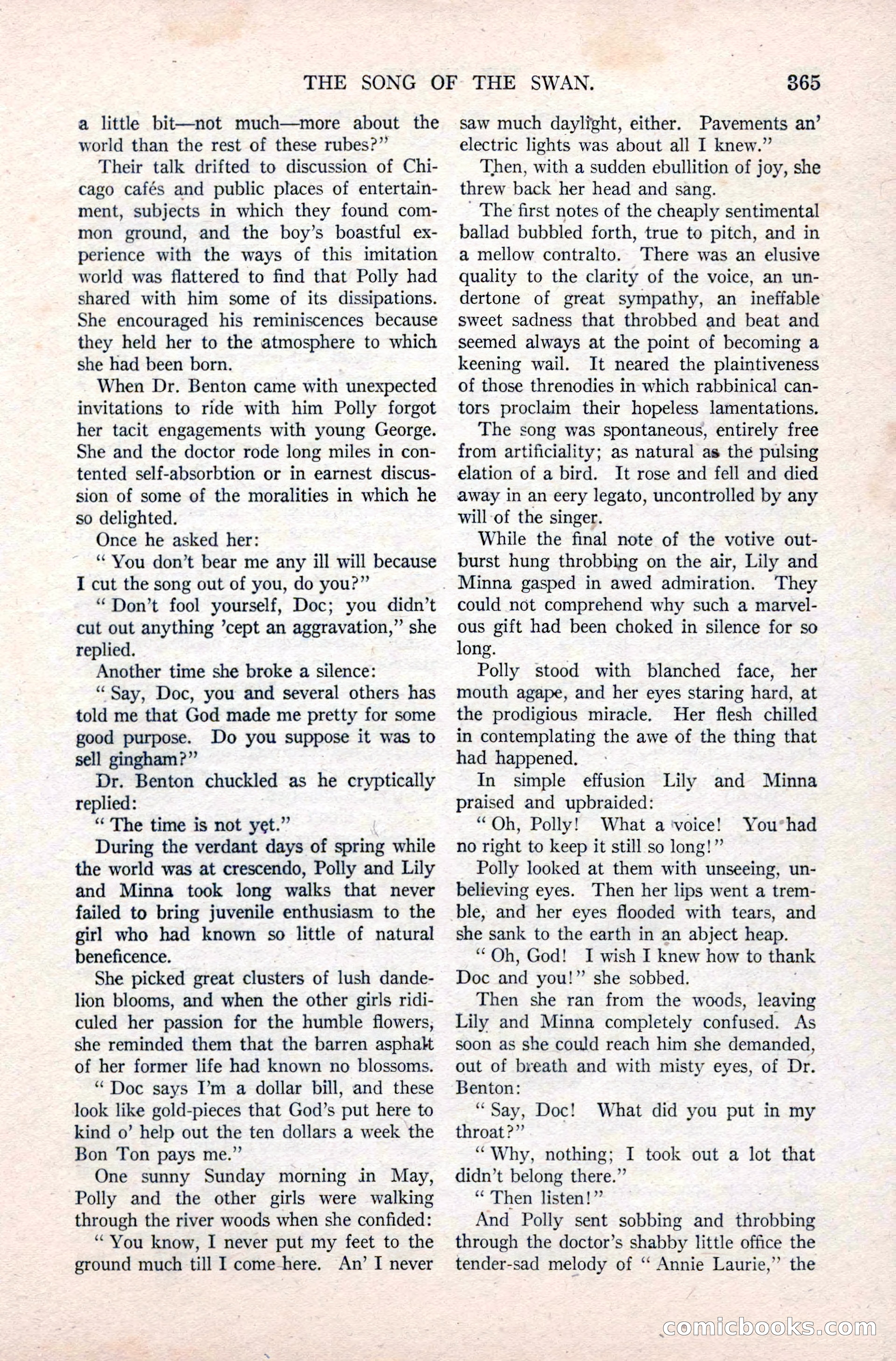
A restored page from Pulp Fiction, 1920. Page through the whole issue in the reader above.
📄 Transcribed text from this page (OCR, searchable)
Machine-transcribed from the original scan — historical spelling and the odd misread are preserved.
THE SONG OF THE SWAN. a little bit—not much—more about the world than the rest of these rubes?”’ Their talk drifted to discussion of Chi- cago cafés and public places of entertain- ment, subjects in which they found com- mon ground, and the boy’s boastful ex- perience with the ways of this imitation world was flattered to find that Polly had shared with him some of its dissipations. She encouraged his reminiscences because they held her to the atmosphere to which she had been born. When Dr. Benton came with unexpected invitations to ride with him Polly forgot her tacit engagements with young George. She and the doctor rode long miles in con- tented self-absorbtion or in earnest discus- sion of some of the moralities in which he so delighted. Once he asked her: “You don’t bear me any ill will because I cut the song out of you, do you?”’ “Don’t fool yourself, Doc; you didn’t cut out anything ’cept an aggravation,” she replied. Another time she broke a silence: “Say, Doc, you and several others has told me that God made me pretty for some good purpose. Do you suppose it was to sell gingham?” Dr. Benton chuckled as he cryptically replied: “The time is not yet.” During the verdant days of spring while the world was at crescendo, Polly and Lily and Minna took long walks that never failed to bring juvenile enthusiasm to the girl who had known so little of natural beneficence. She picked great clusters of lush dande- lion blooms, and when the other girls ridi- culed her passion for the humble flowers; she reminded them that the barren asphalt of her former life had known no blossoms. “ Doc says I’m a dollar bill, and these look like gold-pieces that God’s put here to kind o’ help out the ten dollars a week the Bon Ton pays me.” One sunny Sunday morning in May, Polly and the other girls were walking through the river woods when she confided: “You know, I never put my feet to the ground much till I come here. An’ I never 065 saw much daylight, either. Pavements an’ electric lights was about all I knew.” Then, with a sudden ebullition of joy, she threw back her head and sang. - The first notes of the cheaply sentimental ballad bubbled forth, true to pitch, and in a mellow contralto. There was an elusive quality to the clarity of the voice, an un- dertone of great sympathy, an ineffable sweet sadness that throbbed and beat and seemed always at the point of becoming a keening wail. It neared the plaintiveness of those threnodies in which rabbinical can- tors proclaim their hopeless lamentations. The song was spontaneous, entirely free from artificiality; as natural as the pulsing elation of a bird. It rose and fell and died away in an eery legato, uncontrolled by any will of the singer. While the final note of the votive out- burst hung throbbing on the air, Lily and Minna gasped in awed admiration. They could not comprehend why such a marvel- ous gift had been choked in silence for so long. Polly stood with blanched face, her mouth agape, and her eyes staring hard, at the prodigious miracle. Her flesh chilled in contemplating the awe of the thing that had happened. In simple effusion Lily and Minna praised and upbraided: “Oh, Polly! What a ‘voice! no right to keep it still so long!” Polly looked at them with unseeing, un- believing eyes. Then her lips went a trem- ble, and her eyes flooded with tears, and she sank to the earth in an abject heap. ‘““Oh, God! I wish I knew how to thank Doc and you!” she sobbed. Then she ran from the woods, leaving Lily and Minna completely confused. As soon as she could reach him she demanded, out of breath and with misty eyes, of Dr. Benton: Say, Doc! throat?” “Why, nothing; I took out a lot that didn’t belong there.” “Then listen!” And Polly sent sobbing and throbbing through the doctor’s shabby little office the tender-sad melody of “ Annie Laurie,” the “ou* had What did you put in my COmicoooks (C@