
Pulp Fiction, 1920 · page 50 of 188
Argosy, Vol. 117, No. 3 — page 50: what you’re looking at
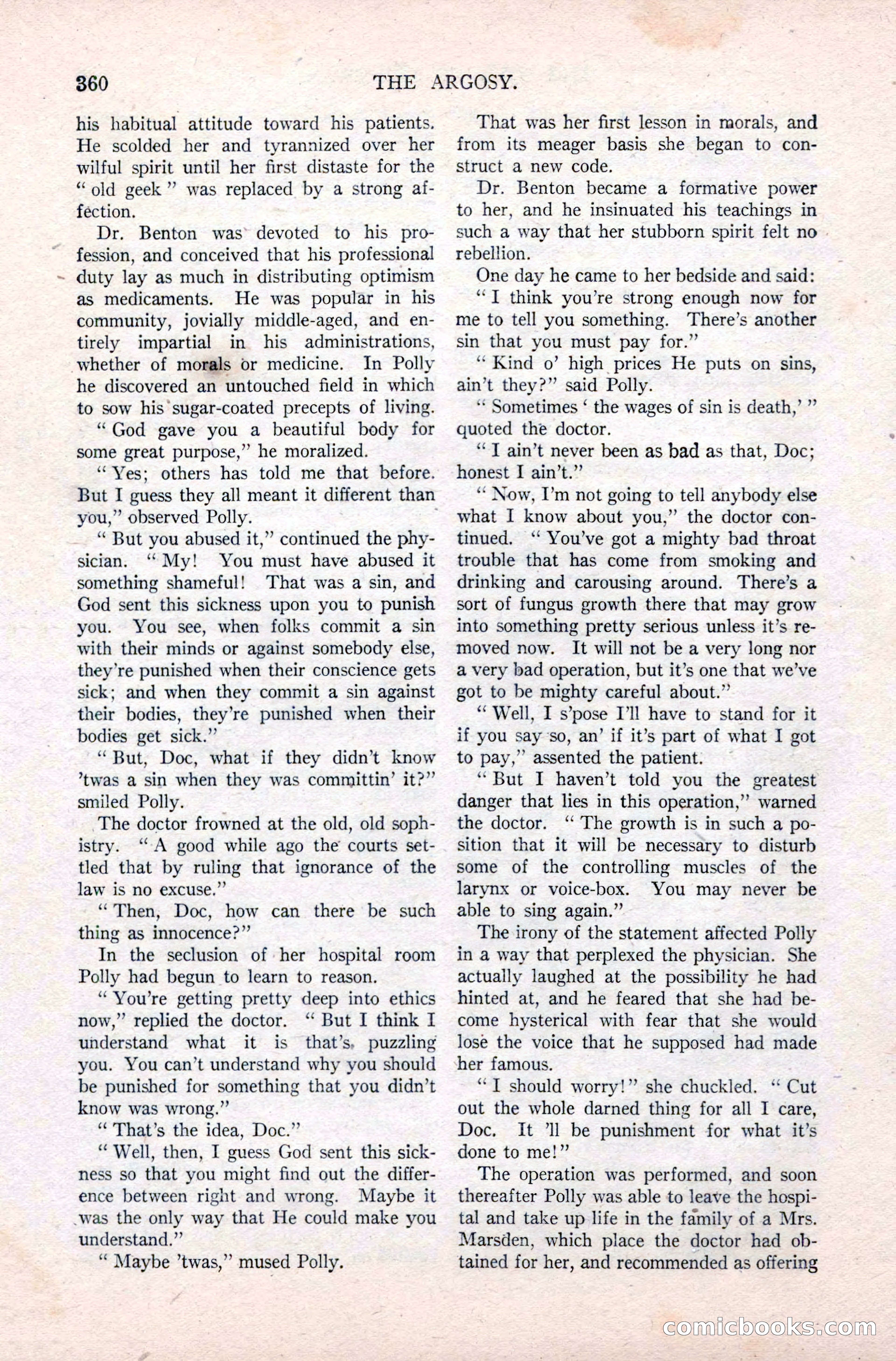
A restored page from Pulp Fiction, 1920. Page through the whole issue in the reader above.
📄 Transcribed text from this page (OCR, searchable)
Machine-transcribed from the original scan — historical spelling and the odd misread are preserved.
360 his habitual attitude toward his patients. He scolded her and tyrannized over her wilful spirit until her first distaste for the “old geek ” was replaced by a strong af- fection. Dr. Benton was devoted to his pro- fession, and conceived that his professional duty lay as much in distributing optimism as medicaments. He was popular in his community, jovially middle-aged, and en- tirely impartial in his administrations, whether of morals or medicine. In Polly he discovered an untouched field in which to sow his sugar-coated precepts of living. “God gave you a beautiful body for some great purpose,” he moralized. “Yes; others has told me that before. But I guess they all meant it different than you,” observed Polly. ‘“ But you abused it,” continued the phy- sician. ‘My! You must have abused it something shameful! That was a sin, and God sent this sickness upon you to punish you. You see, when folks commit a sin with their minds or against somebody else, they’re punished when their conscience gets sick; and when they commit a sin against their bodies, they’re punished when their bodies get sick.” “But, Doc, what if they didn’t know ’twas a sin when they was committin’ it?” smiled Polly. | The doctor frowned at the old, old soph- istry. ‘A good while ago the courts set- tled that by ruling that ignorance of the law is no excuse,”’ “Then, Doc, how can there be such thing as innocence?” In the seclusion of her hospital room Polly had begun to learn to reason. “You're getting pretty deep into ethics now,” replied the doctor. ‘ But I think I understand what it is that’s, puzzling you. You can’t understand why you should be punished for something that you didn’t know was wrong.” “That’s the idea, Doc.” “Well, then, I guess God sent this sick- ness so that you might find out the differ- ence between right and wrong. Maybe it -was the only way that He could make you understand.” ‘* Maybe ’twas,” mused Polly. THE ARGOSY. That was her first lesson in morals, and from its meager basis she began to con- struct a new code. Dr. Benton became a formative power to her, and he insinuated his teachings in such a way that her stubborn spirit felt no» rebellion. One day he came to her bedside and said: ‘I think you’re strong enough now for me to tell you something. There’s another sin that you must pay for.” “Kind o’ high prices He puts on sins, ain’t they?” said Polly. ‘** Sometimes ‘ the wages of sin is death,’ ” quoted the doctor. “T ain’t never been as bad as that, Doc; honest I ain’t.” ‘* Now, I’m not going to tell anybody else what I know about you,” the doctor con- tinued. ‘‘ You’ve got a mighty bad throat trouble that has come from smoking and drinking and carousing around. There’s a sort of fungus growth there that may grow into something pretty serious unless it’s re- moved now. It will not be a very long nor a very bad operation, but it’s one that we’ve got to be mighty careful about.” *“* Well, I s’pose I'll have to stand for it if you say so, an’ if it’s part of what I got to pay,’’ assented the patient. “But I haven’t told you the greatest danger that lies in this operation,’’ warned the doctor. “ The growth is in such a po- sition that it will be necessary to disturb some of the controlling muscles of the larynx or voice-box. You may never be able to sing again.” The irony of the statement affected Polly in a way that perplexed the physician. She actually laughed at the possibility he had hinted at, and he feared that she had be- come hysterical with fear that she would lose the voice that he supposed had made her famous. “IT should worry!” she chuckled. “ Cut out the whole darned thing for all I care, Doc, It ll be punishment for what it’s done to me!” The operation was performed, and soon thereafter Polly was able to leave the hospi- tal and take up life in the family of a Mrs. Marsden, which place the doctor had ob- tained for her, and recommended as offering (eo) 0)(0)(6) AUG Si (C@