
Pulp Fiction, 1920 · page 32 of 188
Argosy, Vol. 117, No. 3 — page 32: what you’re looking at
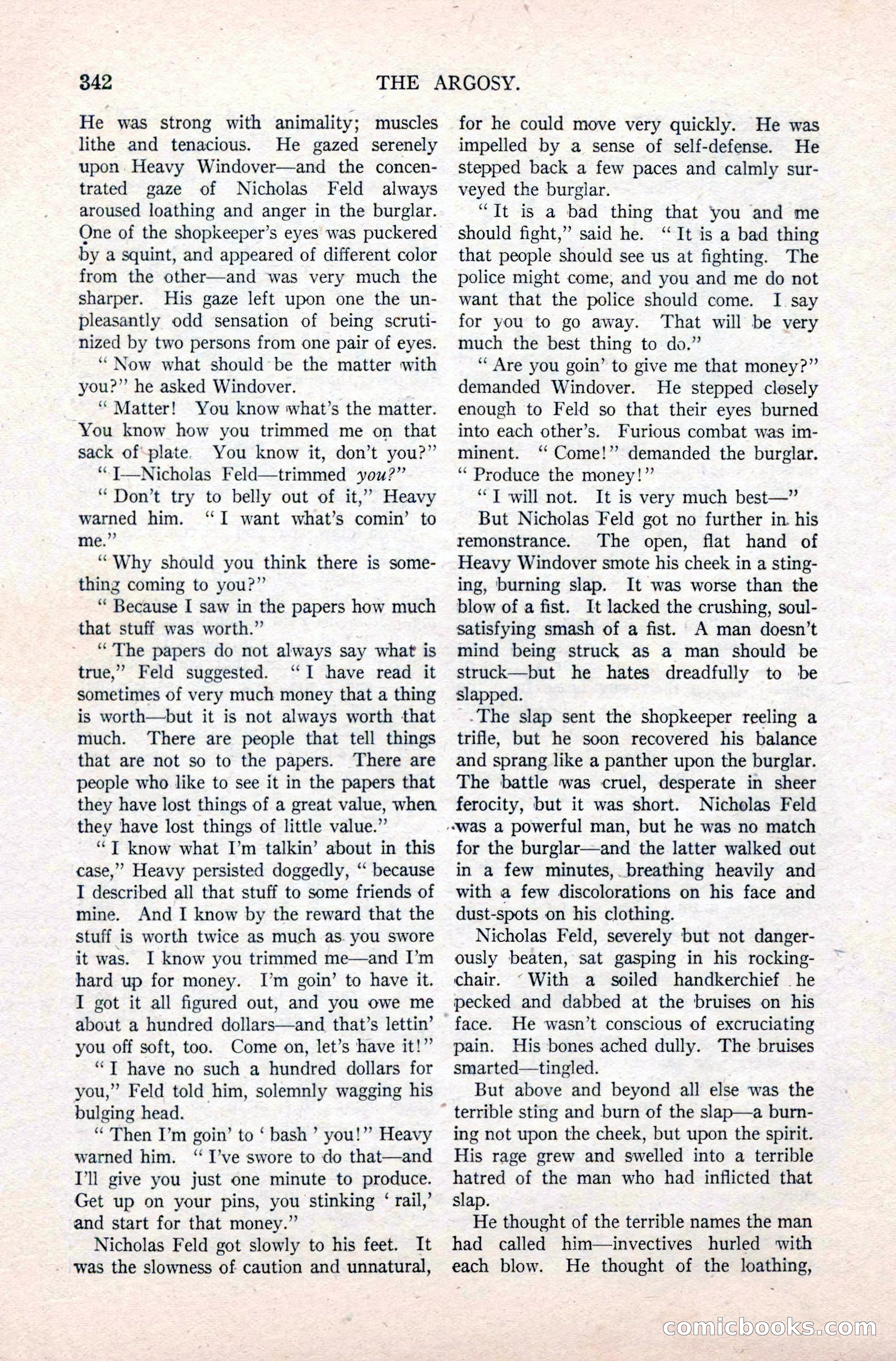
A restored page from Pulp Fiction, 1920. Page through the whole issue in the reader above.
📄 Transcribed text from this page (OCR, searchable)
Machine-transcribed from the original scan — historical spelling and the odd misread are preserved.
342 He was strong with animality; muscles lithe and tenacious. He gazed serenely upon. Heavy Windover—and the concen- trated gaze of Nicholas Feld always aroused loathing and anger in the burglar. One of the shopkeeper’s eyes was puckered by a squint, and appeared of different color from the other—and was very much the sharper. His gaze left upon one the un- pleasantly odd sensation of being scruti- nized by two persons from one pair of eyes. ‘“Now what should be the matter with you?” he asked Windover. “Matter! You know what’s the matter. You know how you trimmed me on that sack of-plate. You know it, don’t you?” ‘“T—Nicholas Feld—trimmed you?” “Don’t try to belly out of it,” Heavy warned him. “I want what’s comin’ to me.” “Why should you think there is some- thing coming to you?” “Because I saw in the papers how much that stuff was worth.” “The papers do not always say what is true,’ Feld suggested. “I have read it sometimes of very much money that a thing is worth—but it is not always worth that much. ‘There are people that tell things that are not so to the papers. There are people who like to see it in the papers that they have lost things of a great value, when they have lost things of little value.” ‘“T know what I’m talkin’ about in this case,”’ Heavy persisted doggedly, “‘ because I described all that stuff to some friends of mine. And I know by the reward that the stuff is worth twice as much as. you swore it was. I know you trimmed me—and I’m hard up for money. I’m goin’ to have it. I got it all figured out, and you owe me about a hundred dollars—and that’s lettin’ you off soft, too. Come on, let’s have it!”’ “T have no such a hundred dollars for you,” Feld told him, solemnly wagging his bulging head. “Then I’m goin’ to ‘ bash’ you!”” Heavy warned him. “I’ve swore to do that—and I'll give you just one minute to produce. Get up on your pins, you stinking ‘ rail,’ and start for that money.” Nicholas Feld got slowly to his feet. It was the slowness of caution and unnatural, - face. THE ARGOSY. for he could move very quickly. He was impelled by a sense of self-defense. He stepped back a few paces and calmly sur- veyed the burglar. “It is a bad thing that ‘you and me should fight,” said he. “It is a bad thing that people should see us at fighting. The police might come, and you and me do not want that the police should come. I say for you to go away. ‘That will be very much the best thing to do.” ‘“ Are you goin’ to give me that money?” demanded Windover. He stepped closely enough to Feld so that their eyes burned into each other’s. Furious combat was im- minent. ‘‘ Come!” demanded the burglar. ‘Produce the money!”’ “T will not. It is very much best—” But Nicholas Feld got no further in his remonstrance. The open, flat hand of Heavy Windover smote his cheek in a sting- ing, burning slap. It was worse than the blow of a fist. It lacked the crushing, soul- satisfying smash of a fist. A man doesn’t mind being struck as a man should be struck—but he hates dreadfully to be slapped. -The slap sent the shopkeeper reeling a trifle, but he soon recovered his balance and sprang like a panther upon the burglar. The battle was cruel, desperate in sheer ferocity, but it was short. Nicholas Feld ‘was a powerful man, but he was no match for the burglar—and the latter walked out in a few minutes, breathing heavily and with a few discolorations on his face and dust-spots on his clothing. Nicholas Feld, severely but not danger- ously beaten, sat gasping in his rocking- chair. “With a soiled handkerchief _he pecked and dabbed at the bruises on his He wasn’t conscious of excruciating pain. His bones ached dully. The bruises smarted—tingled. But above and beyond all else was the terrible sting and burn of the slap—a burn- ing not upon the cheek, but upon the spirit. His rage grew and swelled into a terrible hatred of the man who had inflicted that slap. He thought of the terrible names the man had called him—<invectives hurled with each blow. He thought of the loathing, COLMUC S .OO (C@)