
Pulp Fiction, 1920 · page 33 of 188
Argosy, Vol. 117, No. 3 — page 33: what you’re looking at
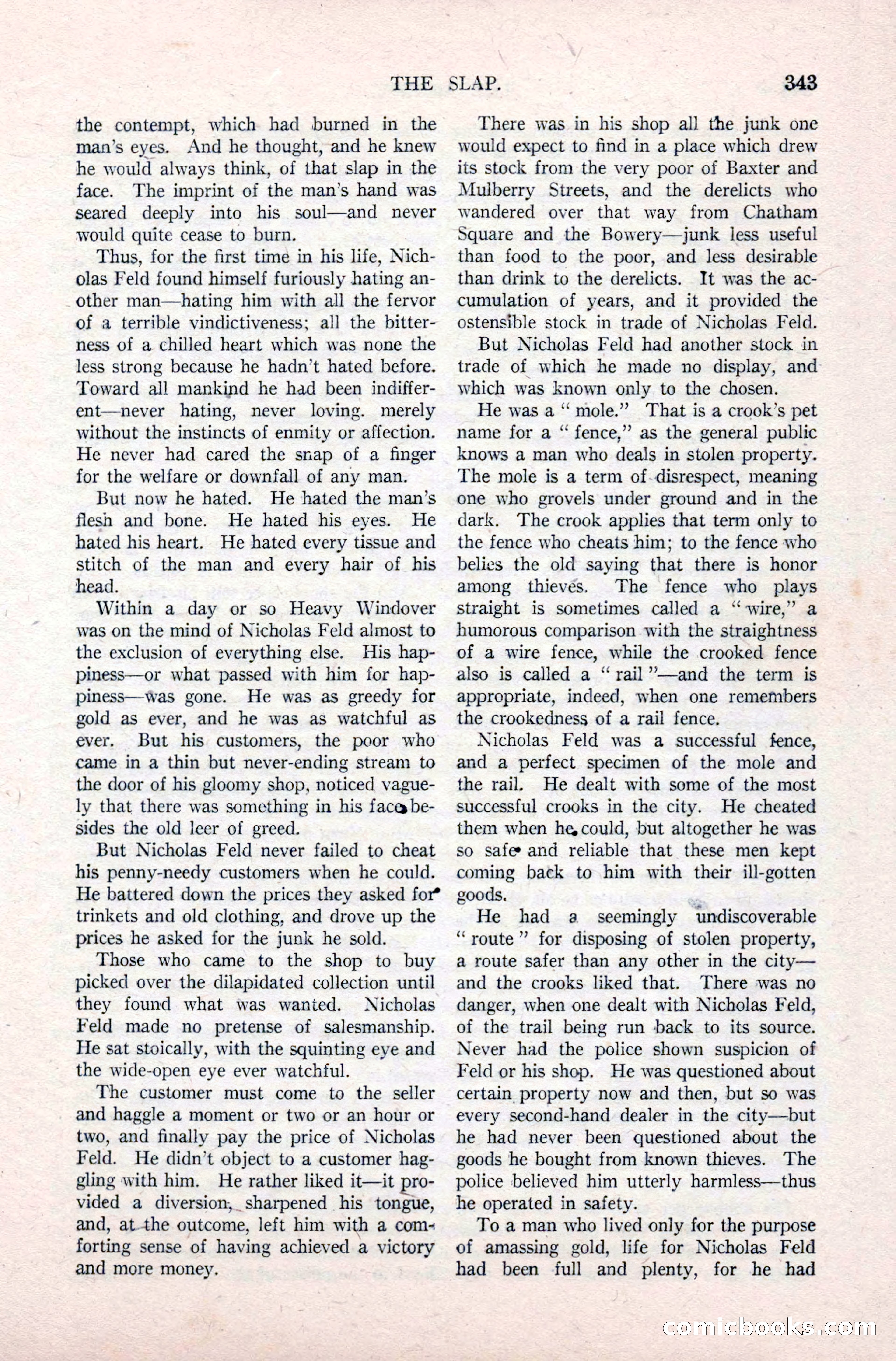
A restored page from Pulp Fiction, 1920. Page through the whole issue in the reader above.
📄 Transcribed text from this page (OCR, searchable)
Machine-transcribed from the original scan — historical spelling and the odd misread are preserved.
THE the contempt, which had burned in the man’s eyes. And he thought, and he knew he would always think, of that slap in the face. The imprint of the man’s hand was seared deeply into his soul—and never would quite cease to burn. Thus, for the first time in his life, Nich- olas Feld found himself furiously hating an- other man—hating him with all the fervor of a terrible vindictiveness; all the bitter- ness of a chilled heart which was none the less strong because he hadn’t hated before. Toward all mankind he had been indiffer- ent—never hating, never loving. merely without the instincts of enmity or affection. He never had cared the snap of a finger for the welfare or downfall of any man. But now he hated. He hated the man’s flesh and bone. He hated his eyes. He hated his heart. He hated every tissue and stitch of the man and every hair of his head. Within a day or so Heavy Windover was on the mind of Nicholas Feld almost to the exclusion of everything else. His hap- piness—or what passed with him for hap- piness—was gone. He was as greedy for gold as ever, and he was as watchful as ever. But his customers, the poor who came in a thin but never-ending stream to the door of his gloomy shop, noticed vague- ly that there was something in his face be- sides the old leer of greed. But Nicholas Feld never failed to cheat his penny-needy customers when he could. He battered down the prices they asked for* trinkets and old clothing, and drove up the prices he asked for the junk he sold. Those who came to the shop to buy picked over the dilapidated collection until they found what was wanted. Nicholas Feld made no pretense of salesmanship. He sat stoically, with the squinting eye and the wide-open eye ever watchful. The customer must come to the seller and haggle a moment or two or an hour or two, and finally pay the price of Nicholas Feld. He didn’t object to a customer hag- gling with him. He rather liked it—it pro- vided a diversion, sharpened his tongue, and, at-the outcome, left him with a com- forting sense of having achieved a victory and more money. SLAP. 343 There was in his shop all the junk one would expect to find in a place which drew its stock from the very poor of Baxter and Mulberry Streets, and the derelicts who wandered over that way from Chatham Square and the Bowery—junk less useful than food to the poor, and less desirable than drink to the derelicts. It was the ac- cumulation of years, and it provided the ostensible stock in trade of Nicholas Feld. But Nicholas Feld had another stock in trade of which he made no display, and which was known only to the chosen. He was a “ mole.” ‘That is a crook’s pet name for a “ fence,” as the general public knows a man who deals in stolen property. The mole is a term of-disrespect, meaning one who grovels under ground and in the dark. The crook applies that term only to the fence who cheats him; to the fence who belies the old saying that there is honor among thieves. The fence who plays straight is sometimes called a “wire,” a humorous comparison with the straightness of a wire fence, while the crooked fence also is called a “ rail”—and the term is appropriate, indeed, when one remembers the crookedness of a rail fence. Nicholas Feld was a successful fence, and a perfect specimen of the mole and the rail. He dealt with some of the most successful crooks in the city. He cheated them when he, could, but altogether he was so safe and reliable that these men kept coming back to him with their ill-gotten goods. - He had a seemingly undiscoverable “route” for disposing of stolen property, a route safer than any other in the city— and the crooks liked that. There was no danger, when one dealt with Nicholas Feld, of the trail being run back to its source. Never had the police shown suspicion of Feld or his shop. He was questioned about certain property now and then, but so was every second-hand dealer in the city—but he had never been questioned about the goods he bought from known thieves. The police believed him utterly harmless—thus he operated in safety. To a man who lived only for the purpose of amassing gold, life for Nicholas Feld had been full and plenty, for he had ECOPMICLOO© C “eS (CO)