
Pulp Fiction, 1920 · page 31 of 188
Argosy, Vol. 117, No. 3 — page 31: what you’re looking at
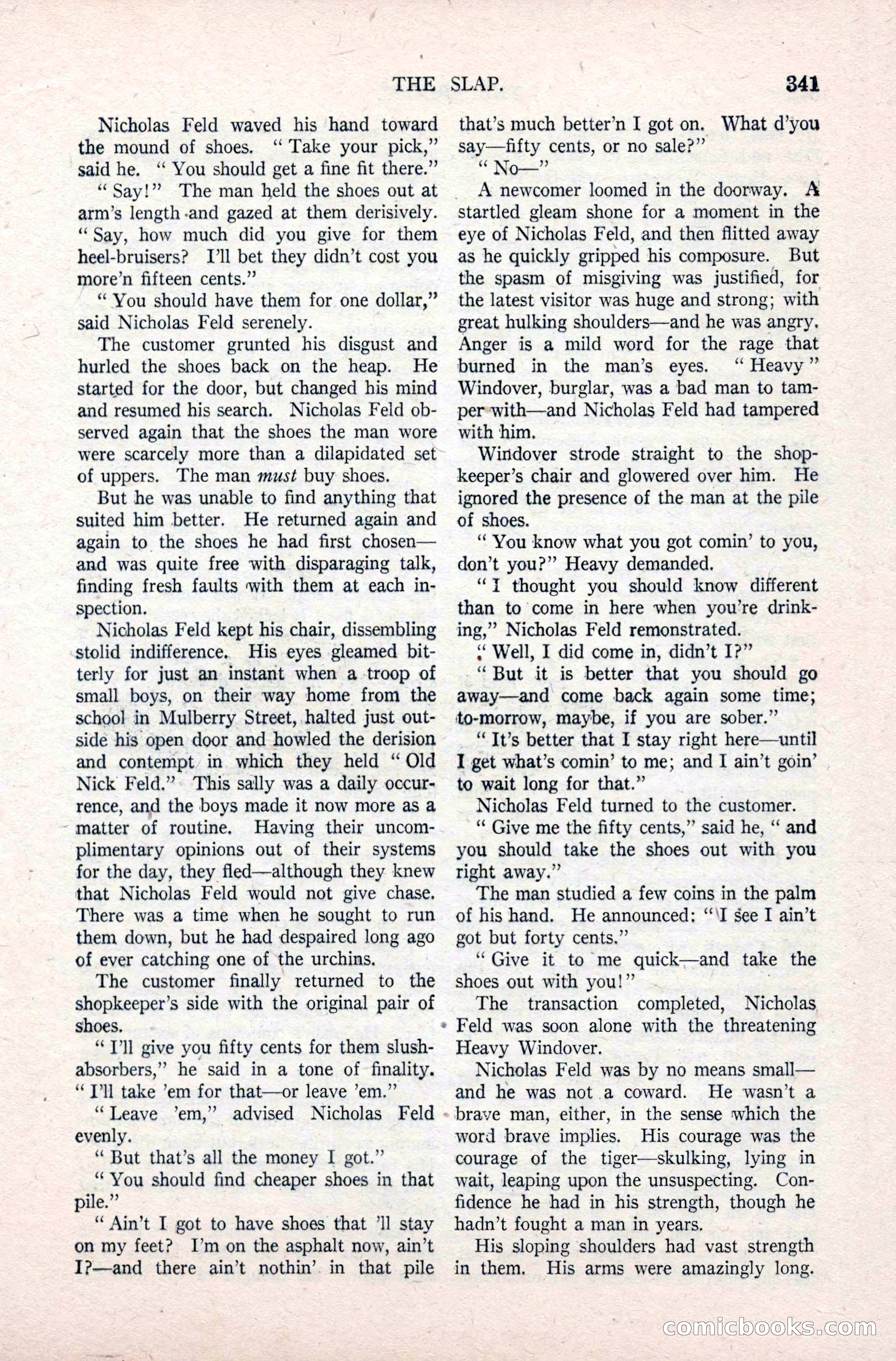
A restored page from Pulp Fiction, 1920. Page through the whole issue in the reader above.
📄 Transcribed text from this page (OCR, searchable)
Machine-transcribed from the original scan — historical spelling and the odd misread are preserved.
THE SLAP. Nicholas Feld waved his hand toward the mound of shoes. ‘ Take your pick,” said he. ‘‘ You should get a fine fit there.” “Say!” The man held the shoes out at arm’s length-and gazed at them derisively. ‘Say, how much did you give for them heel-bruisers? Ill bet they didn’t cost you more’n fifteen cents.” “You should have them for one dollar,” said Nicholas Feld serenely. The customer grunted his disgust and hurled the shoes back on the heap. He started for the door, but changed his mind and resumed his search. Nicholas Feld ob- served again that the shoes the man wore were scarcely more than a dilapidated set of uppers. The man must buy shoes. But he was unable to find anything that suited him better. He returned again and again to the shoes he had first chosen— and was quite free with disparaging talk, finding fresh faults with them at each in- spection. Nicholas Feld kept his chair, dissembling stolid indifference. His eyes gleamed bit- terly for just an instant when a-troop of small boys, on their way home from the school in Mulberry Street, halted just out- side his open door and howled the derision and contempt in which they held “Old Nick Feld.” This sally was a daily occur- rence, and the boys made it now more as a matter of routine. Having their uncom- plimentary opinions out of their systems for the day, they fled—although they knew that Nicholas Feld would not give chase. There was a time when he sought to run them down, but he had despaired long ago of ever catching one of the urchins. The customer finally returned to the shopkeeper’s side with the original pair of shoes. “T’ll give you fifty cents for them slush- absorbers,” he said in a tone of finality. “Tl take ’em for that—or leave ’em.”’ “Leave ’em,”’ advised Nicholas Feld evenly. “But that’s all the money I got.” “You should find cheaper shoes in that pile.” ‘“ Ain’t I got to have shoes that ’ll stay on my feet? I’m on the asphalt now, ain’t I?—and there ain’t nothin’ in that pile 341 that’s much better’n I got on. What d’you say—fifty cents, or no sale?” t¢ No-=’" A newcomer loomed in the doorway. A startled gleam shone for a moment in the eye of Nicholas Feld, and then flitted away as he quickly gripped his composure. But the spasm of misgiving was justified, for the latest visitor was huge and strong; with great hulking shoulders—and he was angry. Anger is a mild word for the rage that burned in the man’s eyes. ‘“ Heavy” Windover, burglar, was a bad man to tam- per with—and Nicholas Feld had tampered with him, Windover strode straight to the shop- keeper’s chair and glowered over him. He ignored the presence of the man at the pile of shoes. ‘You know what you got comin’ to you, don’t you?” Heavy demanded. “T thought you should know different than to come in here when you're drink- ing,” Nicholas Feld remonstrated. ‘‘ Well, I did come in, didn’t I?” “But it is better that you should go away—and come back again some time; to-morrow, maybe, if you are sober.” “It’s better that I stay right here—until I get what’s comin’ to me; and I ain’t goin’ to wait long for that.” Nicholas Feld turned to the customer. ‘“‘ Give me the fifty cents,” said he, “ and you should take the shoes out with you right away.” The man studied a few coins in the palm of his hand. He announced: “‘‘I see I ain’t got but forty cents.” “Give it to me quick—and take the shoes out with you!” | The transaction completed, Nicholas * Feld was soon alone with the threatening Heavy Windover. Nicholas Feld was by no means small— and he was not.a coward. He wasn’t a - brave man, either, in the sense which the word brave implies. His courage was the courage of the tiger—skulking, lying in wait, leaping upon the unsuspecting. Con- fidence he had in his strength, though he hadn’t fought a man in years. His sloping shoulders had vast strength in them. His arms were amazingly long. CORMICLOOOkKS (C@