
Pulp Fiction, 1920 · page 30 of 188
Argosy, Vol. 117, No. 3 — page 30: what you’re looking at
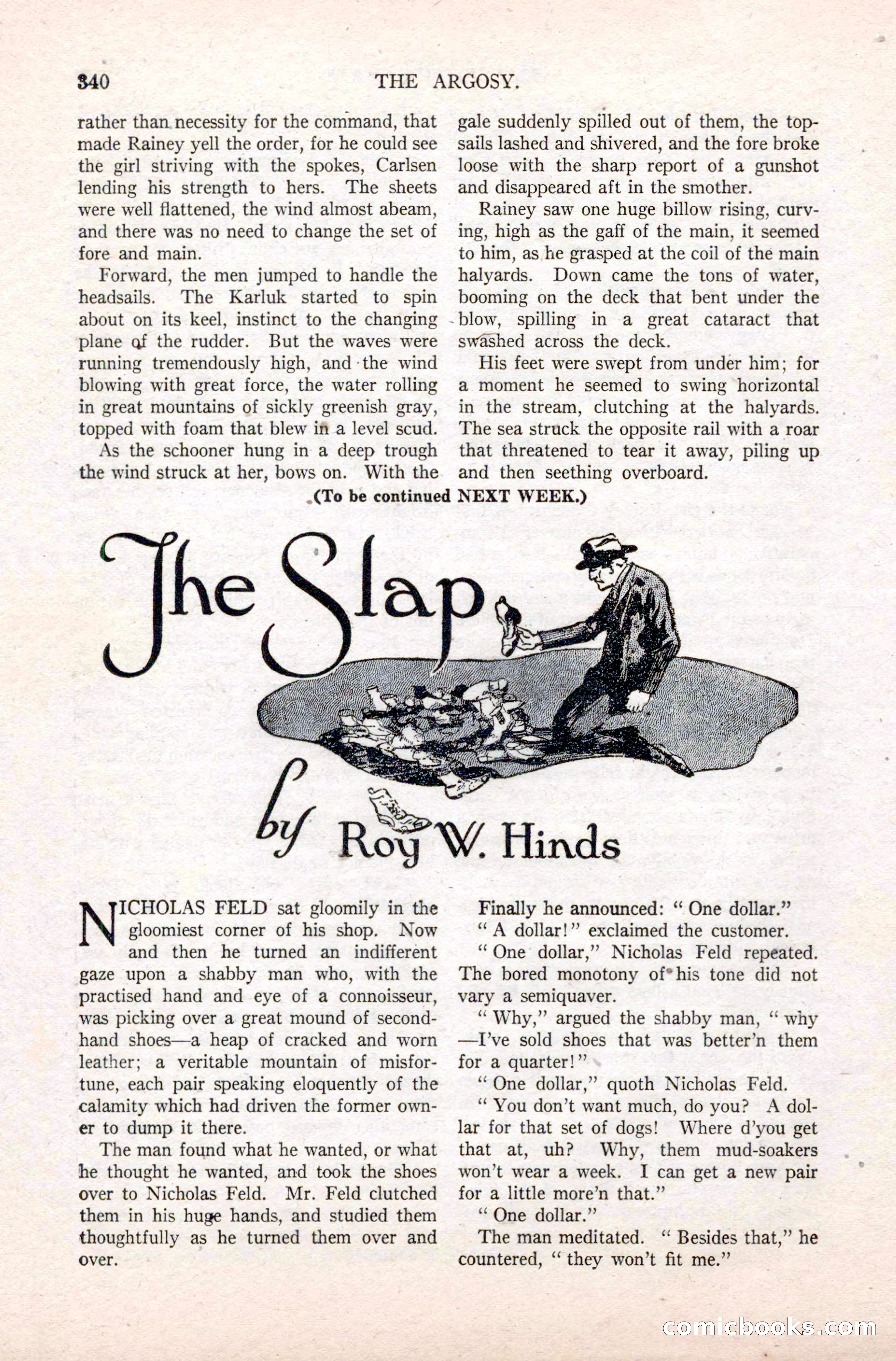
A restored page from Pulp Fiction, 1920. Page through the whole issue in the reader above.
📄 Transcribed text from this page (OCR, searchable)
Machine-transcribed from the original scan — historical spelling and the odd misread are preserved.
340 rather than. necessity for the command, that made Rainey yell the order, for he could see the girl striving with the spokes, Carlsen lending his strength to hers. The sheets were well flattened, the wind almost abeam, and there was no need to change the set of fore and main. Forward, the men jumped to handle the headsails. The Karluk started to spin about on its keel, instinct to the changing plane qf the rudder. But the waves were running tremendously high, andthe wind blowing with great force, the water rolling in great mountains of sickly greenish gray, topped with foam that blew in a level scud. As the schooner hung in a deep trough the wind struck at her, bows on. With the THE ARGOSY. gale suddenly spilled out of them, the top- sails lashed and shivered, and the fore broke loose with the sharp report of a gunshot and disappeared aft in the smother. Rainey saw one huge billow rising, curv- ing, high as the gaff of the main, it seemed to him, as he grasped at the coil of the main halyards. Down came the tons of water, booming on the deck that bent under the -blow, spilling in a great cataract that swashed across the deck. His feet were swept from under him; for a moment he seemed to swing horizontal in the stream, clutching at the halyards. The sea struck the opposite rail with a roar that threatened to tear it away, piling up and then seething overboard. .(To be continued NEXT WEEK.) . i . a _ A T 3 +g » 7 ns Re ~F eae NS ee ee ae ty Y Roe W. Hinds ICHOLAS FELD sat gloomily in the gloomiest corner of his shop. Now and then he turned an_ indifferent gaze upon a shabby man who, with the practised hand and eye of a connoisseur, was picking over a great mound of second- hand shoes—a heap of cracked and worn leather; a veritable mountain of misfor- tune, each pair speaking eloquently of the calamity which had driven the former own- er to dump it there. The man found what he wanted, or what he thought he wanted, and took the shoes over to Nicholas Feld. Mr. Feld clutched them in his huge hands, and studied them thoughtfully as he turned them over and over. HY ee se > Nae ay) ? Finally he announced: “ One dollar.” “A dollar!” exclaimed the customer. ‘‘One dollar,” Nicholas Feld repeated. The bored monotony of*his tone did not vary a semiquaver. “Why,” argued the shabby man, ‘‘ why —lI’ve sold shoes that was better’n them for a quarter!” ‘“One dollar,” quoth Nicholas Feld. “You don’t want much, do you? A dol- lar for that set of dogs! Where d’you get that at, uh? Why, them mud-soakers won’t wear a week. I can get a new pair for a little more’n that.” “One dollar.” The man meditated. ‘ Besides that,” he countered, ‘‘ they won’t fit me.” COL oOOLK (C@