
Pulp Fiction, 1919 · page 72 of 188
Argosy, Vol. 111, No. 1 — page 72: what you’re looking at
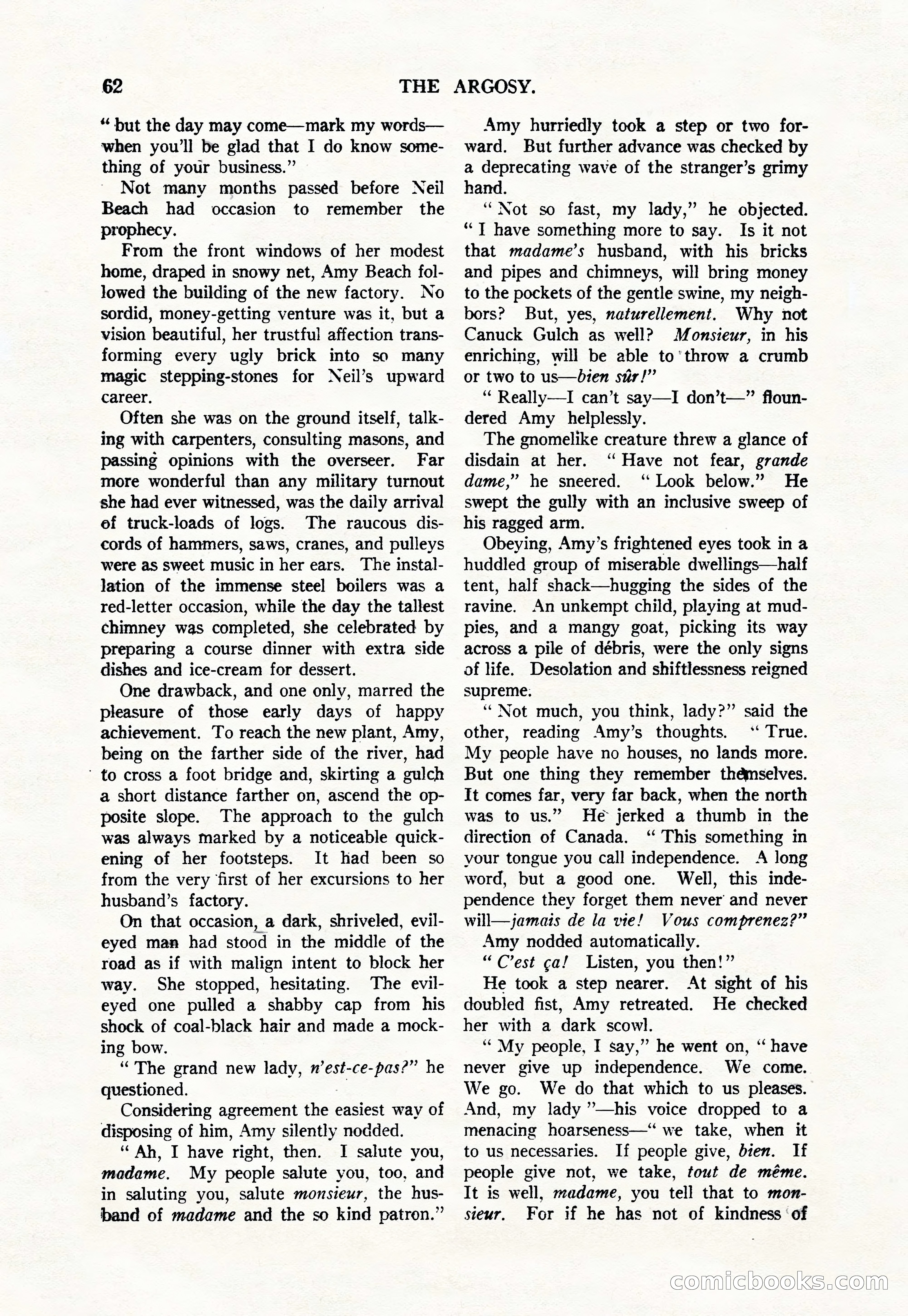
A restored page from Pulp Fiction, 1919. Page through the whole issue in the reader above.
📄 Transcribed text from this page (OCR, searchable)
Machine-transcribed from the original scan — historical spelling and the odd misread are preserved.
62 “ but the day may come—mark my words— when you'll be glad that I do know some- thing of your business.” Not many months passed before Neil Beach had occasion to remember the prophecy. From the front windows of her modest home, draped in snowy net, Amy Beach fol- Jowed the building of the new factory. No sordid, money-getting venture was it, but a vision beautiful, her trustful affection trans- forming every ugly brick into so many magic stepping-stones for Neil’s upward career. Often she was on the ground itself, talk- ing with carpenters, consulting masons, and passing opinions with the overseer. Far more wonderful than any military turnout she had ever witnessed, was the daily arrival ef truck-loads of logs. The raucous dis- cords of hammers, saws, cranes, and pulleys were aS sweet music in her ears. The instal- lation of the immense steel boilers was a red-letter occasion, while the day the tallest chimney was completed, she celebrated by preparing a course dinner with extra side dishes and ice-cream for dessert. One drawback, and one only, marred the pleasure of those early days of happy achievement. To reach the new plant, Amy, being on the farther side of the river, had ’ to cross a foot bridge and, skirting a gulch a short distance farther on, ascend the op- posite slope. The approach to the gulch was always marked by a noticeable quick- ening of her footsteps. It had been so from the very ‘first of her excursions to her husband’s factory. On that occasion, a dark, shriveled, evil- eyed man had stood in the middle of the road as if with malign intent to block her way. She stopped, hesitating. The evil- eyed one pulled a shabby cap from his shock of coal-black hair and made a mock- ing bow. “The grand new lady, n’est-ce-pas?” he questioned. Considering agreement the easiest wav of disposing of him, Amy silently nodded. ‘Ah, I have right, then. I salute you, madame. My people salute you, too, and in saluting you, salute monsieur, the hus- band of madame and the so kind patron.” THE ARGOSY. Amy hurriedly took a step or two for- ward. But further advance was checked by a deprecating wave of the stranger’s grimy hand. ‘“Not so fast, my lady,” he objected. ‘““T have something more to say. Is it not that madame’s husband, with his bricks and pipes and chimneys, will bring money to the pockets of the gentle swine, my neigh- bors? But, yes, naturellement. Why not Canuck Gulch as well? Monsieur, in his enriching, will be able to'throw a crumb or two to us—bien sur!” ‘ Really—I can’t say—I don’t—” floun- dered Amy helplessly. The gnomelike creature threw a glance of disdain at her. ‘‘ Have not fear, grande dame,” he sneered. ‘‘ Look below.” He swept the gully with an inclusive sweep of his ragged arm. Obeying, Amy’s frightened eyes took in a huddled group of miserable dwellings—half tent, half shack—hugging the sides of the ravine. An unkempt child, playing at mud- pies, and a mangy goat, picking its way across a pile of débris, were the only signs of life. Desolation and shiftlessness reigned supreme. ‘“ Not much, you think, lady?” said the other, reading Amy’s thoughts. * True. My people have no houses, no lands more. But one thing they remember themselves. It comes far, very far back, when the north was to us.” He jerked a thumb in the direction of Canada. ‘“ This something m vour tongue you call independence. A long word, but a good one. Well, this inde- pendence they forget them never’ and never will—jamais de la vie! Vous comprenez?”’ Amy nodded automatically. “C’est ca! Listen, you then!” He took a step nearer. At sight of his doubled fist, Amy retreated. He checked her with a dark scowl. ‘““ My people, I say,” he went on, “‘ have never give up independence. We come. We go. We do that which to us pleases. And, my lady ’—his voice dropped to a menacing hoarseness—“ we take, when it to us necessaries. If people give, bien. If people give not, we take, tout de méme. It is well, madame, you tell that to mon- sieur. For if he has not of kindness ‘of GOMIIGIOO S (CO