
Pulp Fiction, 1919 · page 71 of 188
Argosy, Vol. 111, No. 1 — page 71: what you’re looking at
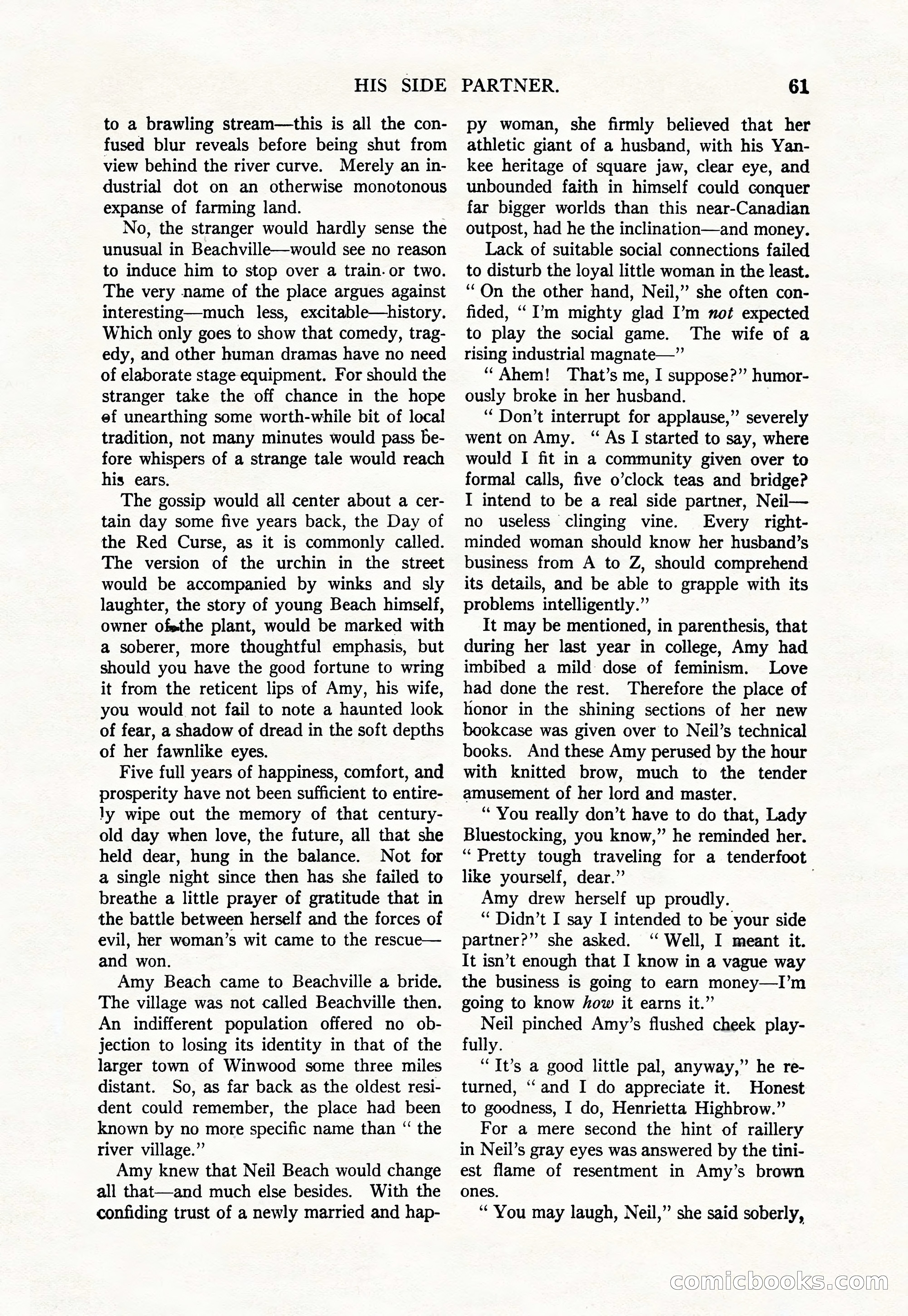
A restored page from Pulp Fiction, 1919. Page through the whole issue in the reader above.
📄 Transcribed text from this page (OCR, searchable)
Machine-transcribed from the original scan — historical spelling and the odd misread are preserved.
HIS SIDE to a brawling stream—this is all the con- fused blur reveals before being shut from view behind the river curve. Merely an in- dustrial dot on an otherwise monotonous expanse of farming land. No, the stranger would hardly sense the unusual in Beachville—would see no reason to induce him to stop over a train. or two. The very name of the place argues against interesting—much less, excitable—history. Which only goes to show that comedy, trag- edy, and other human dramas have no need of elaborate stage equipment. For should the stranger take the off chance in the hope ef unearthing some worth-while bit of local tradition, not many minutes would pass be- fore whispers of a strange tale would reach his ears. The gossip would all center about a cer- tain day some five years back, the Day of the Red Curse, as it is commonly called. The version of the urchin in the street would be accompanied by winks and sly laughter, the story of young Beach himself, owner Ofsthe plant, would be marked with a soberer, more thoughtful emphasis, but should you have the good fortune to wring it from the reticent lips of Amy, his wife, you would not fail to note a haunted look of fear, a shadow of dread in the soft depths of her fawnlike eyes. Five full years of happiness, comfort, and prosperity have not been sufficient to entire- ly wipe out the memory of that century- old day when love, the future, all that she held dear, hung in the balance. Not for a single night since then has she failed to breathe a little prayer of gratitude that in the battle between herself and the forces of evil, her woman’s wit came to the rescue— and won. Amy Beach came to Beachville a bride. The village was not called Beachville then. An indifferent population offered no ob- jection to losing its identity in that of the larger town of Winwood some three miles distant. So, as far back as the oldest resi- dent could remember, the place had been known by no more specific name than “ the river village.” Amy knew that Neil Beach would change all that—and much else besides. With the confiding trust of a newly married and hap- PARTNER. 61 py woman, she firmly believed that her athletic giant of a husband, with his Yan- kee heritage of square jaw, clear eye, and unbounded faith in himself could conquer far bigger worlds than this near-Canadian outpost, had he the inclination—and money. Lack of suitable social connections failed to disturb the loyal little woman in the least. ‘“On the other hand, Neil,’ she often con- fided, “I’m mighty glad I’m not expected to play the social game. The wife of a rising industrial magnate—”’ ‘“ Ahem! That’s me, I suppose?” humor- ously broke in her husband. “Don’t interrupt for applause,” severely went on Amy. “ As I started to say, where would I fit in a community given over to formal calls, five o’clock teas and bridge? I intend to be a real side partner, Neil— no useless clinging vine. Every right- minded woman should know her husband’s business from A to Z, should comprehend its details, and be able to grapple with its problems intelligently.” It may be mentioned, in parenthesis, that during her last year in college, Amy had imbibed a mild dose of feminism. Love had done the rest. Therefore the place of honor in the shining sections of her new bookcase was given over to Neil’s technical books. And these Amy perused by the hour with knitted brow, much to the tender amusement of her lord and master. “You really don’t have to do that, Lady Bluestocking, you know,” he reminded her. ‘Pretty tough traveling for a tenderfoot like yourself, dear.”’ Amy drew herself up proudly. ‘“‘ Didn’t I say I intended to be your side partner?” she asked. ‘“‘ Well, I meant it. It isn’t enough that I know in a vague way the business is going to earn money—I’m going to know ow it earns it.” Neil pinched Amy’s flushed cheek play- fully. “It’s a good little pal, anyway,” he re- turned, ‘“‘ and I do appreciate it. Honest to goodness, I do, Henrietta Highbrow.”’ For a mere second the hint of raillery in Neil’s gray eyes was answered by the tini- est flame of resentment in Amy’s brown ones. “You may laugh, Neil,” she said soberly, CONMUC NOOLK CO