
Pulp Fiction, 1916 · page 68 of 212
The Argosy, Vol. 84 No. 1 — page 68: what you’re looking at
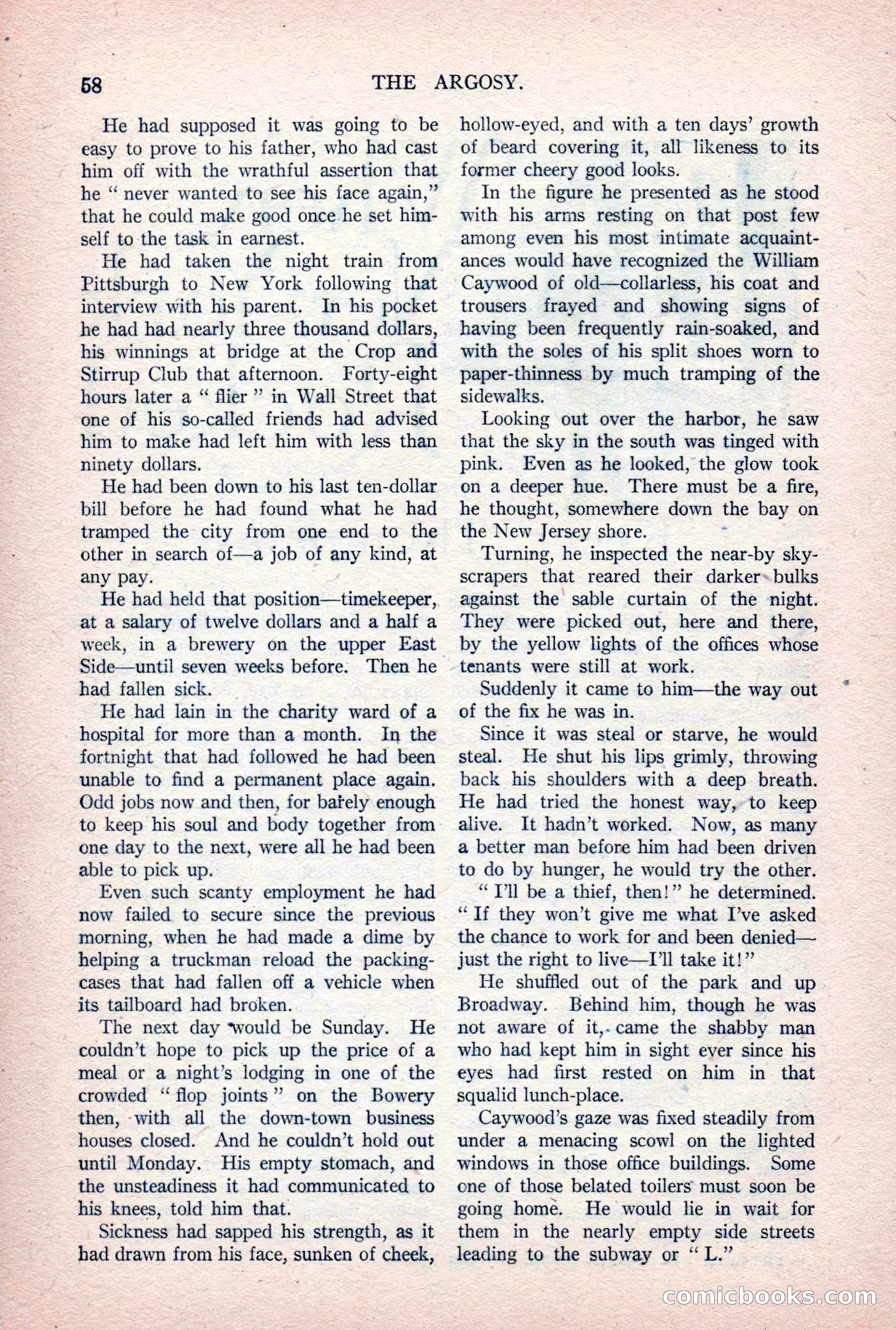
A restored page from Pulp Fiction, 1916. Page through the whole issue in the reader above.
📄 Transcribed text from this page (OCR, searchable)
Machine-transcribed from the original scan — historical spelling and the odd misread are preserved.
58 He had supposed it was going to be easy to prove to his father, who had cast him off with the wrathful assertion that he ‘“‘ never wanted to see his face again,” that he could make good once he set him- self to the task in earnest. He had taken the night train from Pittsburgh to New York following that interview with his parent. In his pocket he had had nearly three thousand dollars, his winnings at bridge at the Crop and Stirrup Club that afternoon. Forty-eight hours later a “ flier” in Wall Street that one of his so-called friends had advised him to make had left him with less than ninety dollars. He had been down to his last ten-dollar bill before he had found what he had tramped the city from one end to the other in search of—a job of any kind, at any pay. He had held that position—timekeeper, at a salary of twelve dollars and a half a week, in a brewery on the upper East Side—until seven weeks before. had fallen sick. He had lain in the charity ward of a hospital for more than a month. In the fortnight that had followed he had been unable to find a permanent place again. Odd jobs now and then, for bately enough to keep his soul and body together from one day to the next, were all he had been able to pick up. Even such scanty employment he had now failed to secure since the previous morning, when he had made a dime by helping a truckman reload the packing- cases that had fallen off a vehicle when its tailboard had broken. The next day ‘would be Sunday. He couldn’t hope to pick up the price of a meal or a night’s lodging in one of the crowded “flop joints” on the Bowery then, -with all the down-town business houses closed. And he couldn’t hold out until Monday. His empty stomach, and the unsteadiness it had communicated to his knees, told him that. Sickness had sapped his strength, as it had drawn from his face, sunken of cheek, Then he THE ARGOSY. hollow-eyed, and with a ten days’ growth of beard covering it, all likeness to its former cheery good looks. In the figure he presented as he stood with his arms resting on that post few among even his most intimate acquaint- ances would have recognized the William Caywood of old—collarless, his coat and trousers frayed and showing signs of — having been frequently rain-soaked, and with the soles of his split shoes worn to paper-thinness by much tramping of the sidewalks. Looking out over the harbor, he saw that the sky in the south was tinged with pink. Even as he looked, the glow took on a deeper hue. There must be a fire, he thought, somewhere down the bay on the New Jersey shore. = Turning, he inspected the near-by sky- scrapers that reared their darker» bulks against the sable curtain of the night. They were picked out, here and there, by the yellow lights of the offices whose tenants were still at work. Suddenly it came to him—the way out of the fix he was in. Since it was steal or starve, he would steal. He shut his lips grimly, throwing back his shoulders with a deep breath. He had tried the honest way, to keep alive. It hadn’t worked. Now, as many a better man before him had been driven to do by hunger, he would try the other. “ T’ll be a thief, then!” he determined. “If they won’t give me what I’ve asked the chance to work for and been denied— just the right to live—I’ll take it!” He shuffled out of the park and up Broadway. Behind him, though he was not aware of it,.came the shabby man who had kept him in sight ever since his eyes had first rested on him in that squalid lunch-place. Caywood’s gaze was fixed steadily from under a menacing scowl on the lighted windows in those office buildings. Some one of those belated toilers must soon be going home. He would lie in wait for them in the nearly empty side streets — leading to the subway or “ L.” COMMICLOOOKS (C@)