
Pulp Fiction, 1916 · page 67 of 212
The Argosy, Vol. 84 No. 1 — page 67: what you’re looking at
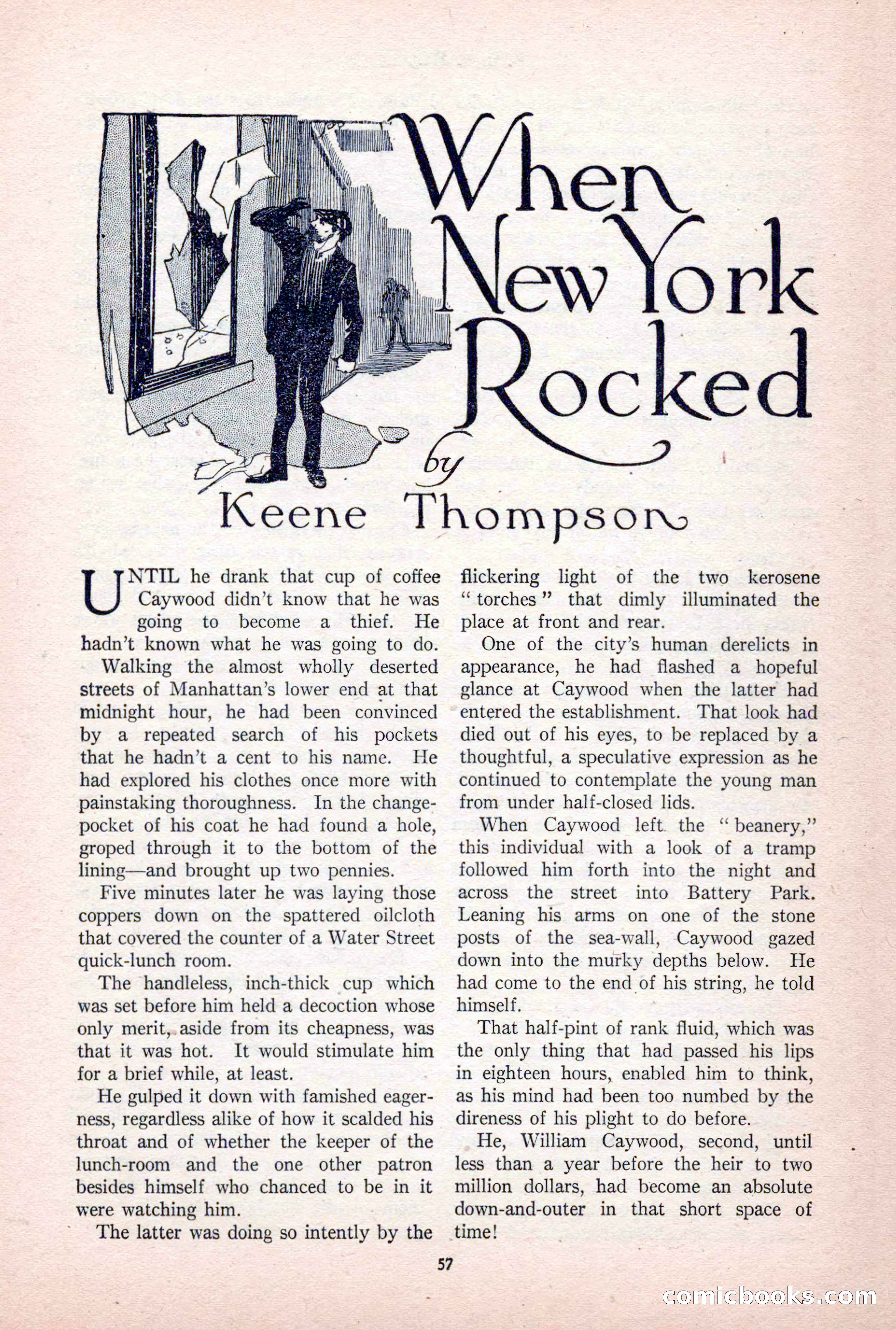
A restored page from Pulp Fiction, 1916. Page through the whole issue in the reader above.
📄 Transcribed text from this page (OCR, searchable)
Machine-transcribed from the original scan — historical spelling and the odd misread are preserved.
ik i {i} rN A i ) 2 ; Fa K ! EY j | ali \4 Keene Thompsons NTIL he drank that cup of coffee Caywood didn’t know that he was going to become a thief. He hadn’t known what he was going to do. Walking the almost wholly deserted streets of Manhattan’s lower end at that midnight hour, he had been convinced by a repeated search of his pockets that he hadn’t a cent to his name. He had explored his clothes once more with painstaking thoroughness. In the change- pocket of his coat he had found a hole, groped through it to the bottom of the lining—and brought up two pennies. Five minutes later he was laying those coppers down on the spattered oilcloth that covered the counter of a Water Street quick-lunch room. The handleless, inch-thick cup which was set before him held a decoction whose only merit,.aside from its cheapness, was that it was hot. It would stimulate him for a brief while, at least. He gulped it down with famished eager- ness, regardless alike of how it scalded his throat and of whether the keeper of the lunch-room and the one other patron besides himself who chanced to be in it were watching him. The latter was doing so intently by the 57 flickering light of the two _ kerosene “torches” that dimly illuminated the place at front and rear. One of the city’s human derelicts in appearance, he had flashed a _ hopeful glance at Caywood when the latter had entered the establishment. That look had died out of his eyes, to be replaced by a thoughtful, a speculative expression as he continued to contemplate the young man from under half-closed lids. When Caywood left. the ‘“ beanery,” this individual with a look of a tramp followed him forth into the night and across the street into Battery Park. Leaning his arms on one of the stone posts of the sea-wall, Caywood gazed down into the murky depths below. He had come to the end of his string, he told himself. That half-pint of rank fluid, which was the only thing that had passed his lips in eighteen hours, enabled him to think, as his mind had been too numbed by the direness of his plight to do before. He, William Caywood, second, until less than a year before the heir to two million dollars, had become an absolute down-and-outer in that short space of time! _TOOK (C@ (E@)