
Pulp Fiction, 1916 · page 69 of 212
The Argosy, Vol. 84 No. 1 — page 69: what you’re looking at
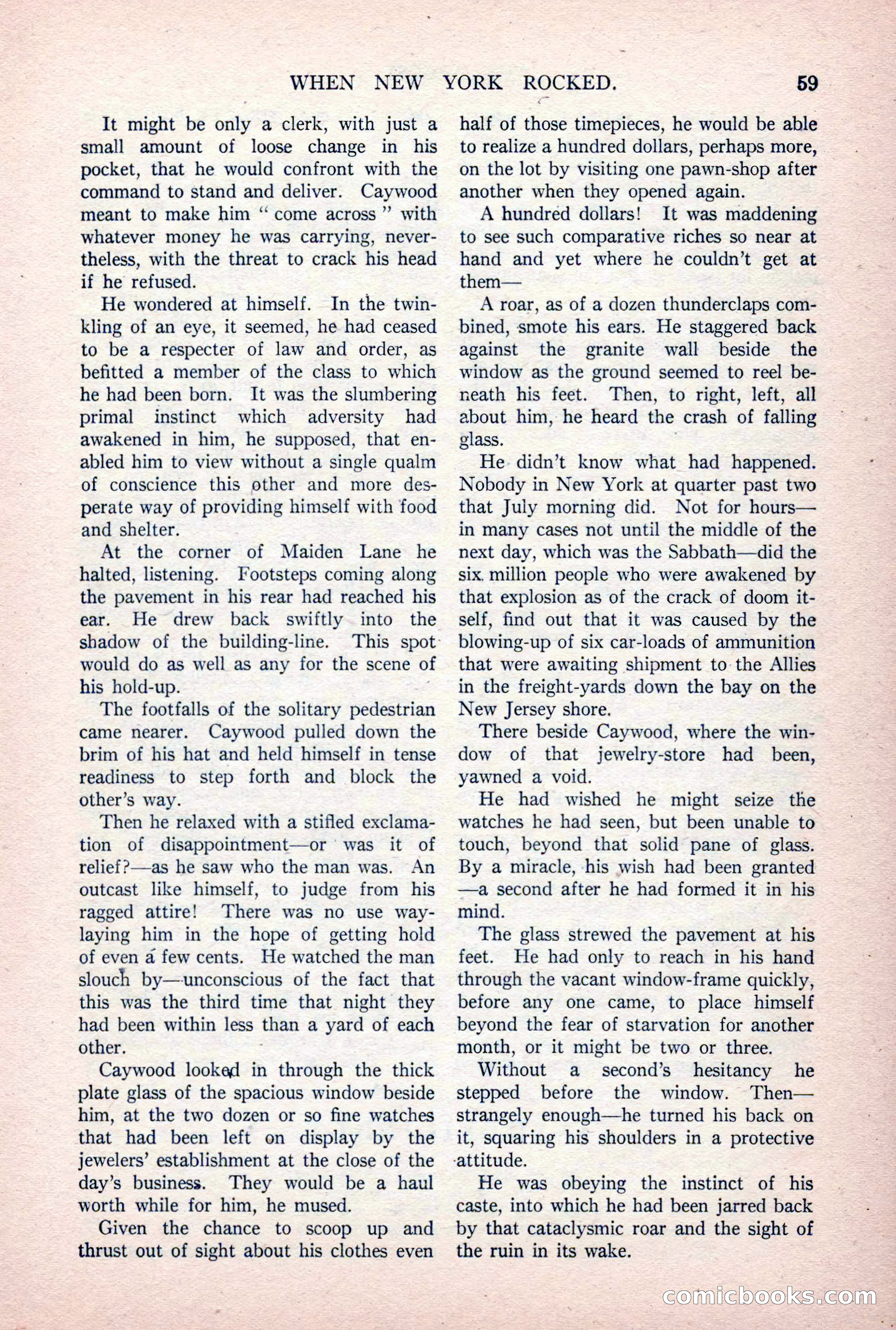
A restored page from Pulp Fiction, 1916. Page through the whole issue in the reader above.
📄 Transcribed text from this page (OCR, searchable)
Machine-transcribed from the original scan — historical spelling and the odd misread are preserved.
WHEN NEW YORK ROCKED. It might be only a clerk, with just a small amount of loose change in his pocket, that he would confront with the command to stand and deliver. Caywood meant to make him ‘“ come across” with whatever money he was carrying, never- theless, with the threat to crack his head if he refused. He wondered at himself. In the twin- kling of an eye, it seemed, he had ceased to be a respecter of law and order, as befitted a member of the class to which he had been born. It was the slumbering primal instinct which adversity had awakened in him, he supposed, that en- abled him to view without a single qualm of conscience this other and more des- perate way of providing himself with food and shelter. At the corner of Maiden Lane he halted, listening. Footsteps coming along the pavement in his rear had reached his ear. He drew back swiftly into the shadow of the building-line. would do as well as any for the scene of his hold-up. The footfalls of the solitary pedestrian came nearer. Caywood pulled down the brim of his hat and held himself in tense readiness to step forth and block the other’s way. Then he relaxed with a stifled exclama- tion of disappointment—or was it of relief ?—as he saw who the man was. An outcast like himself, to judge from his ragged attire! There was no use way- laying him in the hope of getting hold of even a few cents. He watched the man slouch by—unconscious of the fact that this was the third time that night they had been within less than a yard of each other. . Caywood looked in through the thick plate glass of the spacious window beside him, at the two dozen or so fine watches that had been left on display by the jewelers’ establishment at the close of the day’s business. They would be a haul worth while for him, he mused. Given the chance to scoop up and thrust out of sight about his clothes even This spot: 59 half of those timepieces, he would be able to realize a hundred dollars, perhaps more, on the lot by visiting one pawn-shop after another when they opened again. A hundred dollars! It was maddening to see such comparative riches so near at hand and yet where he couldn’t get at them— A roar, as of a dozen thunderclaps com- bined, smote his ears. He staggered back against the granite wall beside the window as the ground seemed to reel be- neath his feet. Then, to right, left, all about him, he heard the crash of falling 3 glass. He didn’t know what had happened. Nobody in New York at quarter past two that July morning did. Not for hours— in many cases not until the middle of the next day, which was the Sabbath—did the six. million people who were awakened by that explosion as of the crack of doom it- self, find out that it was caused by the blowing-up of six car-loads of ammunition that were awaiting shipment to the Allies in the freight-yards down the bay on the New Jersey shore. There beside Caywood, where the win- dow of that jewelry-store had been, yawned a void. He had wished he might seize the watches he had seen, but been unable to touch, beyond that solid pane of glass. By a miracle, his wish had been granted —a second after he had formed it in his mind. The glass strewed the pavement at his feet. He had only to reach in his hand through the vacant window-frame quickly, before any one came, to place himself beyond the fear of starvation for another month, or it might be two or three. Without a _ second’s hesitancy he stepped before the window. Then— strangely enough—he turned his back on it, squaring his shoulders in a protective attitude. He was obeying the instinct of his caste, into which he had been jarred back by that cataclysmic roar and the sight of the ruin in its wake. EOPMIC OOOKS (ECO)