
Pulp Fiction, 1916 · page 37 of 208
The Argosy, Vol. 82 No. 4 — page 37: what you’re looking at
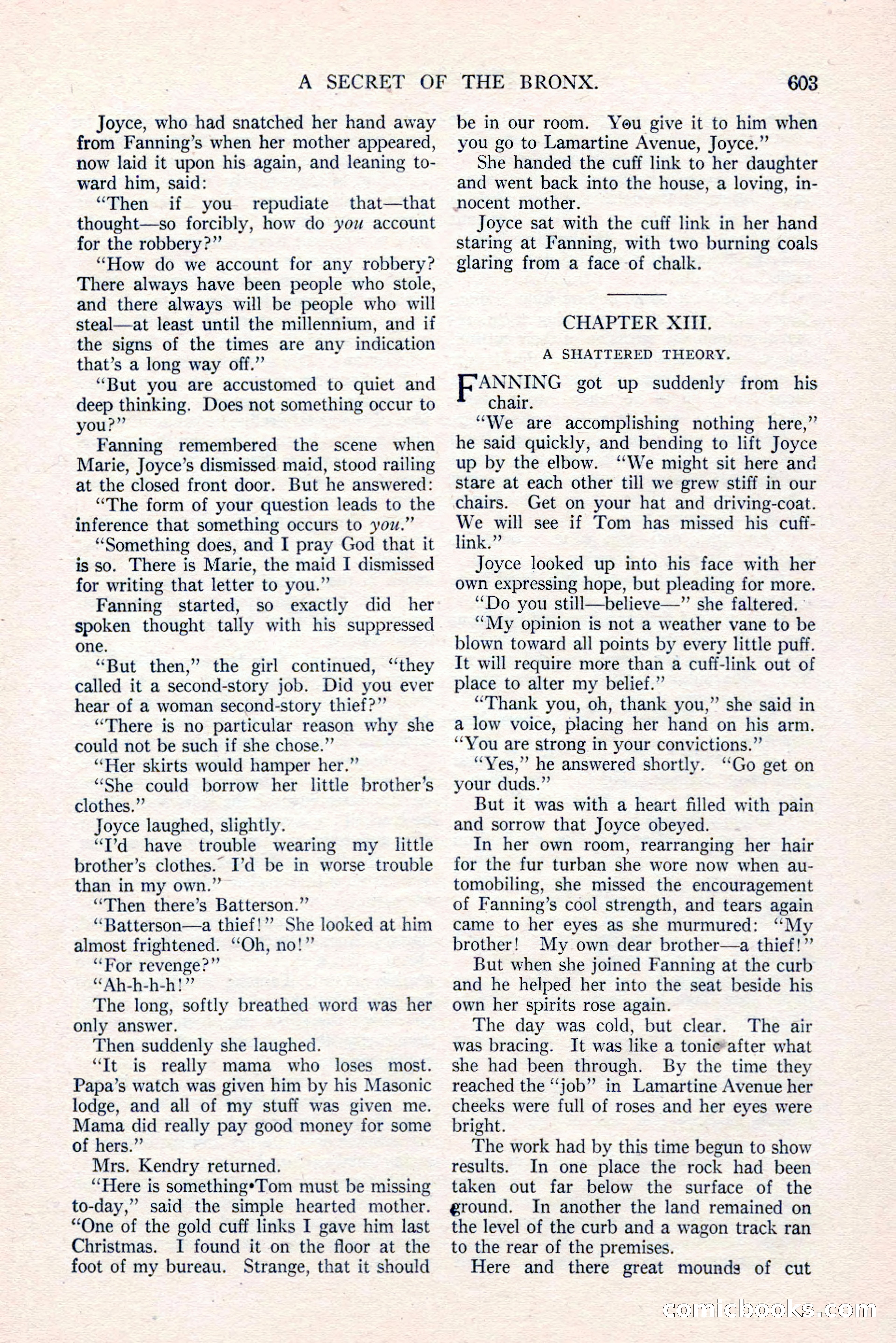
A restored page from Pulp Fiction, 1916. Page through the whole issue in the reader above.
📄 Transcribed text from this page (OCR, searchable)
Machine-transcribed from the original scan — historical spelling and the odd misread are preserved.
A SECRET OF THE BRONX. Joyce, who had snatched her hand away from Fanning’s when her mother appeared, now laid it upon his again, and leaning to- ward him, said: “Then if you repudiate that—that thought—so forcibly, how do you account for the robbery?” “How do we account for any robbery? There always have been people who stole, and there always will be people who will steal—at least until the millennium, and if the signs of the times are any indication that’s a long way off.” “But you are accustomed to quiet and deep thinking. Does not something occur to you?” Fanning remembered the scene when Marie, Joyce’s dismissed maid, stood railing at the closed front door. But he answered: “The form of your question leads to the inference that something occurs to you.” “Something does, and I pray God that it is so. There is Marie, the maid I dismissed for writing that letter to you.” Fanning started, so exactly did her spoken thought tally with his suppressed one. “But then,” the girl continued, “they called it a second-story job. Did you ever hear of a woman second-story thief?” “There is no particular reason why she could not be such if she chose.” “Her skirts would hamper her.” “She could borrow her little brother’s clothes.” Joyce laughed, slightly. “T’d have trouble wearing my little brother’s clothes. I’d be in worse trouble than in my own.” “Then there’s Batterson.” “Batterson—a thief!”” She looked at him almost frightened. “Oh, no!”’ “For revenge?” “Ah-h-h-h!” The long, softly breathed word was her only answer. Then suddenly she laughed. “It is really mama who loses most. Papa’s watch was given him by his Masonic lodge, and all of my stuff was given me. Mama did really pay good money for some of hers.” Mrs. Kendry returned. “Here is something*Tom must be missing to-day,” said the simple hearted mother. “One of the gold cuff links I gave him last Christmas. I found it on the floor at the foot of my bureau. Strange, that it should 603 be in our room. You give it to him when you go to Lamartine Avenue, Joyce.” She handed the cuff link to her daughter and went back into the house, a loving, in- nocent mother. Joyce sat with the cuff link in her hand staring at Fanning, with two burning coals glaring from a face of chalk. CHAPTER XIII, A SHATTERED THEORY. ANNING got up suddenly from his chair. “We are accomplishing nothing here,” he said quickly, and bending to lift Joyce up by the elbow. “We might sit here and stare at each other till we grew stiff in our chairs. Get on your hat and driving-coat. We will see if Tom has missed his cuff- link.” Joyce looked up into his face with her own expressing hope, but pleading for more. ‘Do you still—believe—”’ she faltered. “My opinion is not a weather vane to be blown toward all points by every little puff. It will require more than a cuff-link out of place to alter my belief.” “Thank you, oh, thank you,” she said in a low voice, placing her hand on his arm. “You are strong in your convictions.”’ “Yes,” he answered shortly. ‘Go get on your duds.” But it was with a heart filled with pain and sorrow that Joyce obeyed. In her own room, rearranging her hair for the fur turban she wore now when au- tomobiling, she missed the encouragement of Fanning’s cool strength, and tears again came to her eyes as she murmured: ‘My brother! My own dear brother—a thief!” But when she joined Fanning at the curb and he helped her into the seat beside his own her spirits rose again. The day was cold, but clear. The air was bracing. It was like a tonie*after what she had been through. By the time they reached the “‘job” in Lamartine Avenue her cheeks were full of roses and her eyes were bright. The work had by this time begun to show results. In one place the rock had been taken out far below the surface of the ground. In another the land remained on the level of the curb and a wagon track ran to the rear of the premises. Here and there great mounds of cut CORMMICLOOOkKS (C@