
Pulp Fiction, 1916 · page 36 of 208
The Argosy, Vol. 82 No. 4 — page 36: what you’re looking at
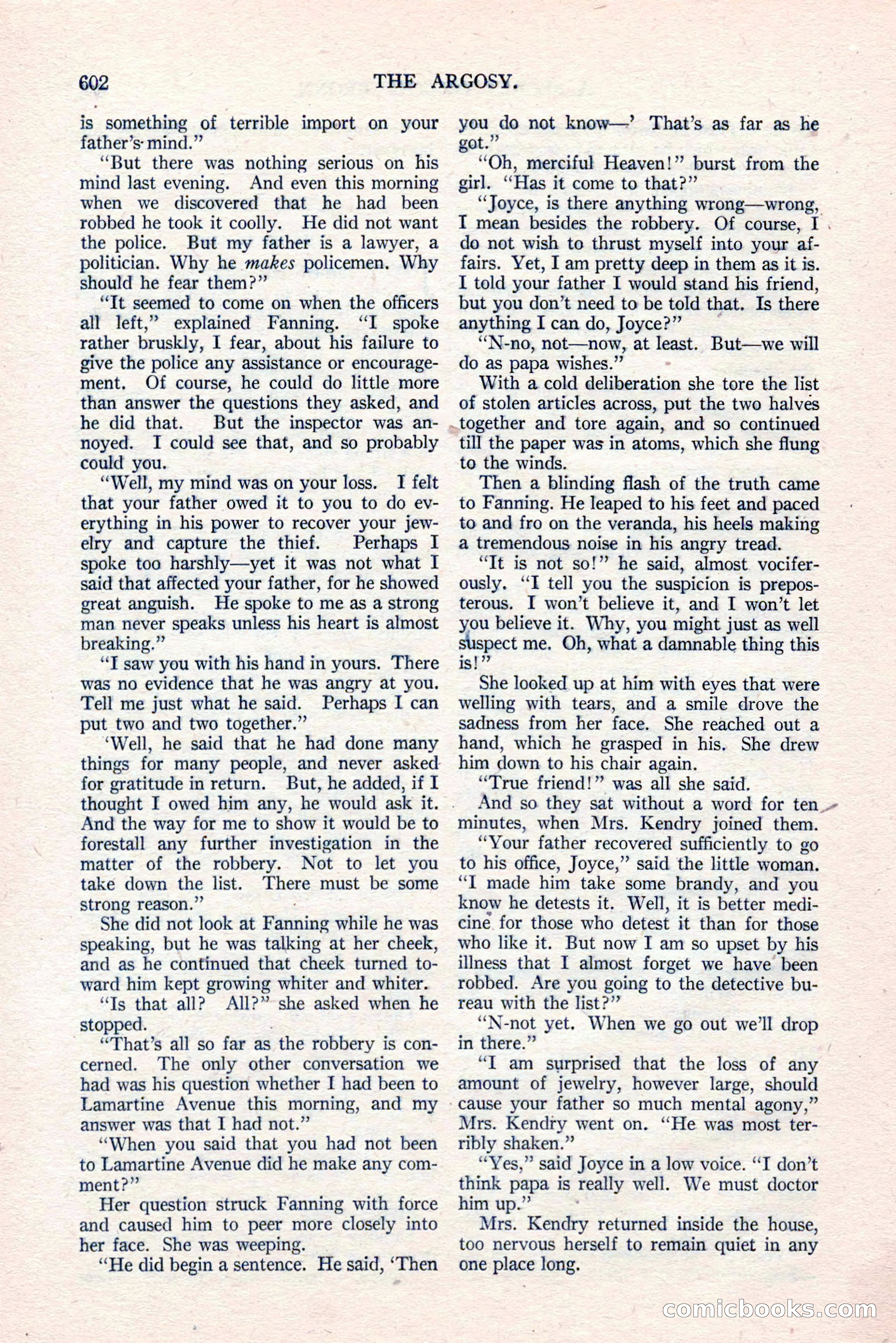
A restored page from Pulp Fiction, 1916. Page through the whole issue in the reader above.
📄 Transcribed text from this page (OCR, searchable)
Machine-transcribed from the original scan — historical spelling and the odd misread are preserved.
602 is something of terrible import on your father’s: mind.” “But there was nothing serious on his mind last evening. And even this morning when we discovered that he had been robbed he took it coolly. He did not want the police. But my father is a lawyer, a politician. Why he makes policemen. Why should he fear them?” “Tt seemed to come on when the officers all left,” explained Fanning. ‘I spoke rather bruskly, I fear, about his failure to give the police any assistance or encourage- ment. Of course, he could do little more than answer the questions they asked, and he did that. But the inspector was an- noyed. I could see that, and so probably could you. “Well, my mind was on your loss. I felt that your father owed it to you to do ev- erything in his power to recover your jew- elry and capture the thief. Perhaps I spoke too harshly—yet it was not what I said that affected your father, for he showed great anguish. He spoke to me as a strong man never speaks unless his heart is almost breaking.” “YT saw you with his hand in yours. There was no evidence that he was angry at you. Tell me just what he said. Perhaps I can put two and two together.” ‘Well, he said that he had done many things for many people, and never asked for gratitude in return. But, he added, if I thought I owed him any, he would ask it. And the way for me to show it would be to forestall any further investigation in the matter of the robbery. Not to let you take down the list. as must be some strong reason.’ She did not look at Fanning while he was speaking, but he was talking at her cheek, and as he continued that cheek turned to- ward him kept growing whiter and whiter. “Ts that all? All?” she asked when he stopped. “That’s all so far as the robbery is con- cerned. The only other conversation we had was his question whether I had been to Lamartine Avenue this morning, and my answer was that I had not.” “When you said that you had not been to Lamartine Avenue did he make any com- ment?” Her question struck Fanning with force and caused him to peer more closely into her face. She was weeping. “He did begin a sentence. He said, ‘Then THE ARGOSY. you do not know—’ That’s as far as he got.” “Oh, merciful Heaven!” burst from the girl. “Has it come to that?” ‘Joyce, is there anything wrong—wrong, Of course, I . I mean besides the robbery. do not wish to thrust myself into your af- fairs. Yet, I am pretty deep in them as it is. I told your father I would stand his friend, but you don’t need to be told that. Is there anything I can do, Joyce?” : ‘““N-no, not—now, at least. But—we will do as papa wishes.” With a cold deliberation she tore the list of stolen articles across, put the two halves .together and tore again, and so continued till the paper was in atoms, which she flung to the winds. Then a blinding flash of the truth came to Fanning. He leaped to his feet and paced to and fro on the veranda, his heels making a tremendous noise in his angry tread. “Tt is not so!” he said, almost vocifer- ously. “I tell you the suspicion is prepos- terous. I won’t believe it, and I won’t let you believe it. Why, you might just as well suspect me. Oh, what a damnable thing this is!” She looked up at him with eyes that were welling with tears, and a smile drove the sadness from her face. She reached out a hand, which he grasped in his. She drew him down to his chair again. “True friend!” was all she said. And so they sat without a word for ten. minutes, when Mrs. Kendry joined them. “Your father recovered sufficiently to go to his office, Joyce,’ said the little woman. “IT made him take some brandy, and you know he detests it. Well, it is better medi- cine for those who detest it than for those who like it. But now I am so upset by his illness that I almost forget we have been robbed. Are you going to the detective bu- reau with the list?” “N-not yet. When we go out we’ll drop in there.” “I am surprised that the loss of any amount of jewelry, however large, should “cause your father so much mental agony,” Mrs. Kendry went on. “He was most ter- ribly shaken.” “Yes,” said Joyce in a low voice. “TI don’t think papa is really well. We must doctor him up.” Mrs. Kendry returned inside the house, too nervous herself to remain quiet in any one place long. COMiICooolkX (C@