
Pulp Fiction, 1916 · page 38 of 208
The Argosy, Vol. 82 No. 4 — page 38: what you’re looking at
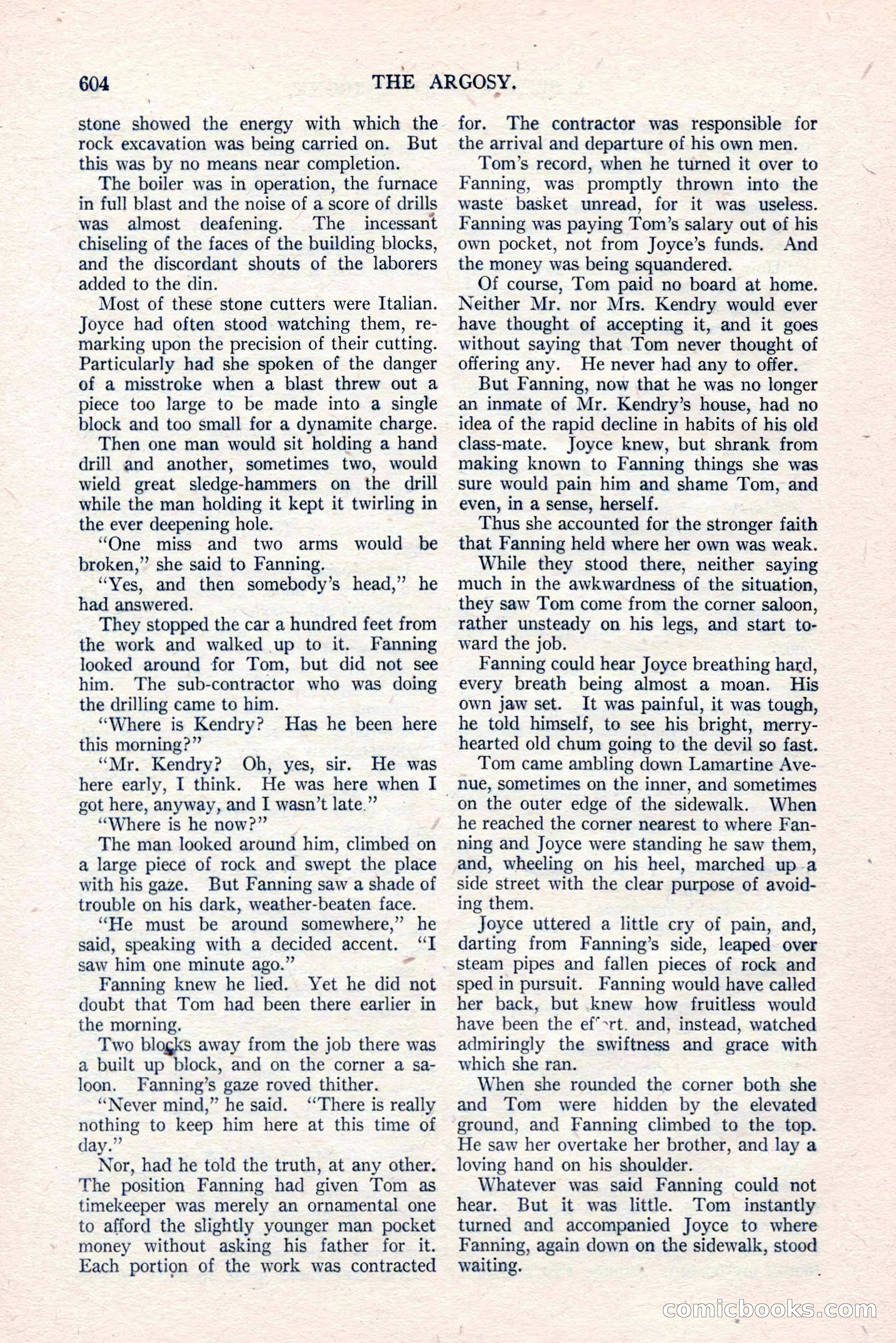
A restored page from Pulp Fiction, 1916. Page through the whole issue in the reader above.
📄 Transcribed text from this page (OCR, searchable)
Machine-transcribed from the original scan — historical spelling and the odd misread are preserved.
604 stone showed the energy with which the rock excavation was being carried on. But this was by no means near completion. The boiler was in operation, the furnace in full blast and the noise of a score of drills was almost deafening. The _ incessant chiseling of the faces of the building blocks, and the discordant shouts of the laborers added to the din. Most of these stone cutters were Italian. Joyce had often stood watching them, re- marking upon the precision of their cutting. Particularly had she spoken of the danger of a misstroke when a blast threw out a piece too large to be made into a single block and too small for a dynamite charge. Then one man would sit holding a hand drill and another, sometimes two, would wield great sledge-hammers on the drill while the man holding it kept it twirling in the ever deepening hole. “One miss and two arms would be broken,” she said to Fanning. “Ves, and then somebody’s head,” he had answered. They stopped the car a hundred feet from the work and walked up to it. Fanning looked around for Tom, but did not see him. The sub-contractor who was doing the drilling came to him. “Where is Kendry? this morning?” “Mr. Kendry? Oh, yes, sir. He was here early, I think. He was here when I got here, anyway, and I wasn’t late.” “Where is he now?” The man looked around him, climbed on a large piece of rock and swept the place with his gaze. But Fanning saw a shade of trouble on his dark, weather-beaten face. “He must be around somewhere,” he said, speaking with a decided accent. “I saw him one minute ago.” e Fanning knew he lied. Yet he did not doubt that Tom had been there earlier in the morning. Two blogks away from the job there was a built up block, and on the corner a sa- loon. Fanning’s gaze roved thither. “Never mind,” he said. “There is really nothing to keep him here at this time of day.” Nor, had he told the truth, at any other. The position Fanning had given Tom as timekeeper was merely an ornamental one to afford the slightly younger man pocket money without asking his father for it. Each portion of the work was contracted Has he been here THE ARGOSY. for. The contractor was responsible for the arrival and departure of his own men. Tom’s record, when he turned it over to Fanning, was promptly thrown into the waste basket unread, for it was useless. Fanning was paying Tom’s salary out of his own pocket, not from Joyce’s funds. And the money was being squandered. Of course, Tom paid no board at home. Neither Mr. nor Mrs. Kendry would ever have thought of accepting it, and it goes without saying that Tom never thought of offering any. He never had any to offer. But Fanning, now that he was no longer an inmate of Mr. Kendry’s house, had no idea of the rapid decline in habits of his old class-mate. Joyce knew, but shrank from making known to Fanning things she was sure would pain him and shame Tom, and even, in a sense, herself. Thus she accounted for the stronger faith that Fanning held where her own was weak. While they stood there, neither saying much in the awkwardness of the situation, they saw Tom come from the corner saloon, rather unsteady on his legs, and start to- ward the job. Fanning could hear Joyce breathing hard, every breath being almost a moan. His own jaw set. It was painful, it was tough, he told himself, to see his bright, merry- hearted old chum going to the devil so fast. Tom came ambling down Lamartine Ave- nue, sometimes on the inner, and sometimes on the outer edge of the sidewalk. When he reached the corner nearest to where Fan- ning and Joyce were standing he saw them, and, wheeling on his heel, marched up-a side street with the clear purpose of avoid- ing them. Joyce uttered a little cry of pain, and, darting from Fanning’s side, leaped over steam pipes and fallen pieces of rock and sped in pursuit. Fanning would have called her back, but knew how fruitless would have been the ef*>rt. and, instead, watched admiringly the swiftness and grace with which she ran. When she rounded the corner both she and Tom were hidden by the elevated ground, and Fanning climbed to the top. He saw her overtake her brother, and lay a loving hand on his shoulder. Whatever was said Fanning could not hear. But it was little. Tom instantly turned and accompanied Joyce to where Fanning, again down on the sidewalk, stood waiting. COMIC OOOKS (C@