
Pulp Fiction, 1916 · page 35 of 208
The Argosy, Vol. 82 No. 4 — page 35: what you’re looking at
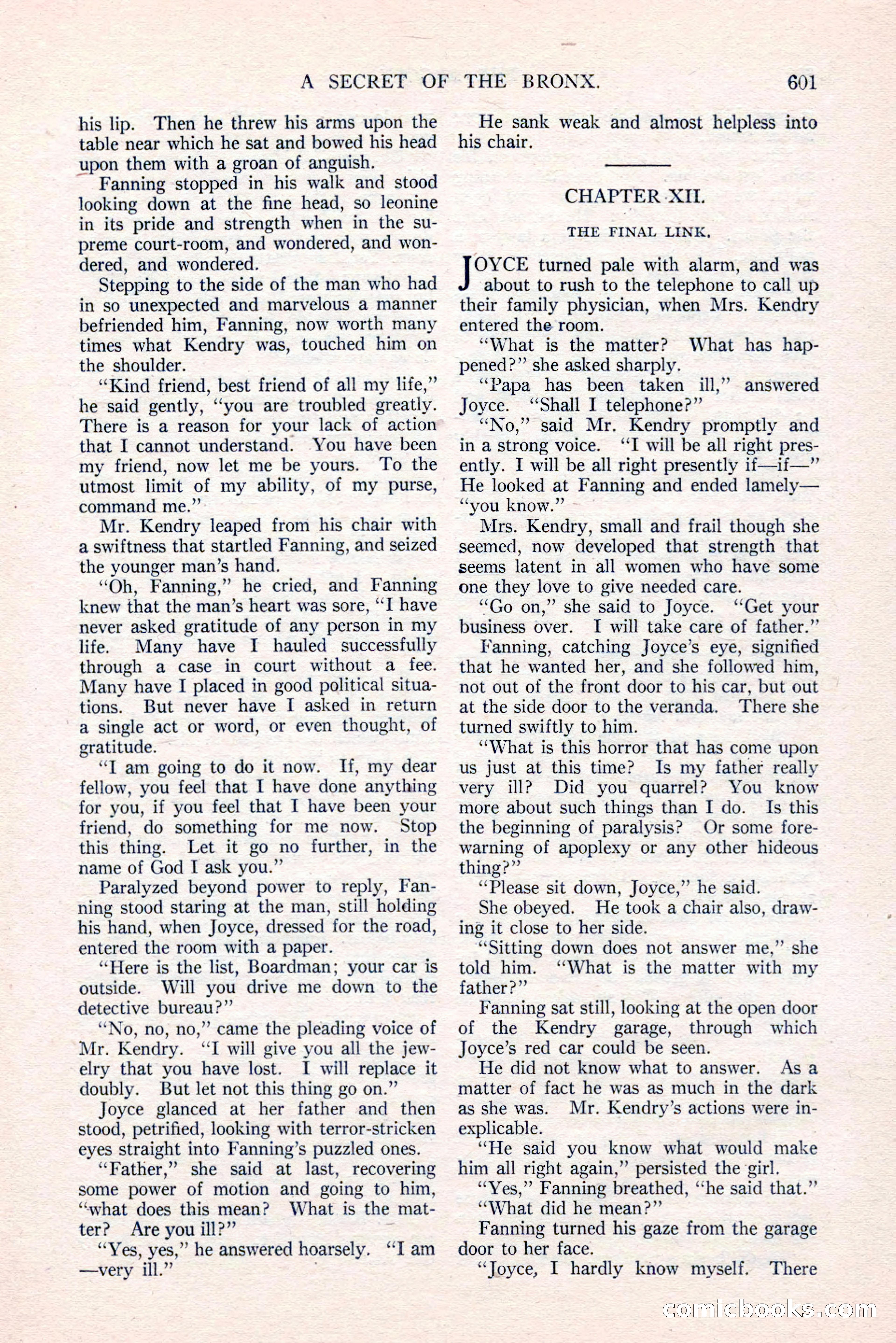
A restored page from Pulp Fiction, 1916. Page through the whole issue in the reader above.
📄 Transcribed text from this page (OCR, searchable)
Machine-transcribed from the original scan — historical spelling and the odd misread are preserved.
A SECRET: OF THE BRONX. his lip. Then he threw his arms upon the table near which he sat and bowed his head upon them with a groan of anguish. Fanning stopped in his walk and stood looking down at the fine head, so leonine in its pride and strength when in the su- preme court-room, and wondered, and won- dered, and wondered. Stepping to the side of the man who had in so unexpected and marvelous a manner befriended him, Fanning, now worth many times what Kendry was, touched him on the shoulder. “Kind friend, best friend of all my life,” he said gently, “you are troubled greatly. There is a reason for your lack of action that I cannot understand. You have been my friend, now let me be yours. To the utmost limit of my ability, of my purse, command me.” Mr. Kendry leaped from his chair with a swiftness that startled Fanning, and seized the younger man’s hand. “Oh, Fanning,” he cried, and Fanning knew that the man’s heart was sore, “I have never asked gratitude of any person in my life. Many have I hauled successfully through a case in court without a fee. Many have I placed in good political situa- tions. But never have I asked in return a single act or word, or even thought, of gratitude. “T am going to do it now. If, my dear fellow, you feel that I have done anything for you, if you feel that I have been your friend, do something for me now. Stop this thing. Let it go no further, in the name of God I ask you.” Paralyzed beyond power to reply, Fan- ning stood staring at the man, still holding his hand, when Joyce, dressed for the road, entered the room with a paper. “Here is the list, Boardman; your car is outside. Will you drive me down to the detective bureau?”’ “No, no, no,” came the pleading voice of Mr. Kendry. “I will give you all the jew- elry that you have lost. I will replace it doubly. But let not this thing go on.” Joyce glanced at her father and then stood, petrified, looking with terror-stricken eyes straight into Fanning’s puzzled ones. “Father,” she said at last, recovering some power of motion and going to him, “what does this mean? What is the mat- ter? Are you ill?” “Ves, yes,” he answered hoarsely. “I am —very ill.” 601 He sank weak and almost helpless into his chair. CHAPTER XIL. THE FINAL LINK, OYCE turned pale with alarm, and was about to rush to the telephone to call up their family physician, when Mrs. Kendry entered the room. “What is the matter? pened?” she asked sharply. ‘Papa has been taken ill,” answered Joyce. ‘Shall I telephone?” “No,” said Mr. Kendry promptly and in a strong voice. ‘‘I will be all right pres- ently. I will be all right presently if—if—”’ He looked at Fanning and ended lamely— “vou know.” Mrs. Kendry, small and frail though she seemed, now developed that strength that seems latent in all women who have some one they love to give needed care. “Go on,” she said to Joyce. ‘Get your business over. I will take care of father.” Fanning, catching Joyce’s eye, signified that he wanted her, and she followed him, not out of the front door to his car, but out at the side door to the veranda. ‘There she turned swiftly to him. “What is this horror that has come upon us just at this time? Is my father really very ill? Did you quarrel? You know more about such things than I do. Is this the beginning of paralysis? Or some fore- warning of apoplexy or any other hideous thing?” : “Please sit down, Joyce,” he said. She obeyed. He took a chair also, draw- ing it close to her side. “Sitting down does not answer me,’’ she told him. ‘‘What is the matter with my father?”’ Fanning sat still, looking at the open door What has hap- of the Kendry garage, through which Joyce’s red car could be seen. He did not know what to answer. Asa matter of fact he was as much in the dark as she was. Mr. Kendry’s actions were in- explicable. “He said you know what would make him all right again,” persisted the girl. “Yes,” Fanning breathed, “‘he said that.” ‘“‘What did he mean?”’ Fanning turned his gaze from the garage door to her face. “Joyce, I hardly know myself. There GomiGcdooks (C@