
Pulp Fiction, 1916 · page 34 of 208
The Argosy, Vol. 82 No. 4 — page 34: what you’re looking at
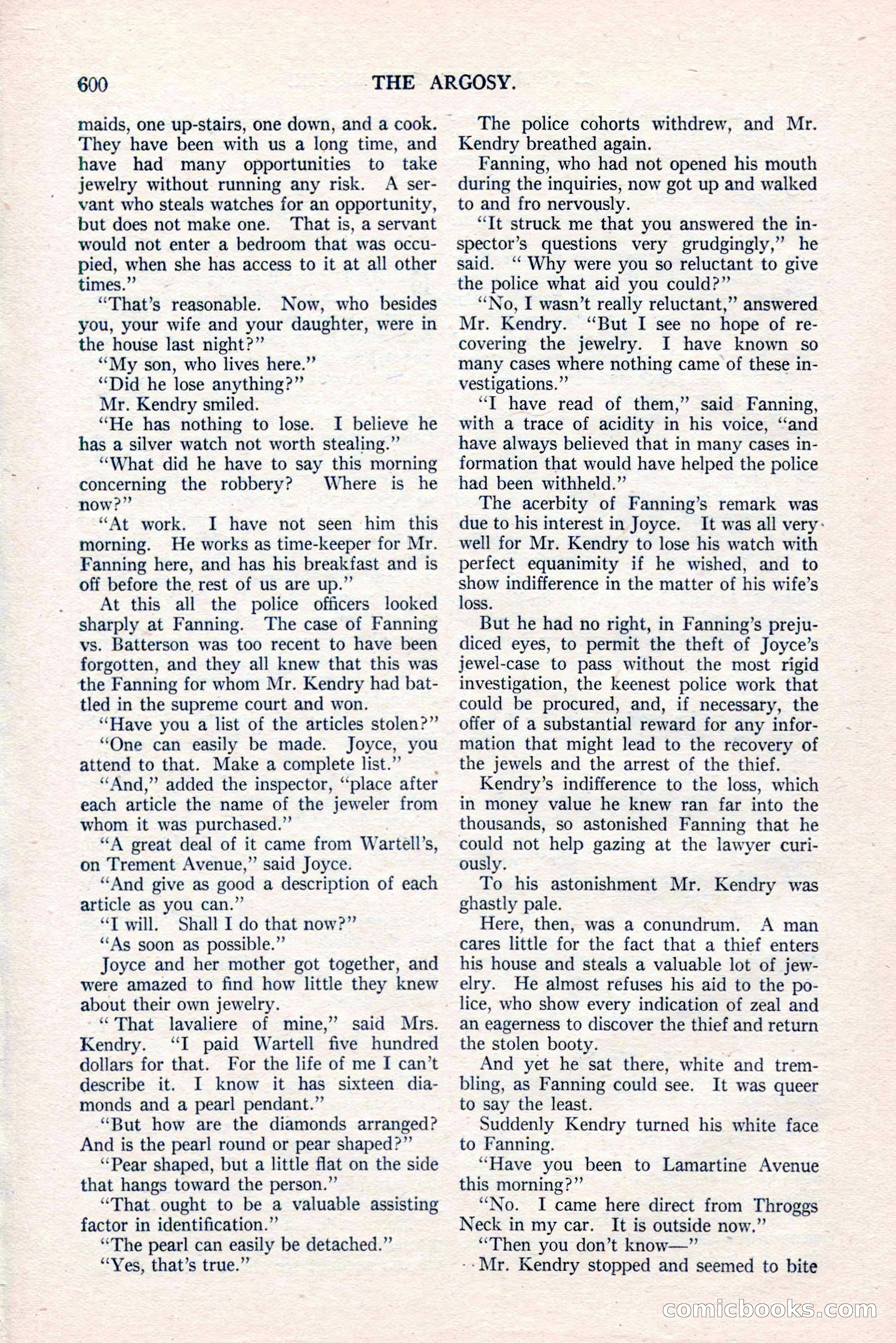
A restored page from Pulp Fiction, 1916. Page through the whole issue in the reader above.
📄 Transcribed text from this page (OCR, searchable)
Machine-transcribed from the original scan — historical spelling and the odd misread are preserved.
600 maids, one up-stairs, one down, and a cook. They have been with us a long time, and have had many opportunities to take jewelry without running any risk. A ser- vant who steals watches for an opportunity, but does not make one. That is, a servant would not enter a bedroom that was occu- pied, when she has access to it at all other times.” “That’s reasonable. Now, who besides you, your wife and your daughter, were in the house last night?” ““My son, who lives here.” “Did he lose anything?” Mr. Kendry smiled. “He has nothing to lose. I believe he has a silver watch not worth stealing.” “What did he have to say this morning concerning the robbery? Where is he now?” “At work. I have not seen him this morning. He works as time-keeper for Mr. Fanning here, and has his breakfast and is off before the rest of us are up.” At this all the police officers looked sharply at Fanning. The case of Fanning vs. Batterson was too recent to have been forgotten, and they all knew that this was the Fanning for whom Mr. Kendry had bat- tled in the supreme court and won. “Have you a list of the articles stolen?” “One can easily be made. Joyce, you attend to that. Make a complete list.” “And,” added the inspector, “place after each article the name of the jeweler from whom it was purchased.”’ “A great deal of it came from Wartell’s, on Trement Avenue,” said Joyce. “And give as good a description of each article as you can.” “T will. Shall I do that now?” ‘““As soon as possible.” Joyce and her mother got together, and were amazed to find how little they knew about their own jewelry. ‘That lavaliere of mine,” said Mrs. Kendry. “I paid Wartell five hundred dollars for that. For the life of me I can’t describe it. I know it has sixteen dia- monds and a pearl pendant.” “But how are the diamonds arranged? And is the pearl round or pear shaped?” “Pear shaped, but a little flat on the side that hangs toward the person.” “That ought to be a valuable assisting factor in identification.” ‘The pearl can easily be detached.” “Ves, that’s true.” THE ARGOSY. The police cohorts withdrew, and Mr. Kendry breathed again. Fanning, who had not opened his mouth during the inquiries, now got up and walked to and fro nervously. “It struck me that you answered the in- spector’s questions very grudgingly,” he said. ‘‘ Why were you so reluctant to give the police what aid you could?” “No, I wasn’t really reluctant,” answered Mr. Kendry. “But I see no hope of re- covering the jewelry. I have known so many cases where nothing came of these in- vestigations.” ‘“T have read of them,” said Fanning, with a trace of acidity in his voice, ‘‘and have always believed that in many cases in- formation that would have helped the police had been withheld.” The acerbity of Fanning’s remark was due to his interest in Joyce. well for Mr. Kendry to lose his watch with perfect equanimity if he wished, and to show indifference in the matter of his wife’s loss. But he had no right, in Fanning’s preju- diced eyes, to permit the theft of Joyce’s jewel-case to pass without the most rigid investigation, the keenest police work that could be procured, and, if necessary, the offer of a substantial reward for any infor- mation that might lead to the recovery of the jewels and the arrest of the thief. Kendry’s indifference to the loss, which in money value he knew ran far into the thousands, so astonished Fanning that he could not help gazing at the lawyer curi- ously. To his astonishment Mr. Kendry was ghastly pale. Here, then, was a conundrum. A man cares little for the fact that a thief enters his house and steals a valuable lot of jew- elry. He almost refuses his aid to the po- lice, who show every indication of zeal and an eagerness to discover the thief and return the stolen booty. And yet he sat there, white and trem- bling, as Fanning could see. It was queer to say the least. Suddenly Kendry turned his white face to Fanning. “Have you been to Lamartine Avenue this morning?” ‘No. I came here direct from Throggs Neck in my car. It is outside now,”’ “Then you don’t know—”’ --Mr. Kendry stopped and seemed to bite COMIC OO® S It was all very: (C@