
Pulp Fiction, 1916 · page 33 of 208
The Argosy, Vol. 82 No. 4 — page 33: what you’re looking at
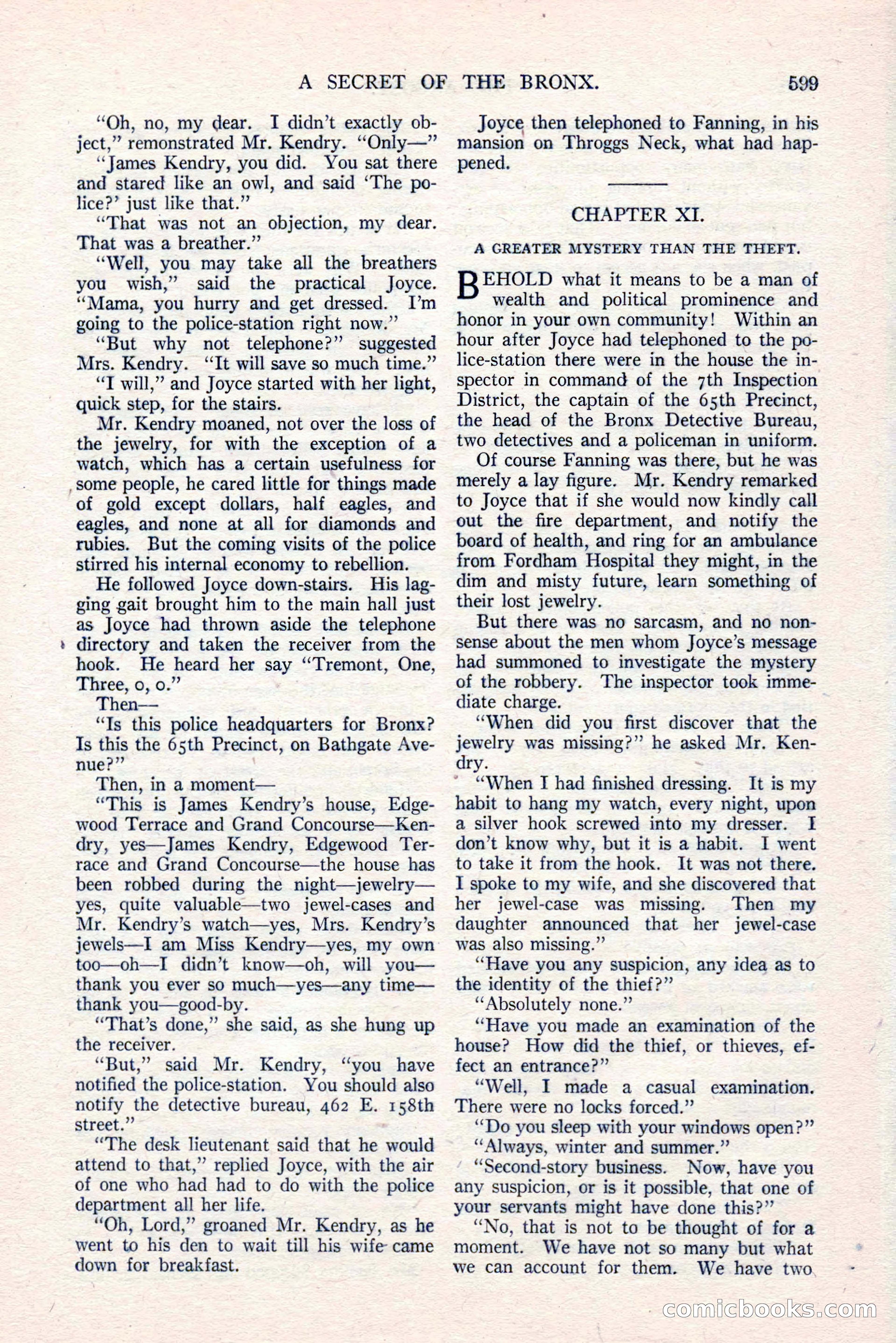
A restored page from Pulp Fiction, 1916. Page through the whole issue in the reader above.
📄 Transcribed text from this page (OCR, searchable)
Machine-transcribed from the original scan — historical spelling and the odd misread are preserved.
- A SECRET OF THE BRONX. “Oh, no, my dear. I didn’t exactly ob- ject,” remonstrated Mr. Kendry. “Only—” ‘James Kendry, you did. You sat there and stared like an owl, and said ‘The po- lice?’ just like that.” “That was not an objection, my dear. That was a breather.” “Well, you may take all the breathers you wish,” said the practical Joyce. ‘““Mama, you hurry and get dressed. I’m going to the police-station right now.” “But why not telephone?” suggested Mrs. Kendry. ‘It will save so much time.” “T will,” and Joyce started with her light, quick step, for the stairs. Mr. Kendry moaned, not over the loss of the jewelry, for with the exception of a watch, which has a certain usefulness for _some people, he cared little for things made of gold except dollars, half eagles, and eagles, and none at all for diamonds and rubies. But the coming visits of the police stirred his internal economy to rebellion. He followed Joyce down-stairs. His lag- ging gait brought him to the main hall just as Joyce had thrown aside the telephone directory and taken the receiver from the hook. He heard her say “Tremont, One, Three, 0, 0.” Then— “Ts this police headquarters for Bronx? Is this the 65th Precinct, on Bathgate Ave- nue?”’ Then, in a moment— “This is James Kendry’s house, Edge- wood Terrace and Grand Concourse—Ken- dry, yes—James Kendry, Edgewood Ter- race and Grand Concourse—the house has been robbed during the night—jewelry— yes, quite valuable—two jewel-cases and Mr. Kendry’s watch—yes, Mrs. Kendry’s jewels—I am Miss Kendry—yes, my own too—oh—I didn’t know—oh, will you— thank you ever so much—yes—any time— thank you—good-by. “That’s done,” she said, as she hung up the receiver. “But,” said Mr. Kendry, “you have notified the police-station. You should also notify the detective bureau, 462 E. 158th street.” “The desk lieutenant said that he would attend to that,” replied Joyce, with the air of one who had had to do with the police department all her life. “Oh, Lord,” groaned Mr. Kendry, as he went to his den to wait till his wife came down for breakfast. 599 Joyce then telephoned to Fanning, in his mansion on Throggs Neck, what had hap- pened. CHAPTER XI. A GREATER MYSTERY THAN THE THEFT. EHOLD what it means to be a man of wealth and political prominence and honor in your own community! Within an hour after Joyce had telephoned to the po- lice-station there were in the house the in- spector in command of the 7th Inspection District, the captain of the 65th Precinct, the head of the Bronx Detective Bureau, two detectives and a policeman in uniform. Of course Fanning was there, but he was merely a lay figure. Mr. Kendry remarked to Joyce that if she would now kindly call out the fire department, and notify the board of health, and ring for an ambulance from Fordham Hospital they might, in the dim and misty future, learn something of their lost jewelry. But there was no sarcasm, and no non- sense about the men whom Joyce’s message had summoned to investigate the mystery of the robbery. The inspector took imme- diate charge. “When did you first discover that the jewelry was missing?” he asked Mr. Ken- dry. “When I had finished dressing. It is my habit to hang my watch, every night, upon a silver hook screwed into my dresser. I don’t know why, but it is a habit. I went to take it from the hook. It was not there. I spoke to my wife, and she discovered that her jewel-case was missing. Then my daughter announced that her jewel-case was also missing.” ‘“‘Have you any suspicion, any idea as to the identity of the thief?” “Absolutely none.” “Have you made an examination of the house? How did the thief, or thieves, ef- fect an entrance?” “Well, I made a casual examination. There were no locks forced.” “Do you sleep with your windows open?” “Always, winter and summer.” “Second-story business. Now, have you any suspicion, or is it possible, that one of your servants might have done this?” “No, that is not to be thought of for a moment. We have not so many but what we can account for them. We have two. - CONNICLOOOKS (C@