
Pulp Fiction, 1916 · page 32 of 208
The Argosy, Vol. 82 No. 4 — page 32: what you’re looking at
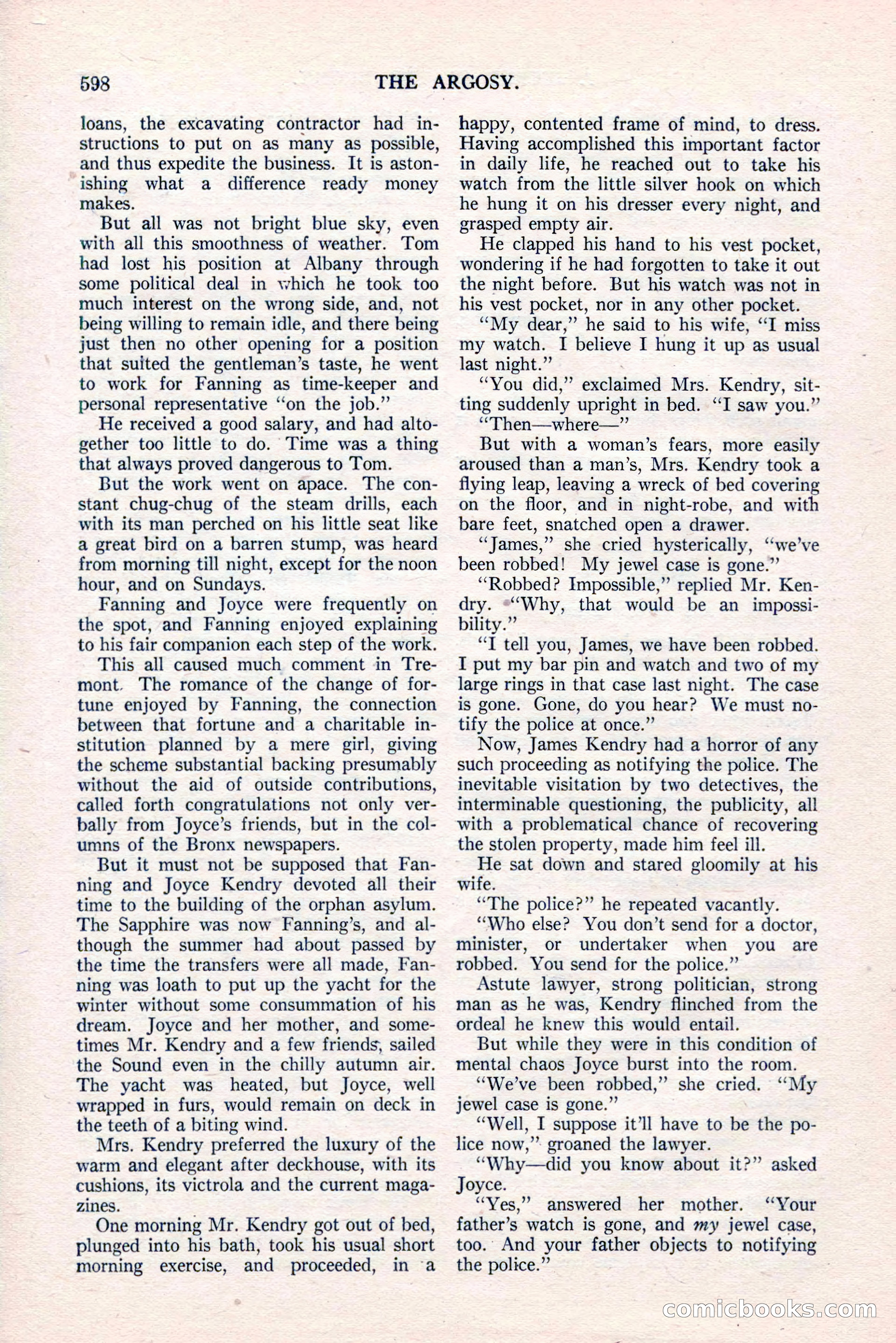
A restored page from Pulp Fiction, 1916. Page through the whole issue in the reader above.
📄 Transcribed text from this page (OCR, searchable)
Machine-transcribed from the original scan — historical spelling and the odd misread are preserved.
598 loans, the excavating contractor had in- structions to put on as many as possible, and thus expedite the business. It is aston- ishing what a difference ready money makes. But all was not bright blue sky, even with all this smoothness of weather. Tom had lost his position at Albany through some political deal in which he took too much interest on the wrong side, and, not being willing to remain idle, and there being just then no other opening for a position that suited the gentleman’s taste, he went to work for Fanning as time-keeper and personal representative ‘‘on the job.” He received a good salary, and had alto- gether too little to do. Time was a thing that always proved dangerous to Tom. But the work went on apace. The con- stant chug-chug of the steam drills, each with its man perched on his little seat like a great bird on a barren stump, was heard from morning till night, except for the noon hour, and on Sundays. Fanning and Joyce were frequently on the spot, and Fanning enjoyed explaining to his fair companion each step of the work. This all caused much comment in Tre- mont. The romance of the change of for- tune enjoyed by Fanning, the connection between that fortune and a charitable in- stitution planned by a mere girl, giving the scheme substantial backing presumably without the aid of outside contributions, called forth congratulations not only ver- bally from Joyce’s friends, but in the col- umns of the Bronx newspapers. But it must not be supposed that Fan- ning and Joyce Kendry devoted all their time to the building of the orphan asylum. The Sapphire was now Fanning’s, and al- though the summer had about passed by the time the transfers were all made, Fan- ning was loath to put up the yacht for the winter without some consummation of his dream. Joyce and her mother, and some- times Mr. Kendry and a few friends, sailed the Sound even in the chilly autumn air. The yacht was heated, but Joyce, well wrapped in furs, would remain on deck in the teeth of a biting wind. Mrs. Kendry preferred the luxury of the warm and elegant after deckhouse, with its cushions, its victrola and the current maga- zines. ; One morning Mr. Kendry got out of bed, plunged into his bath, took his usual short morning exercise, and proceeded, in a THE ARGOSY. happy, contented frame of mind, to dress. Having accomplished this important factor in daily life, he reached out to take his watch from the little silver hook on which he hung it on his dresser every night, and grasped empty air. He clapped his hand to his vest pocket, wondering if he had forgotten to take it out the night before. But his watch was not in his vest pocket, nor in any other pocket. ‘“My dear,” he said to his wife, ‘‘I miss my watch. I believe I hung it up as usual last night.” “You did,” exclaimed Mrs. Kendry, sit- ting suddenly upright in bed. “I saw you.” ‘“Then—where—” But with a woman’s fears, more easily aroused than a man’s, Mrs. Kendry took a flying leap, leaving a wreck of bed covering on the floor, and in night-robe, and with bare feet, snatched open a drawer. “James,” she cried hysterically, “‘we’ve been robbed! My jewel case is gone.” ‘“‘Robbed? Impossible,” replied Mr. Ken- dry. *““Why, that would be an impossi- bility.” “T tell you, James, we have been robbed. I put my bar pin and watch and two of my large rings in that case last night. The case is gone. Gone, do you hear? We must no- tify the police at once.” Now, James Kendry had a horror of any such proceeding as notifying the police. The inevitable visitation by two detectives, the interminable questioning, the publicity, all with a problematical chance of recovering the stolen property, made him feel ill. He sat down and stared gloomily at his wife. “The police?” he repeated vacantly. “Who else? You don’t send for a doctor, minister, or undertaker when you are robbed. You send for the police.” Astute lawyer, strong politician, strong man as he was, Kendry flinched from the ordeal he knew this would entail. But while they were in this condition of mental chaos Joyce burst into the room. ‘“‘We’ve been robbed,” she cried. ‘‘My jewel case is gone.” “Well, I suppose it’ll have to be the po- lice now,” groaned the lawyer. “Why—did you know about it?” asked Joyce. “Ves,” answered her mother. “Your father’s watch is gone, and my jewel case, too. And your father objects to notifying the police.” (C@ ANICELOOOLKS (C@