
Pulp Fiction, 1916 · page 31 of 208
The Argosy, Vol. 82 No. 4 — page 31: what you’re looking at
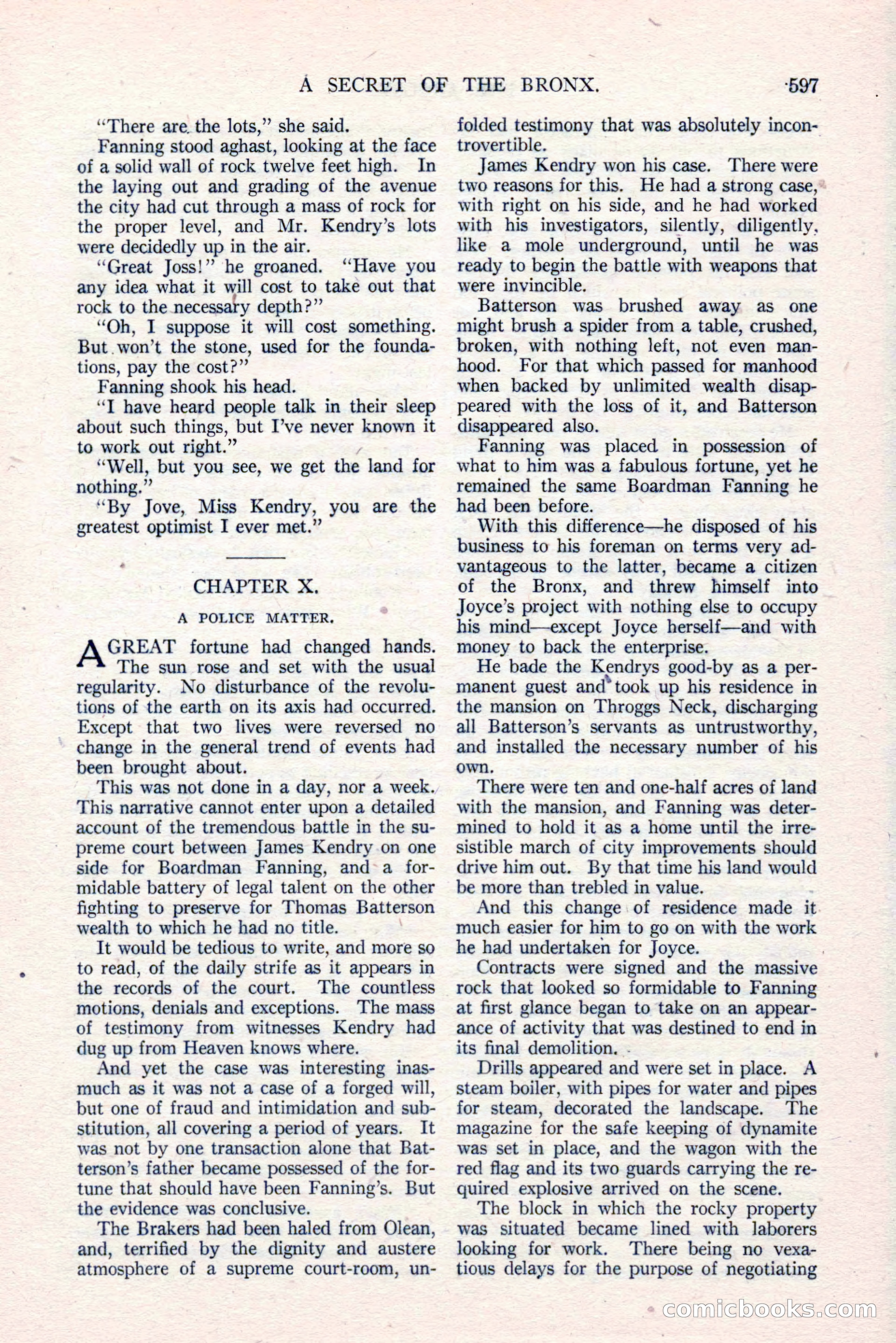
A restored page from Pulp Fiction, 1916. Page through the whole issue in the reader above.
📄 Transcribed text from this page (OCR, searchable)
Machine-transcribed from the original scan — historical spelling and the odd misread are preserved.
A SECRET OF THE BRONX. “There are. the lots,” she said. Fanning stood aghast, looking at the face of a solid wall of rock twelve feet high. In the laying out and grading of the avenue the city had cut through a mass of rock for the proper level, and Mr. Kendry’s lots were decidedly up in the air. “Great Joss!” he groaned. “Have you any idea what it will cost to take out that rock to the necessary depth?” “Oh, I suppose it will cost something. But won’t the stone, used for the founda- tions, pay the cost?”’ Fanning shook his head. “T have heard people talk in their sleep about such things, but I’ve never known it to work out right.” “Well, but you see, we get the land for nothing.” “By Jove, Miss Kendry, you are the greatest optimist I ever met.” CHAPTER X. A POLICE MATTER. AGREAT fortune had changed hands. The sun rose and set with the usual regularity. No disturbance of the revolu- tions of the earth on its axis had occurred. Except that two lives were reversed no change in the general trend of events had been brought about. This was not done in a day, nor a week. This narrative cannot enter upon a detailed account of the tremendous battle in the su- preme court between James Kendry on one side for Boardman Fanning, and a for- midable battery of legal talent on the other fighting to preserve for Thomas Batterson wealth to which he had no title. It would be tedious to write, and more so to read, of the daily strife as it appears in the records of the court. The countless motions, denials and exceptions. The mass of testimony from witnesses Kendry had dug up from Heaven knows where. And yet the case was interesting inas- much as it was not a case of a forged will, but one of fraud and intimidation and sub- stitution, all covering a period of years. It was not by one transaction alone that Bat- terson’s father became possessed of the for- tune that should have been Fanning’s. But the evidence was conclusive. The Brakers had been haled from Olean, and, terrified by the dignity and austere atmosphere of a supreme court-room, un- ‘597 folded testimony that was absolutely incon- trovertible. James Kendry won his case. There were two reasons for this. with right on his side, and he had worked with his investigators, silently, diligently, like a mole underground, until he was ready to begin the battle with weapons that were invincible. Batterson was brushed away as one might brush a spider from a table, crushed, broken, with nothing left, not even man- hood. For that which passed for manhood when backed by unlimited wealth disap- peared with the loss of it, and Batterson disappeared also. Fanning was placed in possession of what to him was a fabulous fortune, yet he remained the same Boardman Fanning he had been before. With this difference—he disposed of his business to his foreman on terms very ad- vantageous to the latter, became a citizen of the Bronx, and threw himself into Joyce’s project with nothing else to occupy his mind—except Joyce herself—and with money to back the enterprise. He bade the Kendrys good-by as a per- manent guest and’ took up his residence in the mansion on Throggs Neck, discharging all Batterson’s servants as untrustworthy, and installed the necessary number of his own. There were ten and one-half acres of land with the mansion, and Fanning was deter- mined to hold it as a home until the irre- sistible march of city improvements should drive him out. By that time his land would be more than trebled in value. And this change of residence made it much easier for him to go on with the work he had undertaken for Joyce. Contracts were signed and the massive rock that looked so formidable to Fanning at first glance began to take on an appear- ance of activity that was destined to end in its final demolition. - Drills appeared and were set in place. A steam boiler, with pipes for water and pipes for steam, decorated the landscape. The magazine for the safe keeping of dynamite was set in place, and the wagon with the red flag and its two guards carrying the re- quired explosive arrived on the scene. The block in which the rocky property was situated became lined with laborers looking for work. There being no vexa- tious delays for the purpose of negotiating COMMICLOOOKS He had a strong case,’ (C@