
Pulp Fiction, 1916 · page 30 of 208
The Argosy, Vol. 82 No. 4 — page 30: what you’re looking at
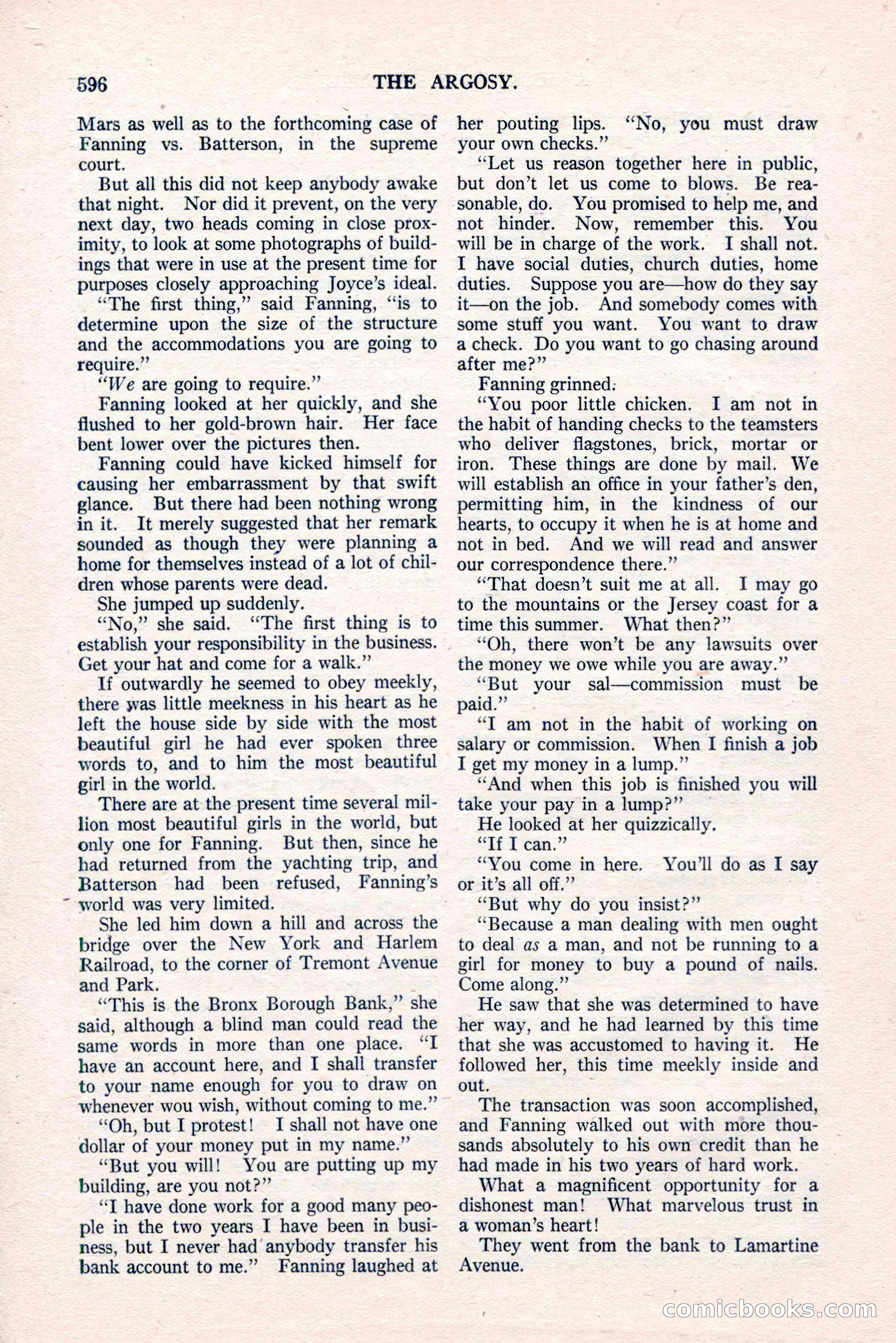
A restored page from Pulp Fiction, 1916. Page through the whole issue in the reader above.
📄 Transcribed text from this page (OCR, searchable)
Machine-transcribed from the original scan — historical spelling and the odd misread are preserved.
596 Mars as well as to the forthcoming case of Fanning vs. Batterson, in the supreme court. But all this did not keep anybody awake that night. Nor did it prevent, on the very next day, two heads coming in close prox- imity, to look at some photographs of build- ings that were in use at the present time for purposes closely approaching Joyce’s ideal. “The first thing,” said Fanning, “is to determine upon the size of the structure and the accommodations you are going to require.” “We are going to require.” Fanning looked at her quickly, and she flushed to her gold-brown hair. Her face bent lower over the pictures then. Fanning could have kicked himself for causing her embarrassment by that swift glance. But there had been nothing wrong in it. It merely suggested that her remark sounded as though they were planning a home for themselves instead of a lot of chil- dren whose parents were dead. She jumped up suddenly. “No,” she said. ‘The first thing is to establish your responsibility in the business. Get your hat and come for a walk.” If outwardly he seemed to obey meekly, there was little meekness in his heart as he left the house side by side with the most beautiful girl he had ever spoken three words to, and to him the most beautiful girl in the world. There are at the present time several mil- lion most beautiful girls in the world, but only one for Fanning. But then, since he had returned from the yachting trip, and Batterson had been refused, Fanning’s world was very limited. She led him down a hill and across the bridge over the New York and Harlem Railroad, to the corner of Tremont Avenue and Park. “This is the Bronx Borough Bank,” she said, although a blind man could read the same words in more than one place. “I have an account here, and I shall transfer to your name enough for you to draw on whenever wou wish, without coming to me.” “Oh, but I protest! I shall not have one dollar of your money put in my name.” “But you will! You are putting up my building, are you not?” “T have done work for a good many peo- ple in the two years I have been in busi- ness, but I never had anybody transfer his bank account to me.” Fanning laughed at THE ARGOSY. her pouting lips. your own checks.”’ : “Let us reason together here in public, but don’t let us come to blows. Be rea- “No, you must draw sonable, do. You promised to help me, and not hinder. Now, remember this. You will be in charge of the work. I shall not. I have social duties, church duties, home duties. Suppose you are—how do they say it—on the job. And somebody comes with some stuff you want. You want to draw a check. Do you want to go chasing around after me?” Fanning grinned: “You poor little chicken. I am not in the habit of handing checks to the teamsters who deliver flagstones, brick, mortar or iron. These things are done by mail. We will establish an office in your father’s den, permitting him, in the kindness of our hearts, to occupy it when he is at home and not in bed. And we will read and answer our correspondence there.”’ “That doesn’t suit me at all. I may go to the mountains or the Jersey coast for a time this summer. What then?” “Oh, there won’t be any lawsuits over the money we owe while you are away.” “But your sal—commission must be paid.” “T am not in the habit of working on salary or commission. When I finish a job I get my money in a lump.” “And when this job is finished you will take your pay in alump?” He looked at her quizzically. Slt T can.” “You come in here. or it’s all off.” “But why do you insist?” “Because a man dealing with men ought to deal as a man, and not be running to a girl for money to buy a pound of nails. Come along.” He saw that she was determined to have her way, and he had learned by this time that she was accustomed to having it. He followed her, this time meekly inside and out. The transaction was soon accomplished, and Fanning walked out with more thou- sands absolutely to his own credit than he had made in his two years of hard work. What a magnificent opportunity for a dishonest man! What marvelous trust in a woman’s heart! They went from the bank to Lamartine Avenue. You'll do as I say CORMICLOOO® S (C@