
Pulp Fiction, 1916 · page 15 of 208
The Argosy, Vol. 82 No. 4 — page 15: what you’re looking at
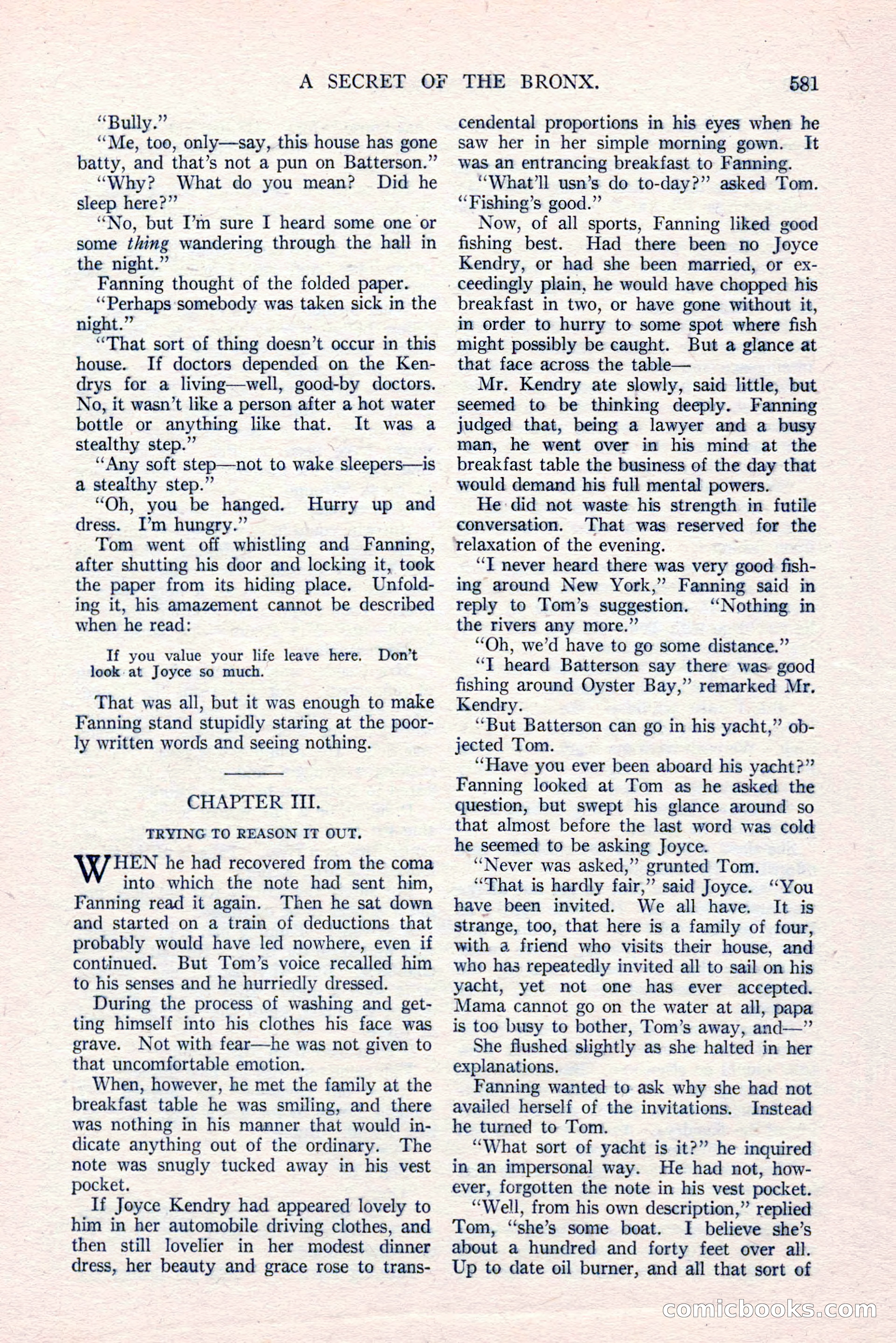
A restored page from Pulp Fiction, 1916. Page through the whole issue in the reader above.
📄 Transcribed text from this page (OCR, searchable)
Machine-transcribed from the original scan — historical spelling and the odd misread are preserved.
A SECRET OF THE BRONX. “Bully.” “Me, too, only—say, this house has gone batty, and that’s not a pun on Batterson.” “Why? What do you mean? Did he sleep here?” “No, but I’m sure I heard some one or some thing wandering through the hall in the night.” Fanning thought of the folded paper. “Perhaps somebody was taken sick in the night.” “That sort of thing doesn’t occur in this house. If doctors depended on the Ken- drys for a living—well, good-by doctors. No, it wasn’t like a person after a hot water bottle or anything like that. It was a stealthy step.” ‘““Any soft step—not to wake sleepers—is a stealthy step.” “Oh, you be hanged. Hurry up and dress. I’m hungry.” Tom went off whistling and Fanning, after shutting his door and locking it, took the paper from its hiding place. Unfold- ' ing it, his amazement cannot be described when he read: If you value your life leave here. Don’t look at Joyce so much. That was all, but it was enough to make Fanning stand stupidly staring at the poor- ly written words and seeing nothing. CHAPTER III. TRYING TO REASON IT OUT. HEN he had recovered from the coma into which the note had sent him, Fanning read it again. Then he sat down and started on a train of deductions that probably would have led nowhere, even if continued. But Tom’s voice recalled him to his senses and he hurriedly dressed. During the process of washing and get- ting himself into his clothes his face was grave. Not with fear—he was not given to that uncomfortable emotion. When, however, he met the family at the breakfast table he was smiling, and there was nothing in his manner that would in- dicate anything out of the ordinary. The note was snugly tucked away in his vest pocket. If Joyce Kendry had appeared lovely to him in her automobile driving clothes, and then still lovelier in her modest dinner dress, her beauty and grace rose to trans- 581 cendental proportions in his eyes when he saw her in her simple morning gown. It was an entrancing breakfast to Fanning. ‘“What’ll usn’s do to-day?” asked Tom. “Fishing’s good.” Now, of all sports, Fanning liked good fishing best. Had there been no Joyce Kendry, or had she been married, or ex- _ceedingly plain, he would have chopped his breakfast in two, or have gone without it, m order to hurry to some spot where fish might possibly be caught. But a glance at that face across the table— Mr. Kendry ate slowly, said little, but seemed to be thinking deeply. Fanning judged that, being a lawyer and a busy man, he went over in his mind at the breakfast table the business of the day that would demand his full mental powers. He did not waste his strength in futile conversation. ‘That was reserved for the relaxation of the evening. ‘““T never heard there was very good fish- ing around New York,” Fanning said in reply to Tom’s suggestion. “Nothing in the rivers any more.” “Oh, we’d have to go some distance.” “JT heard Batterson say there was good fishing around Oyster Bay,” remarked Mr. Kendry. “But Batterson can go in his yacht,” ob- jected Tom. ‘‘Have you ever been aboard his yacht?” Fanning looked at Tom as he asked the question, but swept his glance around so that almost before the last word was cold he seemed to be asking Joyce. ‘‘Never was asked,” grunted Tom. “That is hardly fair,” said Joyce. “You have been invited. We all have. It is strange, too, that here is a family of four, with a friend who visits their house, and who has repeatedly invited all to sail on his yacht, yet not one has ever accepted. Mama cannot go on the water at all, papa is too busy to bother, Tom’s away, and—” She flushed slightly as she halted in her explanations. Fanning wanted to ask why she had not availed herself of the invitations. Instead he turned to Tom. “What sort of yacht is it?” he inquired in an impersonal way. He had not, how- ever, forgotten the note in his vest pocket. “Well, from his own description,” replied Tom, “she? s some boat. I believe she’s about a hundred and forty feet over all. Up to date oil burner, and all that sort of Com Ghbooks (C@