
Pulp Fiction, 1916 · page 16 of 208
The Argosy, Vol. 82 No. 4 — page 16: what you’re looking at
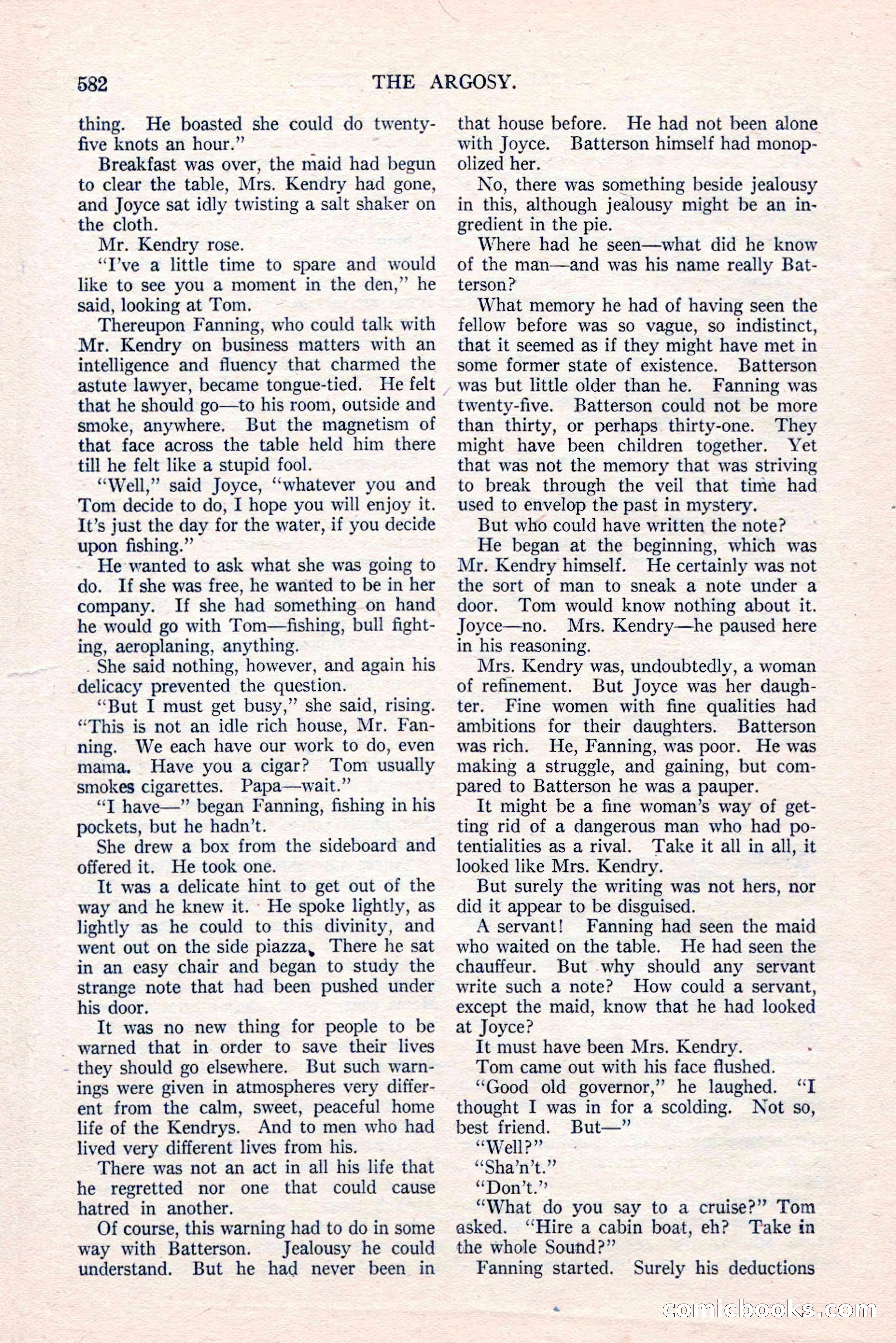
A restored page from Pulp Fiction, 1916. Page through the whole issue in the reader above.
📄 Transcribed text from this page (OCR, searchable)
Machine-transcribed from the original scan — historical spelling and the odd misread are preserved.
582 thing. He boasted she could do twenty- five knots an hour.” E Breakfast was over, the maid had begun to clear the table, Mrs. Kendry had gone, and Joyce sat idly twisting a salt shaker on the cloth. Mr. Kendry rose. “I’ve a little time to spare and would like to see you a moment in the den,” he said, looking at Tom. Thereupon Fanning, who could talk with Mr. Kendry on business matters with an intelligence and fluency that charmed the astute lawyer, became tongue-tied. He felt | that he should go—to his room, outside and smoke, anywhere. But the magnetism of that face across the table held him there till he felt like a stupid fool. “Well,” said Joyce, “whatever you and Tom decide to do, I hope you will enjoy it. It’s just the day for the water, if you decide upon fishing.” He wanted to ask what she was going to do. If she was free, he wanted to be in her company. If she had something on hand he would go with Tom—fishing, bull fight- ing, aeroplaning, anything. . She said nothing, however, and again his delicacy prevented the question. “But I must get busy,” she said, rising. “This is not an idle rich house, Mr. Fan- ning. We each have our work to do, even mama. Have you a cigar? Tom usually smokes cigarettes. Papa—wait.” “T have—” began Fanning, fishing in his pockets, but he hadn’t. She drew a box from the sideboard and offered it. He took one. It was a delicate hint to get out of the way and he knew it. - He spoke lightly, as lightly as he could to this divinity, and went out on the side piazza, There he sat in an easy chair and began to study the strange note that had been pushed under his door. It was no new thing for people to be - warned that in order to save their lives - they should go elsewhere. But such warn- ings were given in atmospheres very differ- ent from the calm, sweet, peaceful home life of the Kendrys. And to men who had lived very different lives from his. There was not an act in all his life that he regretted nor one that could cause hatred in another. Of course, this warning had to do in some way with Batterson. Jealousy he could understand. But he had never been in THE ARGOSY. that house before. He had not been alone with Joyce. Batterson himself had monop- olized her. No, there was something beside jealousy in this, although jealousy might be an in- gredient in the pie. Where had he seen—what did he know of the man—and was his name really Bat- terson? What memory he had of having seen the fellow before was so vague, so indistinct, that it seemed as if they might have met in some former state of existence. Batterson was but little older than he. Fanning was twenty-five. Batterson could not be more than thirty, or perhaps thirty-one. They might have been children together. Yet that was not the memory that was striving to break through the veil that time had used to envelop the past in mystery. But who could have written the note? He began at the beginning, which was Mr. Kendry himself. He certainly was not the sort of man to sneak a note under a door. Tom would know nothing about it. Joyce—no. Mrs. Kendry—he paused here in his reasoning. Mrs. Kendry was, undoubtedly, a woman of refinement. But Joyce was her daugh- ter. Fine women with fine qualities had ambitions for their daughters. Batterson was rich. He, Fanning, was poor. He was making a struggle, and gaining, but com- pared to Batterson he was a pauper. It might be a fine woman’s way of get- ting rid of a dangerous man who had po- tentialities as a rival. ‘Take it all in all, it looked like Mrs. Kendry. But surely the writing was not hers, nor did it appear to be disguised. A servant! Fanning had seen the maid who waited on the table. He had seen the chauffeur. But why should any servant write such a note? How could a servant, except the maid, know that he had looked at Joyce? It must have been Mrs. Kendry. Tom came out with his face flushed. “Good old governor,” he laughed. “I thought I was in for a scolding. Not so, best friend. But—” “Well?” “‘Sha’n’t.”’ “Don’t.” “What do you say to a cruise?” Tom asked. “Hire a cabin boat, eh? Take in the whole Sound?” Fanning started. Surely his deductions - CORmMICOOOKS (C©@