
Pulp Fiction, 1916 · page 14 of 208
The Argosy, Vol. 82 No. 4 — page 14: what you’re looking at
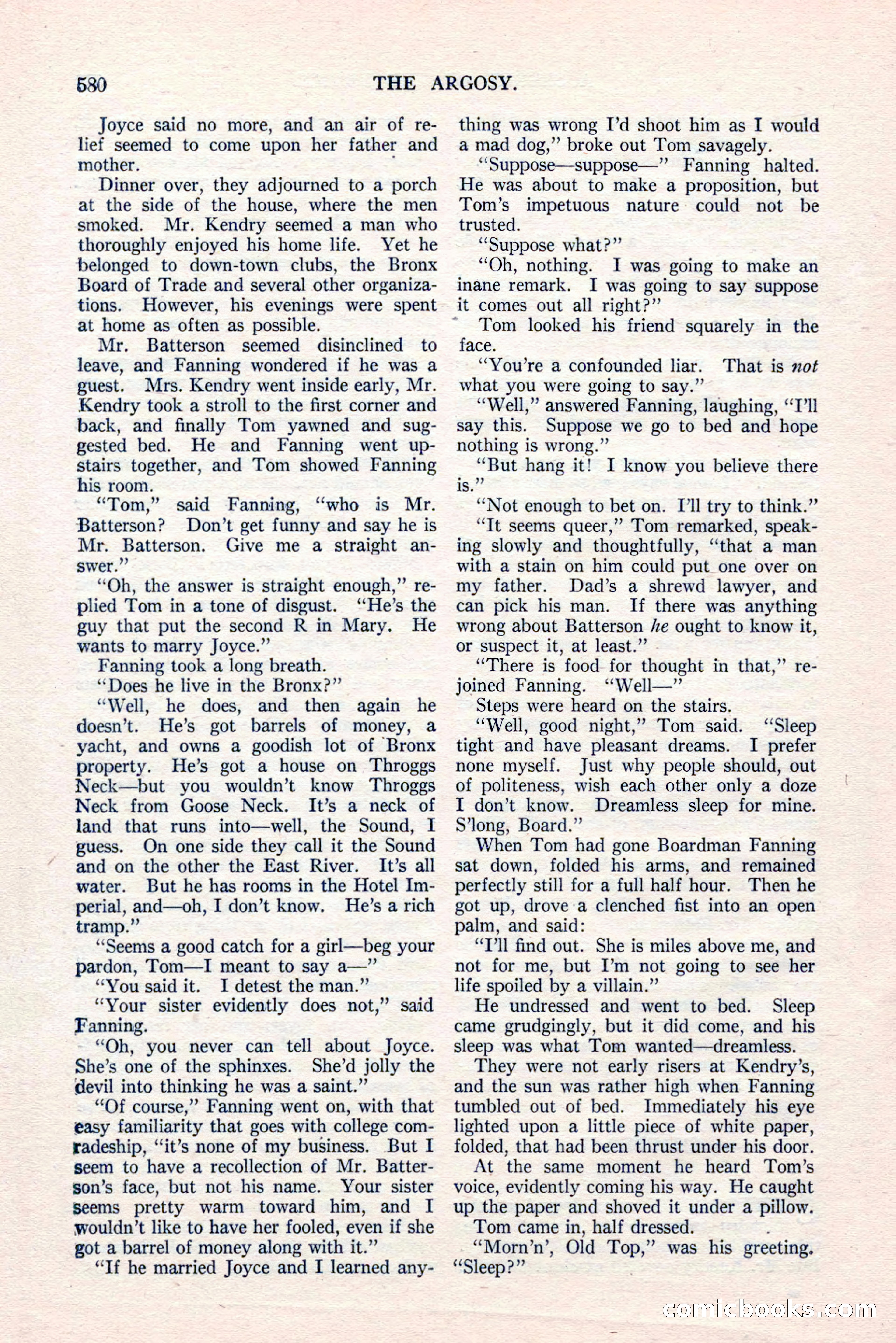
A restored page from Pulp Fiction, 1916. Page through the whole issue in the reader above.
📄 Transcribed text from this page (OCR, searchable)
Machine-transcribed from the original scan — historical spelling and the odd misread are preserved.
580 Joyce said no more, and an air of re- lief seemed to come upon her father and mother. Dinner over, they adjourned to a porch at the side of the house, where the men smoked. Mr. Kendry seemed a man who thoroughly enjoyed his home life. Yet he belonged to down-town clubs, the Bronx Board of Trade and several other organiza- tions. However, his evenings were spent at home as often as possible. Mr. Batterson seemed disinclined to leave, and Fanning wondered if he was a guest. Mrs. Kendry went inside early, Mr. Kendry took a stroll to the first corner and back, and finally Tom yawned and sug- gested bed. He and Fanning went up- stairs together, and Tom showed Fanning his room. “Tom,” said Fanning, “who is Mr. Batterson? Don’t get funny and say he is Mr. Batterson. Give me a straight an- swer.” “Oh, the answer is straight enough,” re- plied Tom in a tone of disgust. ‘“He’s the guy that put the second R in Mary. He wants to marry Joyce.” Fanning took a long breath. “Does he live in the Bronx?”’ “Well, he does, and then again he doesn’t. He’s got barrels of money, a yacht, and owns a goodish lot of Bronx property. He’s got a house on Throggs Neck—but you wouldn’t know Throggs Neck from Goose Neck. It’s a neck of land that runs into—well, the Sound, I guess. On one side they call it the Sound and on the other the East River. It’s all water. But he has rooms in the Hotel Im- perial, and—oh, I don’t know. He’s a rich tramp.” “Seems a good catch for a girl—beg your pardon, Tom—I meant to say a—”’ “You said it. I detest the man.” “Vour sister evidently does not,’ said Fanning. “Oh, you never can tell about Joyce. She’s one of the sphinxes. She’d jolly the devil into thinking he was a saint.” “Of course,’’ Fanning went on, with that easy familiarity that goes with college com- radeship, ‘it’s none of my business. But I seem to have a recollection of Mr. Batter- son’s face, but not his name. Your sister seems pretty warm toward him, and I wouldn’t like to have her fooled, even if she got a barrel of money along with it.” “Tf he married Joyce and I learned any- THE ARGOSY. thing was wrong I’d shoot him as I would a mad dog,” broke out Tom savagely. ‘““Suppose—suppose—” Fanning halted. He was about to make a proposition, but Tom’s impetuous nature could not be trusted. “Suppose what?” “Oh, nothing. I was going to make an inane remark. I was going to say suppose it comes out all right?” Tom looked his friend squarely in the ‘ace. “You’re a confounded liar. what you were going to say.” “Well,” answered Fanning, laughing, ‘‘T’ll say this. Suppose we go to bed and hope nothing is wrong.” “But hang it! I know you believe there is.” “Not enough to bet on. I'll try to think.” “It seems queer,” Tom remarked, speak- ing slowly and thoughtfully, “that a man with a stain on him could put one over on my father. Dad’s a shrewd lawyer, and can pick his man. If there was anything wrong about Batterson /e ought to know it, or suspect it, at least.” “There is food for thought in that,” re- joined Fanning. ‘“‘Well—”’ Steps were heard on the stairs. “Well, good night,” Tom said. ‘Sleep tight and have pleasant dreams. I prefer none myself. Just why people should, out of politeness, wish each other only a doze I don’t know. Dreamless sleep for mine. S’long, Board.” When Tom had gone Boardman Fanning sat down, folded his arms, and remained perfectly still for a full half hour. Then he got up, drove a clenched fist into an open palm, and said: “T’ll find out. She is miles above me, and not for me, but I’m not going to see her life spoiled by a villain.” He undressed and went to bed. Sleep came grudgingly, but it did come, and his sleep was what Tom wanted—dreamless. They were not early risers at Kendry’s, and the sun was rather high when Fanning tumbled out of bed. Immediately his eye lighted upon a little piece of white paper, folded, that had been thrust under his door. At the same moment he heard Tom’s voice, evidently coming his way. He caught up the paper and shoved it under a pillow. Tom came in, half dressed. “Morn’n’, Old Top,” was his greeting. “Sleep?” : That is not COMICLOOOkKS (C@