
Pulp Fiction, 1916 · page 13 of 208
The Argosy, Vol. 82 No. 4 — page 13: what you’re looking at
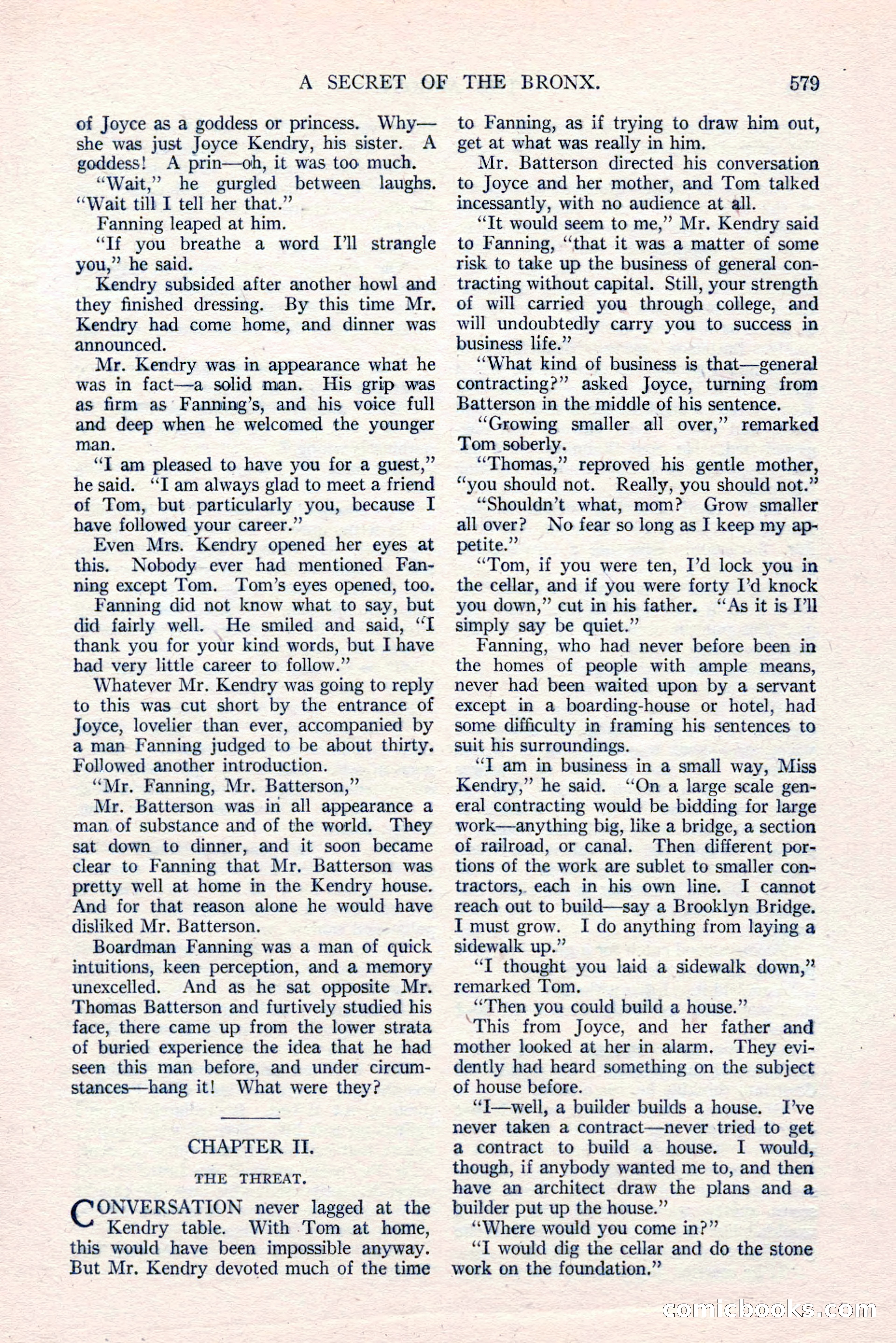
A restored page from Pulp Fiction, 1916. Page through the whole issue in the reader above.
📄 Transcribed text from this page (OCR, searchable)
Machine-transcribed from the original scan — historical spelling and the odd misread are preserved.
A SECRET OF THE BRONX. of Joyce as a goddess or princess. Why— she was just Joyce Kendry, his sister. A goddess! A prin—oh, it was too much. “Wait,” he gurgled between laughs. “Wait till I tell her that.” | Fanning leaped at him. “If you breathe a word I'll strangle you,” he said. Kendry subsided after another howl and they finished dressing. By this time Mr. Kendry had come home, and dinner was announced. Mr. Kendry was in appearance what he was in fact—a solid man. His grip was as firm as Fanning’s, and his voice full and deep when he welcomed the younger man. “T am pleased to have you for a guest,” he said. “I am always glad to meet a friend of Tom, but particularly you, because I have followed your career.” Even Mrs. Kendry opened her eyes at this. Nobody ever had mentioned Fan- ning except Tom. ‘Tom’s eyes opened, too. Fanning did not know what to say, but did fairly well. He smiled and said, “T thank you for your kind words, but I have had very little career to follow.” Whatever Mr. Kendry was going to reply to this was cut short by the entrance of Joyce, lovelier than ever, accompanied by a man Fanning judged to be about thirty. Followed another introduction. “Mr. Fanning, Mr. Batterson,” Mr. Batterson was in all appearance a man. of substance and of the world. They sat down to dinner, and it soon became clear to Fanning that Mr. Batterson was pretty well at home in the Kendry house. And for that reason alone he would have disliked Mr. Batterson. Boardman Fanning was a man of quick intuitions, keen perception, and a memory unexcelled. And as he sat opposite Mr. Thomas Batterson and furtively studied his face, there came up from the lower strata of buried experience the idea that he had seen this man before, and under circum- stances—hang it! What were they? CHAPTER II. THE THREAT, ONVERSATION never lagged at the Kendry table. With .Tom at home, this would have been impossible anyway. But Mr. Kendry devoted much of the time 579 to Fanning, as if trying to draw him out, get at what was really in him, Mr. Batterson directed his conversation to Joyce and her mother, and Tom talked incessantly, with no audience at all. “Tt would seem to me,”’ Mr. Kendry said to Fanning, “that it was a matter of some risk to take up the business of general con- tracting without capital. Still, your strength of will carried you through college, and will undoubtedly carry you to success in business life.” ‘What kind of business is that—general contracting?” asked Joyce, turning from Batterson in the middle of his sentence. “Growing smaller all over,” remarked Tom soberly. “Thomas,” reproved his gentle mother, “vou should not. Really, you should not.” “Shouldn’t what, mom? Grow smaller all over? No fear so long as I keep my ap- petite.” “Tom, if you were ten, I’d lock you in the cellar, and if you were forty I’d knock you down,” cut in his father. “As it is Vl simply say be quiet.” Fanning, who had never before been in the homes of people with ample means, never had been waited upon by a servant except in a boarding-house or hotel, had some difficulty in framing his sentences to suit his surroundings. “YT am in business in a small way, Miss Kendry,” he said. ‘On a large scale gen- eral contracting would be bidding for large work—anything big, like a bridge, a section of railroad, or canal. Then different por- tions of the work are sublet to smaller con- tractors, each in his own line. I cannot reach out to build—say a Brooklyn Bridge. I must grow. I do anything from laying a sidewalk up.” “YT thought you laid a sidewalk down,” remarked Tom. “Then you could build a house.” This from Joyce, and her father and mother looked at her in alarm. They evi- dently had heard something on the subject of house before. “T—well, a builder builds a house. I’ve never taken a contract—never tried to get a contract to build a house. I would, though, if anybody wanted me to, and then have an architect draw the plans and a builder put up the house.” ‘“‘Where would you come in?” “T would dig the cellar and do the stone work on the foundation.” COMMICLOOOKS (CO