
Pulp Fiction, 1916 · page 93 of 212
The Argosy, Vol. 82, No. 3 — page 93: what you’re looking at
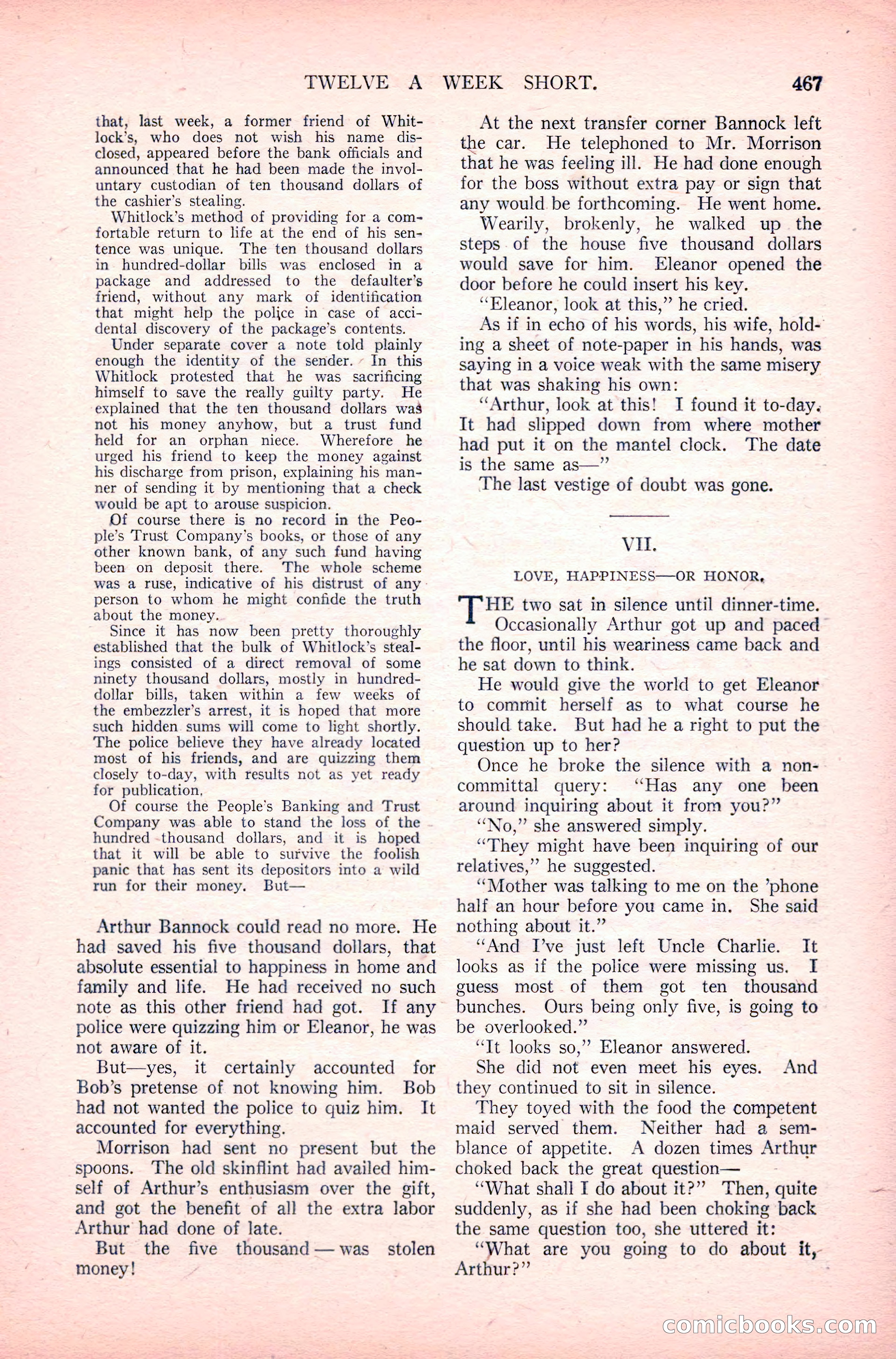
A restored page from Pulp Fiction, 1916. Page through the whole issue in the reader above.
📄 Transcribed text from this page (OCR, searchable)
Machine-transcribed from the original scan — historical spelling and the odd misread are preserved.
TWELVE A WEEK SHORT. that, last week, a former friend of Whit- lock’s, who does not wish his name dis- closed, appeared before the bank officials and announced that he had been made the invol- untary custodian of ten thousand dollars of the cashier’s stealing. Whitlock’s method of providing for a com- fortable return to life at the end of his sen- tence was unique. ‘The ten thousand dollars in hundred-dollar bills was enclosed in a package and addressed to the defaulter’s friend, without any mark of identification that might help the police in case of acci- dental discovery of the package’s contents. Under separate cover a note told plainly enough the identity of the sender. ~ In this Whitlock protested that he was sacrificing himself to save the really guilty party. He explained that the ten thousand dollars was not his money anyhow, but a trust fund held for an orphan niece. Wherefore he urged his friend to keep the money against his discharge from prison, explaining his man- ner of sending it by mentioning that a check would be apt to arouse suspicion. Of course there is no record in the Peo- ple’s Trust Company’s books, or those of any other known bank, of any such fund having been on deposit there. The whole scheme was a ruse, indicative of his distrust of any: person to whom he might confide the truth about the money. Since it has now been pretty thoroughly established that the bulk of Whitlock’s steal- ings consisted of a direct removal of some ninety thousand dollars, mostly in hundred- dollar bills, taken within a few weeks of the embezzler’s arrest, it is hoped that more such hidden. sums will come to light shortly. The police believe they have already located most of his friends, and are quizzing them closely to-day, with results not as yet ready for publication, Of course the People’s Banking and Trust Company was able to stand the loss of the hundred -thousand dollars, and it is hoped that it will be able to survive the foolish panic that has sent its depositors into a wild run for their money. But— Arthur Bannock could read no more. He had saved his five thousand dollars, that absolute essential to happiness in home and family and life. He had received no such note as this other friend had got. If any police were quizzing him or Eleanor, he was not aware of it. But—yes, it certainly accounted for Bob’s pretense of not knowing him. Bob had not wanted the police to quiz him. It accounted for everything. Morrison had sent no present but the spoons. The old skinflint had availed him- self of Arthur’s enthusiasm over the gift, and got the benefit of all the extra labor Arthur had done of late. But the five thousand — was stolen money! 467 At the next transfer corner Bannock left the car. He telephoned to Mr. Morrison that he was feeling ill. He had done enough for the boss without extra pay or sign that any would. be forthcoming. He went home. Wearily, brokenly, he walked up _ the steps. of the house five thousand dollars would save for him. Eleanor opened the door before he could insert his key. ‘Eleanor, look at this,” he cried. As if in echo of his words, his wife, hold- ing a sheet of note-paper in his hands, was saying in a voice weak with the same misery that was shaking his own: “Arthur, look at this! I found it to-day. It had slipped down from where mother had put it on the mantel clock. The date is the same as—” The last vestige of doubt was gone. Vil. LOVE, HAPPINESS—OR HONOR, HE two sat in silence until dinner-time. Occasionally Arthur got up and paced the floor, until his weariness came back and he sat down to think. He would give the world to get Eleanor to commit herself as to what course he should take. But had he a right to put the question up to her? Once he broke the silence with a non- committal query: ‘“‘Has any one been around inquiring about it from you?” “No,” she answered simply. “They might have been inquiring of our relatives,’ he suggested. ‘““Mother was talking to me on the ’phone half an hour before you came in. She said nothing about it.” “And I’ve just left Uncle Charlie. It looks as ii the police were missing us. I euess most of them got ten thousand bunches. Ours being only five, is going to be overlooked.” “It looks so,’ Eleanor answered. She did not even meet his eyes. they continued to sit in silence. They toyed with the food the competent maid served them. Neither had a sem- blance of appetite. A dozen times Arthur choked back the great question— ‘‘What shall I do about it?” Then, quite suddenly, as if she had been choking back the same question too, she uttered it: “What are you going to do about it,- Arthur?” And DOO (C@)