
Pulp Fiction, 1916 · page 92 of 212
The Argosy, Vol. 82, No. 3 — page 92: what you’re looking at
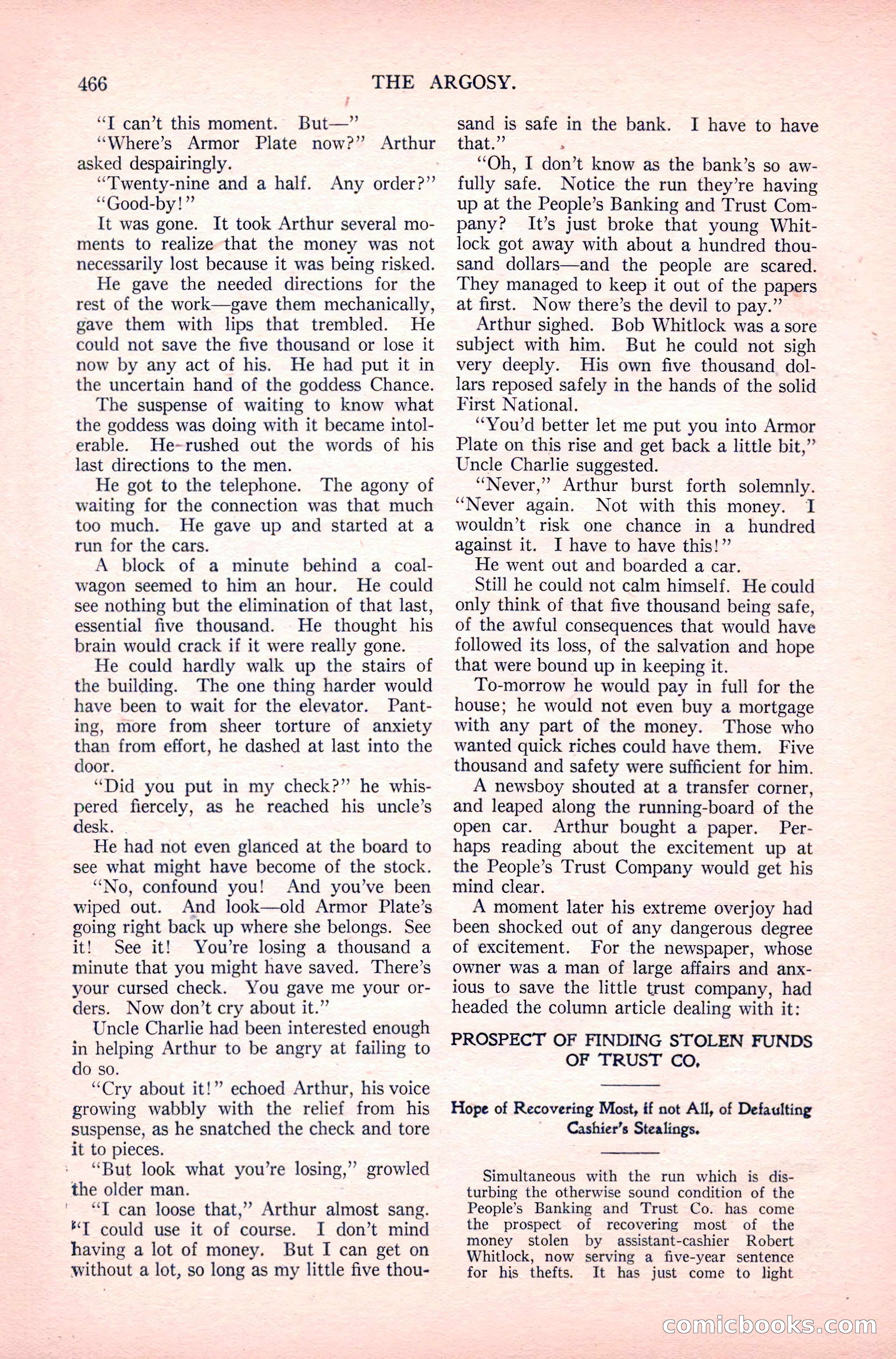
A restored page from Pulp Fiction, 1916. Page through the whole issue in the reader above.
📄 Transcribed text from this page (OCR, searchable)
Machine-transcribed from the original scan — historical spelling and the odd misread are preserved.
466 “T can’t this moment. But—” ‘“‘Where’s Armor Plate now?” Arthur asked despairingly. “Twenty-nine and a half. Any order?” ‘““Good-by!”’ It was gone. It took Arthur several mo- ments to realize that the money was not necessarily lost because it was being risked. He gave the needed directions for the rest of the work—gave them mechanically, gave them with lips that trembled. He could not save the five thousand or lose it now by any act of his. He had put it in the uncertain hand of the goddess Chance. The suspense of waiting to know what the goddess was doing with it became intol- erable. He-rushed out the words of his last directions to the men. He got to the telephone. The agony of waiting for the connection was that much too much. He gave up and started at a run for the cars. A block of a minute behind a coal- wagon seemed to him an hour. He could see nothing but the elimination of that last, essential five thousand. He thought his brain would crack if it were really gone. He could hardly walk up the stairs of the building. The one thing harder would have been to wait for the elevator. Pant- ing, more from sheer torture of anxiety than from effort, he dashed at last into the door. “Did you put in my check?” he whis- pered fiercely, as he reached his uncle’s desk. He had not even glariced at the board to see what might have become of the stock. “No, confound you! And you’ve been wiped out. And look—old Armor Plate’s going right back up where she belongs. See it! See it! You’re losing a thousand a minute that you might have saved. There’s your cursed check. You gave me your or- ders. Now don’t cry about it.” Uncle Charlie had been interested enough in helping Arthur to be angry at failing to do so. “Cry about it!” echoed Arthur, his voice growing wabbly with the relief from his suspense, as he snatched the check and tore it to pieces. “But look what you’re losing,” growled the older man. “T can loose that,’ Arthur almost sang. ‘T could use it of course. I don’t mind having a lot of money. But I can get on without a lot, so long as my little five thou- THE ARGOSY. sand is safe in the bank. I have to have that.” P ‘Oh, I don’t know as the bank’s so aw- fully safe. Notice the run they’re having up at the People’s Banking and Trust Com- pany? It’s just broke that young Whit- lock got away with about a hundred thou- sand dollars—and the people are scared. They managed to keep it out of the papers at first. Now there’s the devil to pay.” Arthur sighed. Bob Whitlock was a sore subject with him. But he could not sigh very deeply. His own five thousand dol- lars reposed safely in the hands of the solid First National. ‘You'd better let me put you into Armor Plate on this rise and get back a little bit,” Uncle Charlie suggested. “Never,” Arthur burst forth solemnly. “Never again. Not with this money. I wouldn’t risk one chance in a hundred against it. I have to have this!” He went out and boarded a car. Still he could not calm himself. He could only think of that five thousand being safe, of the awful consequences that would have followed its loss, of the salvation and hope that were bound up in keeping it. To-morrow he would pay in full for the house; he would not even buy a mortgage with any part of the money. Those who wanted quick riches could have them. Five thousand and safety were sufficient for him. A newsboy shouted at a transfer corner, and leaped along the running-board of the open car. Arthur bought a paper. Per- haps reading about the excitement up at the People’s Trust Company would get his mind clear. A moment later his extreme overjoy had been shocked out of any dangerous degree of excitement. For the newspaper, whose owner was a man of large affairs and anx- ious to save the little trust company, had headed the column article dealing with it: PROSPECT OF FINDING STOLEN FUNDS OF TRUST CO, Hope of Recovering Most, if not All, of Defaulting Cashier’s Stealings. Simultaneous with the run which is dis- turbing the otherwise sound condition of the People’s Banking and Trust Co. has come the prospect of recovering most of the money stolen by assistant-cashier Robert Whitlock, now serving a five-year sentence for his thefts. It has just come to light Gomichbook (C@)