
Pulp Fiction, 1916 · page 94 of 212
The Argosy, Vol. 82, No. 3 — page 94: what you’re looking at
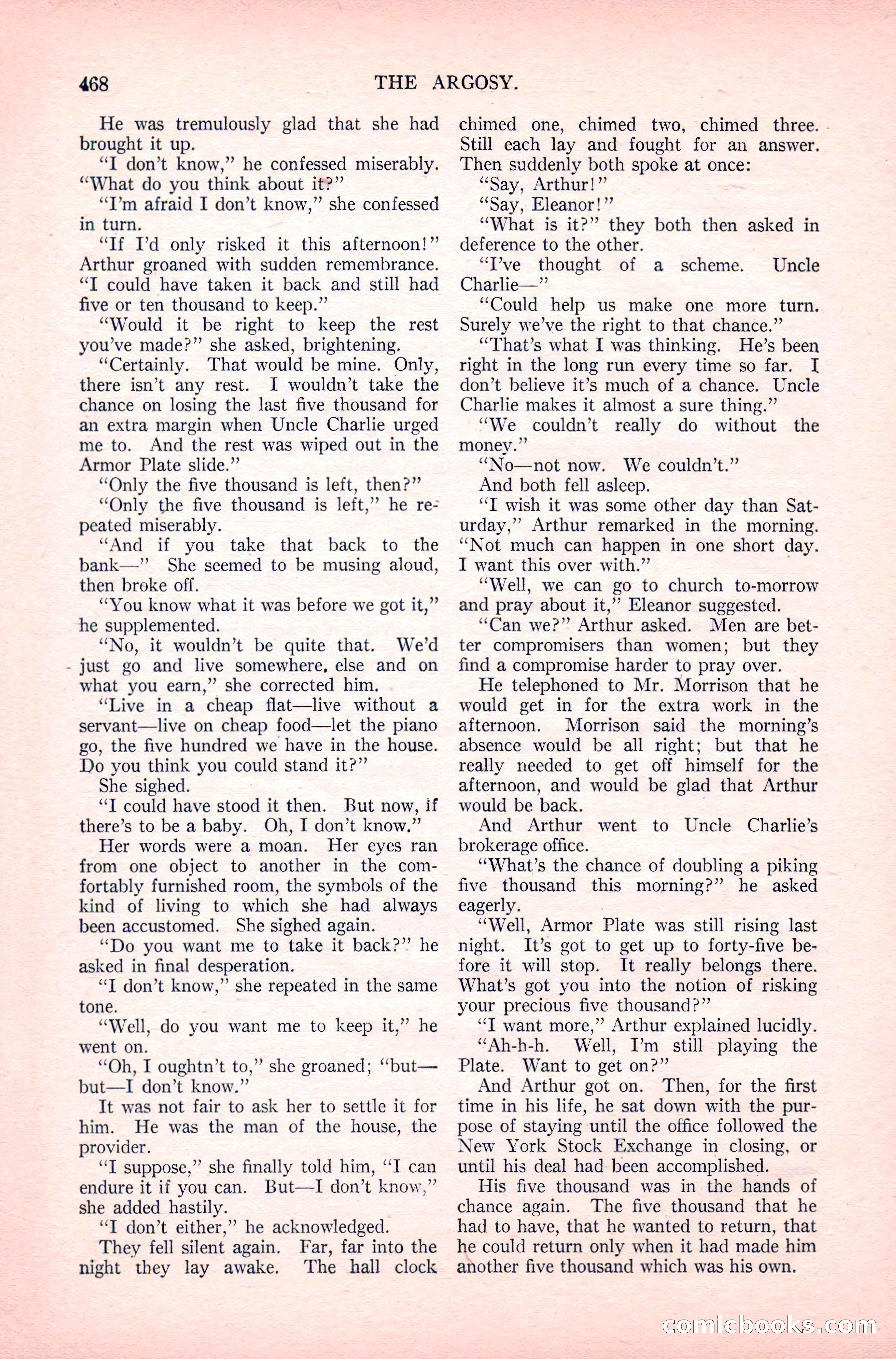
A restored page from Pulp Fiction, 1916. Page through the whole issue in the reader above.
📄 Transcribed text from this page (OCR, searchable)
Machine-transcribed from the original scan — historical spelling and the odd misread are preserved.
468 THE He was tremulously glad that she had brought it up. “T don’t know,” he confessed miserably. “What do you think about it?” “T’m afraid I don’t know,” she confessed in turn. “If I’d only risked it this afternoon!”’ Arthur groaned with sudden remembrance. “Tf could have taken it back and still had five or ten thousand to keep.” “Would it be right to keep the rest you’ve made?” she asked, brightening. “Certainly. That would be mine. Only, there isn’t any rest. I wouldn’t take the chance on losing the last five thousand for an extra margin when Uncle Charlie urged me to. And the rest was wiped out in the Armor Plate slide.” “Only the five thousand is left, then?” “Only the five thousand is left,’ he re- peated miserably. “And if you take that back to the bank—” She seemed to be musing aloud, then broke off. ‘You know what it was before we got it,” he supplemented. “No, it wouldn’t be quite that. We’d - just go and live somewhere, else and on what you earn,” she corrected him. “Live in a cheap flat—live without a servant—live on cheap food—let the piano go, the five hundred we have in the house. Do you think you could stand it?” She sighed. “T could have stood it then. But now, if there’s to be a baby. Oh, I don’t know.” Her words were a moan. Her eyes ran from one object to another in the com- fortably furnished room, the symbols of the kind of living to which she had always been accustomed. She sighed again. “Do you want me to take it back?” he asked in final desperation. ‘“T don’t know,” she repeated in the same tone. “Well, do you want me to keep it,” he went on. “Oh, I oughtn’t to,” she groaned; ‘*but— but—I don’t know.” It was not fair to ask her to settle it for him. He was the man of the house, the provider. “T suppose,” she finally told him, “I can endure it if you can. But—TI don’t know,” she added hastily. “T don’t either,” he acknowledged. They fell silent again. Far, far into the night they lay awake. ‘The hall clock ARGOSY. chimed one, chimed two, chimed three. . Still each lay and fought for an answer. Then suddenly both spoke at once: “Say, Arthur!” “Say, Eleanor!”’ “What is it?” they both then asked in deference to the other. “T’ve thought of a_ scheme. Charlie—”’ “Could help us make one more turn. Surely we’ve the right to that chance.” “That’s what I was thinking. He’s been right in the long run every time so far. I don’t believe it’s much of a chance. Uncle Charlie makes it almost a sure thing.” “We couldn’t really do without the money.” ‘“‘No—not now. We couldn’t.” And both fell asleep. “T wish it was some other day than Sat- urday,” Arthur remarked in the morning. ‘‘Not much can happen in one short day. I want this over with.” ‘Well, we can go to church to-morrow and pray about it,” Eleanor suggested. “Can we?” Arthur asked. Men are bet- ter compromisers than women; but they find a compromise harder to pray over. He telephoned to Mr. Morrison that he would get in for the extra work in the afternoon. Morrison said the morning’s absence would be all right; but that he really needed to get off himself for the afternoon, and would be glad that Arthur would be back. And Arthur went to Uncle Charlie’s brokerage office. ‘“‘What’s the chance of doubling a piking five thousand this morning?” he asked eagerly. , “Well, Armor Plate was still rising last night. It’s got to get up to forty-five be- fore it will stop. It really belongs there. What’s got you into the notion of risking your precious five thousand?” “T want more,” Arthur explained lucidly. “Ah-h-h. Well, I’m still playing the Plate. Want to get on?” And Arthur got on. Then, for the first time in his life, he sat down with the pur- pose of staying until the office followed the New York Stock Exchange in closing, or until his deal had been accomplished. His five thousand was in the hands of chance again. The five thousand that he had to have, that he wanted to return, that he could return only when it had made him another five thousand which was his own. Uncle Gomicbooks (C@)