
Pulp Fiction, 1916 · page 91 of 212
The Argosy, Vol. 82, No. 3 — page 91: what you’re looking at
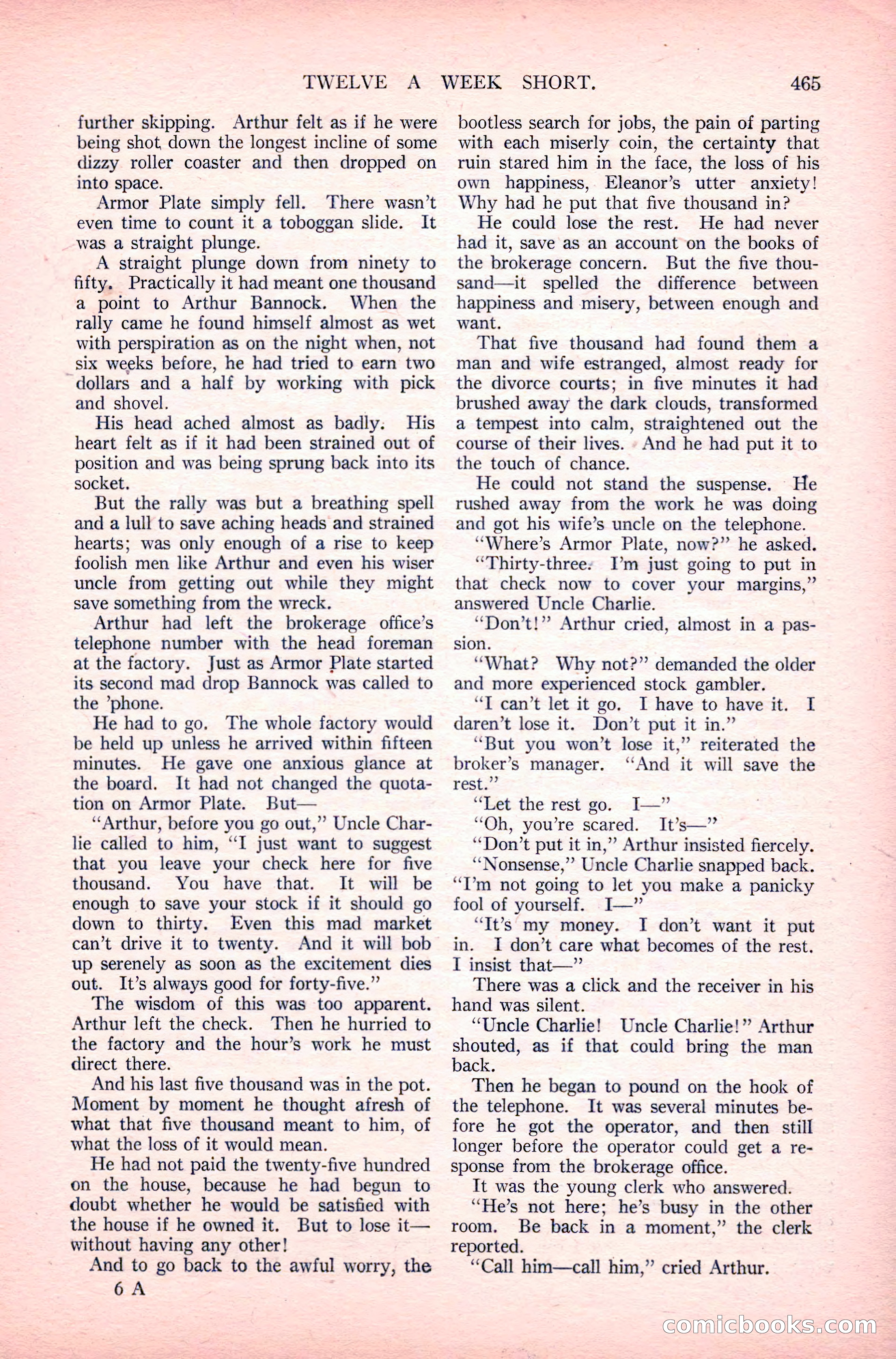
A restored page from Pulp Fiction, 1916. Page through the whole issue in the reader above.
📄 Transcribed text from this page (OCR, searchable)
Machine-transcribed from the original scan — historical spelling and the odd misread are preserved.
TWELVE A further skipping. Arthur felt as if he were being shot, down the longest incline of some dizzy roller coaster and then dropped on into space. Armor Plate simply fell. There wasn’t even time to count it a toboggan slide. It was a Straight plunge. A straight plunge down from ninety to fifty. Practically it had meant one thousand a point to Arthur Bannock. When the rally came he found himself almost as wet with perspiration as on the night when, not six weeks before, he had tried to earn two dollars and a half by working with pick and shovel. His head ached almost as badly: His heart felt as if it had been strained out of position and was being sprung back into its socket. But the rally was but a breathing spell and a lull to save aching heads and strained hearts; was only enough of a rise to keep foolish men like Arthur and even his wiser uncle from getting out while they might save something from the wreck. Arthur had left the brokerage office’s telephone number with the head foreman at the factory. Just as Armor Plate started its second mad drop Bannock was called to the ’phone. He had to go. The whole factory would be held up unless he arrived within fifteen minutes. He gave one anxious glance at the board. It had not changed the quota- tion on Armor Plate. But— “Arthur, before you go out,”’ Uncle Char- lie called to him, “I just want to suggest that you leave your check here for five thousand. You have that. It will be enough to save your stock if it should go down to thirty. Even this mad market can’t drive it to twenty. And it will bob up serenely as soon as the excitement dies out. It’s always good for forty-five.” The wisdom of this was too apparent. Arthur left the check. Then he hurried to the factory and the hour’s work he must direct there. And his last five thousand was in the pot. Moment by moment he thought afresh of what that five thousand meant to him, of what the loss of it would mean. He had not paid the twenty-five hundred on the house, because he had begun to doubt whether he would be satisfied with the house if he owned it. But to lose it— without having any other! And to go back to the awful worry, the 6A WEEK SHORT. 465 bootless search for jobs, the pain of parting with each miserly coin, the certainty that ruin stared him in the face, the loss of his own happiness, Eleanor’s utter anxiety! Why had he put that five thousand in? He could lose the rest. He had never had it, save as an account on the books of the brokerage concern. But the five thou- sand—it spelled the difference between happiness and misery, between enough and want. That five thousand had found them a man and wife estranged, almost ready for the divorce courts; in five minutes it had brushed away the dark clouds, transformed a tempest into calm, straightened out the course of their lives. And he had put it to the touch of chance. He could not stand the suspense. He rushed away from the work he was doing and got his wife’s uncle on the telephone. ‘“‘Where’s Armor Plate, now?” he asked. “Thirty-three: I’m just going to put in that check now to cover your margins,” answered Uncle Charlie. “Don’t!” Arthur cried, almost in a pas- sion. “What? Why not?” demanded the older and more experienced stock gambler. “T can’t let it go. I have to have it. I daren’t lose it. Don’t put it in.” ‘But you won’t lose it,” reiterated the broker’s manager. ‘‘And it will save the rest.” “Let the rest go. I—” “Oh, you’re scared. It’s—” ‘Don’t put it in,” Arthur insisted fiercely. ‘‘Nonsense,”” Uncle Charlie snapped back. “I’m not going to let you make a panicky fool of yourself. I—” “It’s my money. I don’t want it put in. I don’t care what becomes of the rest. I insist that—” There was a click and the receiver in his hand was silent. ‘Uncle Charlie! Uncle Charlie!” Arthur shouted, as if that could bring the man back. Then he began to pound on the hook of the telephone. It was several minutes be- fore he got the operator, and then still longer before the operator could get a re- sponse from the brokerage office. It was the young clerk who answered. ‘‘He’s not here; he’s busy in the other room. Be back in a moment,” the clerk reported. : “Call him—call him,” cried Arthur. COMMICGLOOOKS (C@