
Pulp Fiction, 1916 · page 90 of 212
The Argosy, Vol. 82, No. 3 — page 90: what you’re looking at
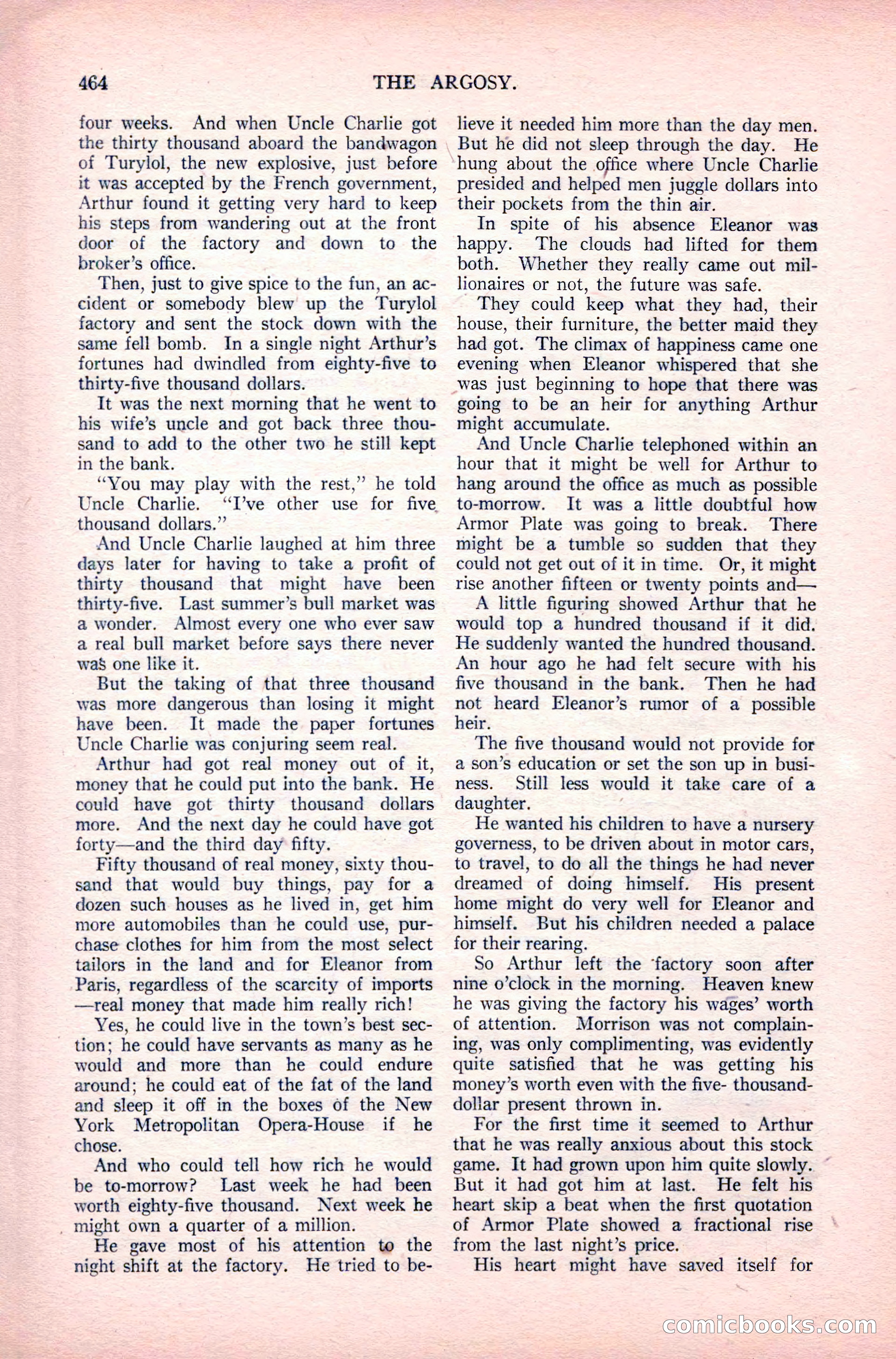
A restored page from Pulp Fiction, 1916. Page through the whole issue in the reader above.
📄 Transcribed text from this page (OCR, searchable)
Machine-transcribed from the original scan — historical spelling and the odd misread are preserved.
464 four weeks. And when Uncle Charlie got the thirty thousand aboard the bandwagon of Turylol, the new explosive, just before it was accepted by the French government, Arthur found it getting very hard to keep his steps from wandering out at the front door of the factory and down to the broker’s office. Then, just to give spice to the fun, an ac- cident or somebody blew up the Turylol factory and sent the stock down with the same fell bomb. In a single night Arthur’s fortunes had dwindled from eighty-five to thirty-five thousand dollars. It was the next morning that he went to his wife’s uncle and got back three thou- sand to add to the other two he still kept in the bank. “You may play with the rest,” he told Uncle Charlie. “I’ve other use for five thousand dollars.” And Uncle Charlie laughed at him three days later for having to take a profit of thirty thousand that might have been thirty-five. Last summer’s bull market was a wonder. Almost every one who ever saw a real bull market before says there never wa& one like it. But the taking of that three thousand was more dangerous than losing it might have been. It made the paper fortunes Uncle Charlie was conjuring seem real. Arthur had got real money out of it, money that he could put into the bank. He could have got thirty thousand dollars more. And the next day he could have got forty—and the third day fifty. Fifty thousand of real money, sixty thou- sand that would buy things, pay for a dozen such houses as he lived in, get him more automobiles than he could use, pur- chase clothes for him from the most select tailors in the land and for Eleanor from Paris, regardless of the scarcity of imports —real money that made him really rich! Yes, he could live in the town’s best sec- - tion; he could have servants as many as he would and more than he could endure around; he could eat of the fat of the land and sleep it off in the boxes of the New York Metropolitan Opera-House if he chose. And who could tell how rich he would be to-morrow? Last week he had been worth eighty-five thousand. Next week he _ might own a quarter of a million. He gave most of his attention to the night shift at the factory. He tried to be- THE ARGOSY. lieve it needed him more than the day men. But he did not sleep through the day. He hung about the office where Uncle Charlie presided and helped men juggle dollars into their pockets from the thin air. In spite of his absence Eleanor was happy. The clouds had lifted for them both. Whether they really came out mil- lionaires or not, the future was safe. They could keep what they had, their house, their furniture, the better maid they had got. The climax of happiness came one evening when Eleanor whispered that she was just beginning to hope that there was going to be an heir for anything Arthur might accumulate. And Uncle Charlie telephoned within an hour that it might be well for Arthur to hang around the office as much as possible to-morrow. It was a little doubtful how Armor Plate was going to break. There might be a tumble so sudden that they could not get out of it in time. Or, it might rise another fifteen or twenty points and— A little figuring showed Arthur that he would top a hundred thousand if it did. He suddenly wanted the hundred thousand. An hour ago he had felt secure with his five thousand in the bank. Then he had not heard Eleanor’s rumor of a possible heir. The five thousand would not provide for a son’s education or set the son up in busi- ness. Still less would it take care of a daughter. : He wanted his children to have a nursery governess, to be driven about in motor cars, to travel, to do all the things he had never dreamed of doing himself. His present home might do very well for Eleanor and himself. But his children needed a palace for their rearing. So Arthur left the ‘factory soon after nine o’clock in the morning. Heaven knew he was giving the factory his wages’ worth of attention. Morrison was not complain- ing, was only complimenting, was evidently quite satisfied that he was getting his money’s worth even with the five- thousand- doliar present thrown in. For the first time it seemed to Arthur that he was really anxious about this stock game. It had grown upon him quite slowly. ~ But it had got him at last. He felt his heart skip a beat when the first quotation of Armor Plate showed a fractional rise from the last night’s price. His heart might have saved itself for COPMICLOOOKS (S@)