
Pulp Fiction, 1916 · page 87 of 212
The Argosy, Vol. 82, No. 3 — page 87: what you’re looking at
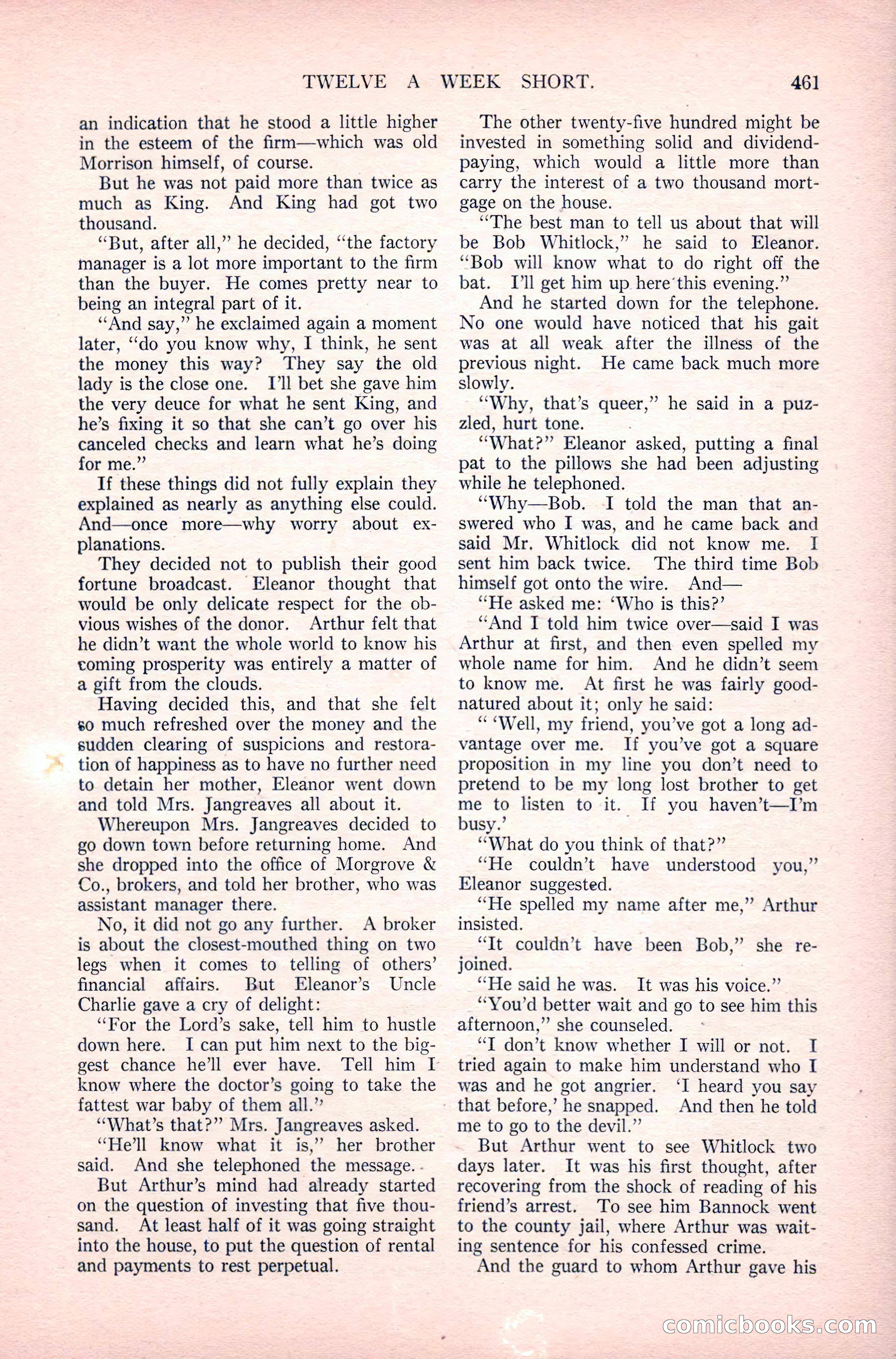
A restored page from Pulp Fiction, 1916. Page through the whole issue in the reader above.
📄 Transcribed text from this page (OCR, searchable)
Machine-transcribed from the original scan — historical spelling and the odd misread are preserved.
TWELVE A WEEK SHORT. an indication that he stood a little higher in the esteem of the firm—which was old Morrison himself, of course. But he was not paid more than twice as much as King. And King had got two thousand. “But, after all,” he decided, “the factory manager is a lot more important to the firm than the buyer. He comes pretty near to being an integral part of it. ‘““And say,” he exclaimed again a moment later, “do you know why, I think, he sent the money this way? ‘They say the old lady is the close one. I'll bet she gave him the very deuce for what he sent King, and he’s fixing it so that she can’t go over his canceled checks and learn what he’s doing for me.” If these things did not fully explain they explained as nearly as anything else could. And—once more—why worry about ex- planations. They decided not to publish their good fortune broadcast. Eleanor thought that would be only delicate respect for the ob- vious wishes of the donor, Arthur felt that he didn’t want the whole world to know his coming prosperity was entirely a matter of a gift from the clouds. Having decided this, and that she felt so much refreshed over the money and the sudden clearing of suspicions and restora- tion of happiness as to have no further need to detain her mother, Eleanor went down and told Mrs. Jangreaves all about it. Whereupon Mrs. Jangreaves decided to go down town before returning home. And she dropped into the office of Morgrove & Co., brokers, and told her brother, who was assistant manager there. No, it did not go any further. A broker is about the closest-mouthed thing on two legs when it comes to telling of others’ financial affairs. But Eleanor’s Uncle Charlie gave a cry of delight: “For the Lord’s sake, tell him to hustle down here. I can put him next to the big- gest chance he’ll ever have. know where the doctor’s going to take the fattest war baby of them all.” ‘““‘What’s that?” Mrs. Jangreaves asked. “Hell know what it is,” her brother said. And she telephoned the message. - But Arthur’s mind had already started on the question of investing that five thou- sand. At least half of it was going straight into the house, to put the question of rental and payments to rest perpetual. ‘Fell him:E 461 The other twenty-five hundred might be invested in something solid and dividend- paying, which would a little more than carry the interest of a two thousand mort- gage on the house. “The best man to tell us about that will be Bob Whitlock,” he said to Eleanor. “Bob will know what to do right off the bat. Ill get him up here’this evening.” And he started down for the telephone. No one would have noticed that his gait was at all weak after the illness of the previous night. He came back much more slowly. ‘Why, that’s queer,” he said in a puz- zled, hurt tone. . “What?” Eleanor asked, putting a final pat to the pillows she had been adjusting while he telephoned. “Why—Bob. I told the man that an- swered who I was, and he came back and said Mr. Whitlock did not know me. I sent him back twice. The third time Bob himself got onto the wire. And— “He asked me: ‘Who is this?’ “And I told him twice over—said I was Arthur at first, and then even spelled my whole name for him. And he didn’t seem to know me. At first he was fairly good- natured about it; only he said: “Well, my friend, you’ve got a long ad- vantage over me. If you’ve got a square proposition in my line you don’t need to pretend to be my long lost brother to get me to listen to it. If you haven’t—I’m busy.’ “What do you think of that?” “He couldn’t have understood you,” Eleanor suggested. “He spelled my name after me,” Arthur insisted. “It couldn’t have been Bob,” she re- joined. “He said he was. It was his voice.’’ “You'd better wait and go to see him this afternoon,”’ she counseled. ‘“T don’t know whether I will or not. I tried again to make him understand who I was and he got angrier. ‘I heard you say that before,’ he snapped. And then he told me to go to the devil.” But Arthur went to see Whitlock two days later. It was his first thought, after recovering from the shock of reading of his friend’s arrest. To see him Bannock went to the county jail, where Arthur was wait- ing sentence for his confessed crime. And the guard to whom Arthur gave his CORMICLOOOKS (C@